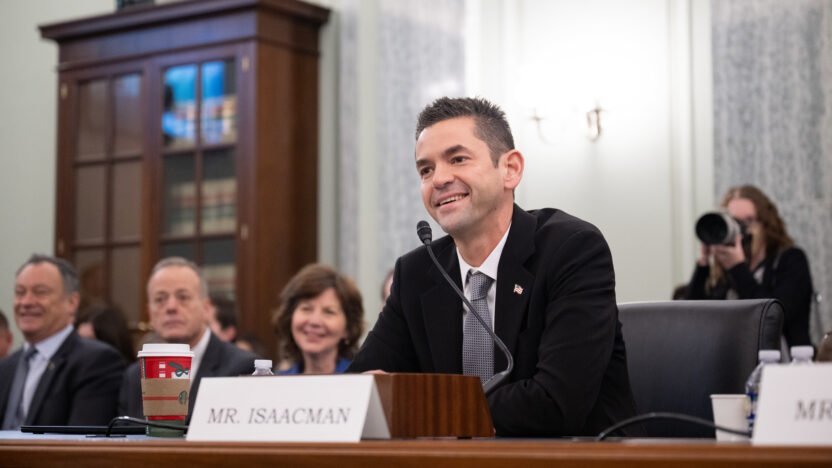
WASHINGTON — The space community welcomed the confirmation of Jared Isaacman as NASA’s next administrator, expressing hope he can lead the agency forward and relief that a long confirmation process is finally over.
The Senate voted 67-30 Dec. 17 to confirm Isaacman as the agency’s 15th administrator. Isaacman is expected to be formally sworn in soon, although neither NASA nor the White House have announced a date.
The vote capped a journey that began just over a year ago when then-President-elect Donald Trump announced his intent to nominate Isaacman to lead the agency. Trump withdrew the nomination in late May, only to renominate Isaacman Nov. 4.
That meant that, since the start of the second Trump administration in January, NASA has had only acting leadership: first Kennedy Space Center Director Janet Petro, then Transportation Secretary Sean Duffy in July. At the same time, NASA was facing threats of steep budget cuts in the White House’s proposal for fiscal year 2026 as well as the departure of a fifth of its civil servant workforce.
“After nearly a year of historic disruptions to the agency’s workforce, facilities and budget, Mr. Isaacman has the opportunity to stabilize and reinvigorate the U.S. space program,” The Planetary Society, an advocacy group, said in a statement after Isaacman’s confirmation.
It and other industry groups said they looked forward to seeing what Isaacman would do with the agency. While Isaacman outlined plans in a confidential document called “Project Athena” that leaked recently, it’s unclear how much of that report he will seek to pursue, or will be able to do by Congress and the White House.
“As an astronaut and aviator, Mr. Isaacman has expertise in both space and aeronautics, and his business enterprise background provides him with the skills needed to bring a commercial and entrepreneurial focus to NASA,” said Tom Stroup, president of the Satellite Industry Association, an industry group.
One major focus will be on exploration. While Isaacman said at his first confirmation hearing in April that he believed the Space Launch System and Orion were the fastest way to return humans to the moon, both Project Athena and the White House’s 2026 budget proposal appeared to favor alternative approaches, with the budget seeking to end SLS and Orion after Artemis 3.
Congress, though, included funding for missions through Artemis 5 in a budget reconciliation bill passed in July, and Isaacman affirmed his support for those programs of record at his second confirmation hearing earlier this month. “I absolutely believe the current architecture, with SLS, is the fastest path to achieving our near-term lunar objectives, which should be to return to the moon before our great rival,” he said, a reference to China.
“The Artemis program remains the nation’s best path to returning astronauts to the moon and establishing a sustainable American presence there,” said Allen Cutler, president and chief executive of the Coalition for Deep Space Exploration, a group which represents many companies working on Artemis. “In this era of renewed global competition, we share Mr. Isaacman’s sense of urgency and commitment to ensuring the United States leads the way, not just in reaching the moon ahead of China, but in building a foundation for future exploration.”
Many in industry, though, expect Isaacman to bring a more commercial emphasis to NASA programs, leveraging his experience as an entrepreneur as well as his experience in commercial spaceflight, funding and commanding the Inspiration4 private astronaut mission in 2021 and the Polaris Dawn mission in 2024.
“Administrator Isaacman brings a unique combination of operational and leadership experience to NASA. As a flight-rated pilot and commander of two commercial space missions, he understands the demands of human flight firsthand,” said Clay Mowry, chief executive of the American Institute of Aeronautics and Astronautics. “Combined with his record of entrepreneurial leadership, his background positions him well to guide NASA through an increasingly complex technical and policy environment.”
One particular area of concern will be science. The White House’s budget proposal sought to cut NASA science funding by nearly 50%, although House and Senate appropriations bills would restore most or all of that funding. Isaacman has described himself as a supporter of science but dodged specific questions about the budget proposal at his second confirmation hearing.
“We are really looking forward to working with Mr. Isaacman,” Nicky Fox, NASA associate administrator for science, said during a planetary science town hall session of the Annual Meeting of the American Geophysical Union a few hours after the Senate confirmation vote. “He is a supporter of science. He really does appreciate what we do at NASA science.”
There remains unease among some in the science community, particularly those who work at the Goddard Space Flight Center, where recent work to close and consolidate facilities there heightened fears about the future of the center and programs run there.
Members of Maryland’s congressional delegation met with reporters Dec. 15 to discuss their efforts to support the center. Sen. Chris Van Hollen, D-Md., noted he met twice with Isaacman. “A lot of what he told me,” he said, “was a positive vision for the space program, including a recognition that you can’t have a space program without fundamental research, space science.”
However, Van Hollen highlighted elements of Project Athena that, he said, discussed “poaching some of the assets from places like NASA Goddard and transferring them to other sites in the country. That was worrisome.”
Van Hollen said that he had been reassured by Isaacman that he would not implement those plans. “My view is, show me,” the senator said. “He at least said that he understands the Goddard mission and how important it is.”
Both Van Hollen and Maryland’s other senator, Angela Alsobrooks, voted against confirming Isaacman.