WASHINGTON — Eutelsat has signed an agreement with French startup MaiaSpace to launch some of its OneWeb replenishment satellites.
The companies announced Jan. 16 a “multi-launch agreement” to deploy OneWeb satellites on MaiaSpace’s small launch vehicle now under development. The launches are expected to begin in 2027.
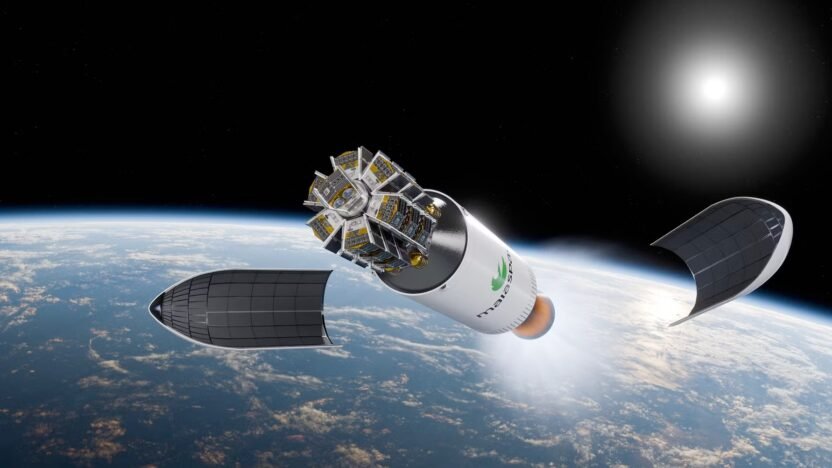
Neither company disclosed the terms of the deal, including its value, the number of launches or the number of satellites to be deployed. An illustration released by MaiaSpace showed what appeared to be 19 OneWeb satellites mounted on an upper stage.
“We are honored to be entrusted by Eutelsat for part of its upcoming LEO satellite launches,” said Yohann Leroy, chief executive of MaiaSpace, in a statement. “This agreement with an experienced and renowned satellite operator confirms that Maia is well-suited for deploying or replenishing satellite broadband constellations.”
Arlen Kassighian, Eutelsat’s chief engineering officer, said the deal with MaiaSpace is part of the company’s strategy to diversify its launch options. “By broadening our launch portfolio, we can continue delivering efficient and resilient services to our customers while ensuring continuity of service for the existing constellation,” he said.
Eutelsat ordered 100 OneWeb replenishment satellites in December 2024 and an additional 340 on Jan. 12. Neither Eutelsat nor Airbus Defence and Space, which is building the satellites, has disclosed details about their size or mass. The original OneWeb satellites, built by an Airbus-OneWeb joint venture, weighed about 150 kilograms each.
The MaiaSpace agreement marks the first time Eutelsat has disclosed details about its plans to launch the replenishment satellites. Most of the original OneWeb constellation was launched on Soyuz rockets, but after Russia’s invasion of Ukraine in 2022, OneWeb turned to SpaceX’s Falcon 9 and ISRO’s LVM3 to complete deployment.
With Eutelsat planning to begin replenishment launches in 2027, the company appeared likely to turn again to those providers. At a Jan. 15 briefing, Arianespace Chief Executive David Cavaillolès said Ariane 6 could accommodate some OneWeb satellites in 2027 but not the full constellation.
“Deploying a full new OneWeb in ’27 would not be possible,” he said, adding that capacity improves in later years. “From ’28 onward, we have a lot of room, so we can deploy a whole new constellation.”
Under the MaiaSpace agreement, Eutelsat is turning to a launch provider that has yet to conduct a flight. MaiaSpace, spun out of ArianeGroup, is developing a small launch vehicle it describes as Europe’s first reusable launcher, featuring a booster designed to land on a droneship for reuse. The vehicle can also fly in an expendable configuration for higher performance, which the company says could deliver up to four metric tons to inclined orbits.
MaiaSpace is also among the companies selected for funding through the European Space Agency’s European Launcher Challenge, approved at the agency’s ministerial conference in November. Member states committed 184.2 million euros ($213 million) to MaiaSpace, nearly all of it from France.
Cavaillolès said Arianespace is considering potential collaborations with MaiaSpace and other companies supported through the program. “We are studying the different possibilities to find synergies,” he said. “We’ll see what comes out of the European Launcher Challenge with Maia, but also the other actors.”