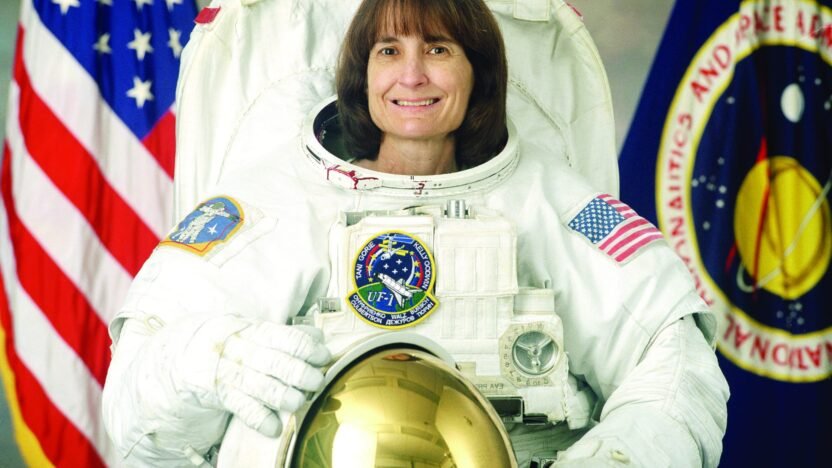
Linda Godwin, a former NASA astronaut and a veteran of four space shuttle missions, knows what it’s like to spend a significant time in space. She chalked up more than 38 days in orbit. She carried out two spacewalks, becoming the first woman to do so outside two space stations with a six-hour spacewalk in March 1996 at Russia’s Mir space station that orbited Earth from 1986 to 2001, and another outside the International Space Station in December 2001.
Godwin joined NASA in 1980, became an astronaut in July 1986, and retired in 2010. Her career at NASA included serving as the assistant to the director for exploration, Flight Crew Operations Directorate at the Johnson Space Center.
Godwin later accepted the position of professor in the Department of Physics and Astronomy at the University of Missouri. She is now professor emeritus there. SpaceNews caught up with Godwin to discuss the challenges of space exploration and NASA’s evolving Artemis endeavor. This interview has been lightly edited for clarity and length.
SpaceNews: So, you’re bullish on Artemis and a U.S. return to the moon as the pathway for humans to Mars?
Godwin: I’ve had people I know and have worked with say “just do the Mars thing and skip the moon.” As difficult as it is to get back to the moon, and it’s not easy to do in terms of budget, we have the technology but have to build it all again. Going to the moon takes a lot more mass than putting [a spacecraft] in low Earth orbit. It just sort of boomerangs in terms of how much more propellant is required.
But yes I see it [moon to Mars], but we have to prove the capability that we haven’t exercised in a while.
What does “prove the capability” mean to you?
In Apollo we did the same kind of buildup before landing on the moon. We still don’t know a lot about the lunar surface. Going to the lunar south pole, there’s incredible potential science down there. We need to learn how to live in a habitat on the lunar surface and have the necessary power sources.
There’s a lot to learn about living in such a different environment. I think the moon can help us do that before we go to Mars, which is going to be such a big project to take on and will be very expensive.
How do you feel about bringing down the ISS?
I’m interested in how NASA is going to phase-in follow-on space stations before we deorbit ISS. We have to continue a presence in low Earth orbit. Personally, I hate to see it come down. There are some issues like the leak on the Russian hardware side that’s still not totally understood or mitigated. It does make you start to think that, over time, more things are going to happen.
You need a lot of subsystems working together to be able to keep ISS in orbit. So, you still have all the maintenance to do. I wish we could stretch it out a little bit longer. I do think there’s a lifetime issue for some of the ISS elements up there and how much money do you sink into this.
The building of the ISS is incredible, and all the different countries and all the different nationalities that have worked up there together. I think that’s one of the biggest positive attributes of ISS. So yes, it’s going to be a sad day when it finally comes down. Maybe it won’t. Who knows?
What’s your take on NASA Administrator Jared Isaacman’s re-casting of the Artemis program?
It was interesting. He’s a smart guy and I hope he did that in conjunction with conversations he had with others working these projects. What makes a lot of sense to me is he talked more about the cadence of the launch system. It was several years between Space Launch System launches of Artemis 1 and Artemis 2. That’s why we had so many issues in the Artemis 2 wet countdown tests. So it makes sense to launch something next year and do it again, even if a lunar lander isn’t ready. It makes more sense to launch something every year than to have another multi-year gap. So let’s get a cadence going!
The Gateway space station has been postponed in the new plan.
Gateway was always interesting to me. From a physics point of view, that near-rectilinear halo orbit that Gateway was to be placed in is really interesting. It’s much more fuel efficient than a polar orbit around the moon. People living on Gateway could do lunar observations, even run robotic operations on the lunar surface.
So I am very interested in the changes. I don’t necessarily think they were bad changes. Maybe some of them are good changes. I definitely like the idea of more frequent SLS launches. The next version of SLS is now not happening, a version that has more lift capability. That could be limiting in the future to take more to the moon for a lunar base. Perhaps [NASA will] switch to the SpaceX Starship, but I don’t know if that’s going to happen.
Looming in the background is China’s moon exploration plans. Are you concerned that China will be on the moon before the United States?
I do try and keep up with China’s space program. It is what it is and they have the right to do that. I want to see us do these things for the science and exploration and not the competitiveness, which kind of drove Apollo. But the reality is that competitiveness matters.
But personally, as an American, I’d like us do it first. It would be a bit of a disappointment if they land before us. I guess we should celebrate anybody from Earth getting to the moon, and I guess there’s room for both of us at the moon’s south pole as that’s where they want to go too.