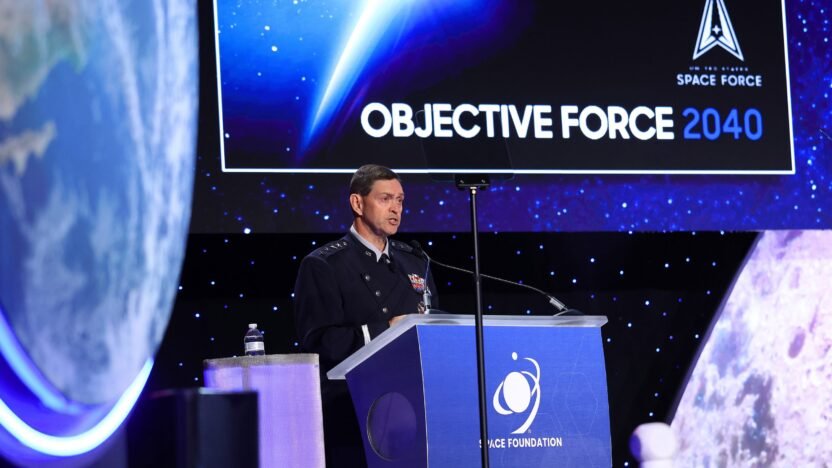
COLORADO SPRINGS — Gen. Chance Saltzman in his final appearance at the Space Symposium as chief of space operations released a warfighting blueprint for the U.S. Space Force, and asked the audience to critique it.
In a keynote address April 15, Saltzman unveiled unclassified versions of two foundational documents, the 68-page Future Operating Environment 2040 and the 104-page Objective Force 2040, framing them as a paired construct that defines both the problem and the solution for the U.S. Space Force.
One document lays out the threat environment, or the conditions the Space Force expects to face, shaped by adversary capabilities, evolving technologies and the changing nature of conflict in orbit. The other describes what the force must become to operate in that environment.
Together, they amount to the most explicit public articulation to date of how the Space Force sees the future of warfare in space.
Saltzman described the Future Operating Environment report as a “conceptual view of a future where our space superiority efforts must contend with new technologies, new threats, new missions and new ways of war.”
He said he expects the document to “spur complex thought, provoke debate, and ultimately put us on a trajectory to secure our nation’s interest in space. It will serve as a point of departure and a catalyst for the growth and change that the future of space warfighting will demand.”
The study notes that military operations, economic systems and daily life are increasingly dependent on space-based infrastructure, yet those same systems are becoming targets.
China is identified as the United States’ primary pacing challenge and Russia as a secondary one. A pacing threat is the adversary whose capabilities and rate of advancement set the benchmark for how the U.S. military plans and builds its force. Both China and Russia are expected to field systems capable of disrupting or destroying satellites and exploiting reliance on services such as GPS, communications and missile warning.
The character of conflict, as described in the report, is less about decisive battles than persistent interference. Future competition is expected to play out below the threshold of open war, through cyberattacks, electronic warfare, spoofing and other forms of disruption. The electromagnetic spectrum and space infrastructure become constant targets.
The study also points to technological shifts that will reshape operations, including artificial intelligence that compresses decision-making to machine speed, proliferated constellations that replace a handful of large satellites, and the expansion of activity beyond Earth orbit into cislunar space. At the same time, congestion from tens of thousands of satellites, growing debris and increased commercial activity adds complexity to both operations and governance.
‘Objective Force’
The Future Operating Environment serves as the analytical baseline for the second document, the Objective Force.
“I ask you to read it critically, debate our assumptions, and then offer suggestions to help us build a stronger Space Force for the future,” said Saltzman. “The aim here is to drive questions, not provide answers, because this approach is visionary and predicting the future is tough. It will certainly get some things wrong,” he added. But what’s certain is that “the Space Force we have today is not the Space Force we need to secure the future domain.”
The Objective Force document translates that assessment into a force design. It is described as a “North Star” rather than a fixed plan, outlining how the service intends to evolve over the next 15 years.
It envisions the Space Force as a combat-capable service designed to operate continuously in a contested domain. That includes building more resilient and distributed architectures, moving away from a small number of high-value satellites toward layered, proliferated systems that can survive attacks and continue operating.
It also frames warfighting in space as active rather than passive. The service must be able not only to defend its own systems but also to deny adversaries the use of space, with capabilities spanning orbital operations, electromagnetic warfare and cyber.
Another feature of the future force is its reliance on external partners. The report describes the architecture as “hybrid by design,” integrating military systems with commercial services and allied capabilities. Faster decision-making would be enabled by AI and automation, the report says.
Executing that vision will require growth, not just in technology, but in people and infrastructure.
Saltzman said the service expects to expand its ranks in the coming years, supported by proposed large budget increases.
“As national security demands grow, our space force must grow to meet them,” he said. “The objective force we’re projecting calls for more guardians, officers, enlisted and civilians necessary to perform the new missions and the operations tempo being asked of the Space Force to meet mission requirements.”
“In the future threat environment, the Space Force must grow significantly over the next five to 10 years … thousands more guardians in our industry, and with equal importance, the infrastructure, the basics, the training structure to support that growth.”
He cautioned that simply adding personnel will not be enough. Future operations will require a workforce with specialized technical skills and training tailored to complex and contested domain.
The document organizes the future force around mission areas such as missile warning and tracking, navigation warfare, satellite communications and space-based sensing and targeting, as well as space access and launch.
“It’s been a long campaign of learning and discovery,” Saltzman said of the studies. “It required analysis, prototyping and feedback from key stakeholders … Through our assessment of these vital mission areas, we’ve built a framework for the systems, formations, support structures that we will need for the next 15 years for each mission.”
Even so, he emphasized that the framework is intentionally unfinished.
“The objective force is intended to be dynamic,” he said. “While there will be higher fidelity in the near term, the out years will require additional assessment and refinement. Documenting it now is our starting point. We want it to spark discussion. We want your feedback, but we also need you to use this as a blueprint to align your priorities with ours.”
That message was aimed directly at the audience in Colorado Springs: lawmakers, industry executives, technologists and allied representatives whose investment decisions will shape how much of the vision becomes reality.
By releasing both documents together and inviting critique Saltzman signaled that building the future Space Force will not be a closed process inside the Pentagon but a broader effort that depends on alignment across government, industry and allies.
“I am proud of the product. I think we got to a good spot,” Saltzman told reporters after the speech. “Glad it’s finally out on the street for people to read and critique and come back with questions.”