COLORADO SPRINGS — The Space Development Agency, created to rapidly field a low Earth orbit satellite network for the military, is poised to be folded into a broader reorganization of Space Force acquisition offices.
Officials said this week at the Space Symposium that the agency is expected to be realigned as the Department of the Air Force restructures procurement programs under so-called Portfolio Acquisition Executives, or PAEs.
The move could also likely absorb the Space Rapid Capabilities Office, another semi-autonomous acquisition shop created to move faster than traditional Pentagon programs. But key details remain unresolved, including how to handle statutory authorities that established both organizations.
“We haven’t yet worked with the Hill on how we handle that going forward,” Air Force Secretary Troy Meink said April 15.
From experiment to model
SDA was established in 2019 to break from the Pentagon’s slower acquisition system, relying on fixed-price contracts, commercial technology and rapid, iterative procurements, known as tranches, to field capabilities quickly.
That model, once viewed as a test case, is now being adopted more broadly across the Space Force, officials said.
“Essentially, when you look at what a PAE is, SDA is essentially a PAE by another name,” Meink said.
Under the new structure, acquisition programs will be grouped by mission area rather than managed by individual program offices. As the PAE framework is implemented, Meink said the goal is to replicate the benefits SDA and the Space RCO brought to acquisition — speed, flexibility and closer alignment with operational needs — across the department.
“What we want to do is get the same benefits like the RCO and SDA … How do we just normalize that?” he said.
Breaking up the architecture
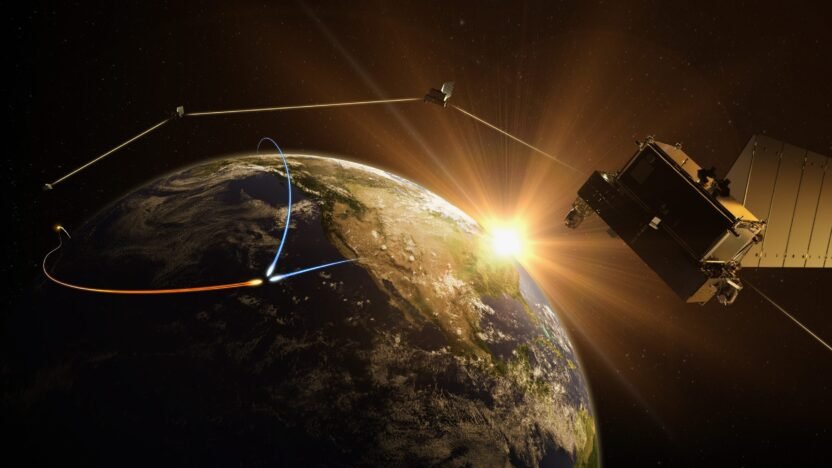
SDA’s flagship effort is the Proliferated Warfighter Space Architecture, a constellation of hundreds of satellites in low Earth orbit designed to support missile warning, tracking and data transport.
Under the new model, the program would be split along functional lines.
The Transport Layer — a network of communications satellites designed to move data across space — is expected to transition to a Space Force PAE focused on building a broader space data network. The Tracking Layer, which uses infrared sensors to detect and track missile threats, would move under a PAE responsible for missile warning.
That shift reflects how the program itself has evolved. What began as a single architecture managed by one office is now being integrated into larger enterprise efforts.
SDA acting director Gurpartap “GP” Sandhoo said the Transport Layer has become a foundational element of a wider military data network, while the Tracking Layer is increasingly central to the Pentagon’s next-generation missile warning architecture, which spans multiple orbital regimes.
A broader consolidation
Folding those missions into portfolio-based acquisition offices is intended to reduce fragmentation and better align budgets, requirements and operations. It would give a single office responsibility for delivering capabilities across an entire mission area.
Sandhoo said combining SDA’s Tracking Layer with other missile warning programs makes sense “so that the whole mission comes to belong to a single PAE, and they are responsible for delivering that capability across all the orbital regimes.”
Lt. Gen. Philip Garrant, head of Space Systems Command, said Sandhoo is expected to lead the missile warning PAE.
Still, officials cautioned that the reorganization is not final.
“There’ll be some shuffling … that will happen,” Sandhoo said, adding that “there probably won’t be an SDA” once the transition is complete. “What that ends up looking like is TBD.”
Culture over structure
Despite the potential disappearance of the agency as a standalone entity, both Meink and Sandhoo emphasized that SDA’s influence will persist.
SDA’s role as a disruptive acquisition organization helped demonstrate a faster way of buying satellites that prioritizes incremental development, frequent competitions and the use of commercial technology. That approach is now being absorbed across the Space Force.
“It may be called something else, but that culture we are doing our best to maintain,” Sandhoo said. “We are making sure that we don’t lose that piece, because speed is critical.”
In practice, that means the Space Force is shifting from relying on a single fast-moving organization to embedding that approach across multiple mission areas.