TAMPA, Fla. — Aethero is preparing to deploy its most powerful computing payload yet this fall, aiming to bring data center-style processing to orbit and expand the scale of AI workloads that can be handled in space.
The San Francisco-based startup announced plans April 16 to integrate its next-generation NxA-ECM compute module with a small satellite bus from Bulgaria’s EnduroSat, using its upcoming ESPA-class FRAME-15 platform with 3.4 kilowatts of peak power.
The Titan mission aims to demonstrate more than 16,000 TFLOPS — a measure of computing performance — which Aethero says is sufficient for real-time data processing and autonomous decisions in orbit, reducing reliance on limited downlink capacity to send raw data back to Earth.
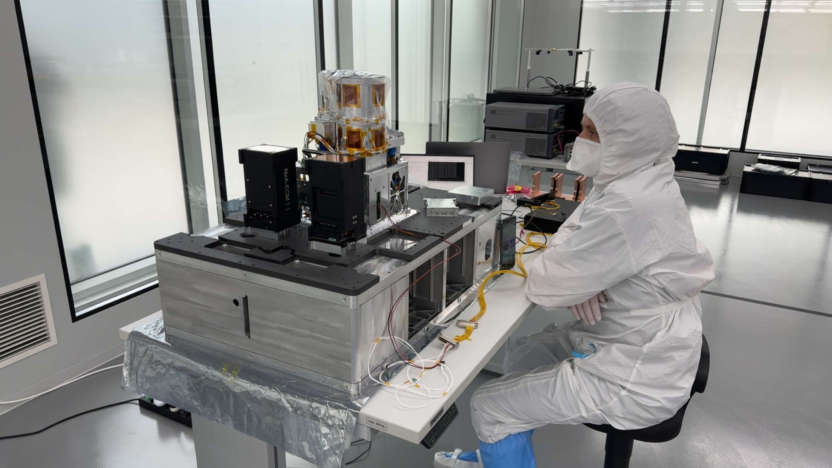
The NxA-ECM module is built around Nvidia’s Blackwell-based Jetson Thor processor, designed to bring significantly more AI computing power to orbit than earlier generations.
Scaling compute in orbit
Titan marks a major step up from the roughly 157 TFLOPS the venture is targeting with Phobos, a far smaller 4U CubeSat deployed earlier this year with tens of watts of power that was largely built in-house to demonstrate early in-orbit computing capabilities.
Amit Pinnamaneni, Aethero cofounder and chief technology officer, said Phobos is still undergoing health checks following its March 30 launch on SpaceX’s Transporter-16 rideshare mission.
Phobos would represent about a 60% increase in performance compared to the Deimos demonstrator Aethero deployed in 2024, its first spacecraft to test a computing payload built around commercial Nvidia hardware. The spacecraft operates as a single compute node supporting multiple software tenants in containerized environments, Pinnamaneni said, including Booz Allen Hamilton and the U.S. Air Force Research Laboratory.
Slated to launch on SpaceX’s Transporter-18 rideshare in October, Pinnamaneni said Titan would scale from a single compute node to a clustered system, “essentially acting as a space cloud provider like a space-based AWS.”
Unlike earlier missions that function more like individual servers, he said Titan is designed to link multiple NxA-ECM compute modules into a coordinated system that shares workloads and operates as a single platform, managed by widely used Kubernetes cloud software.
Each NxA-ECM compute module is designed to deliver more than 4,000 TFLOPS by combining two Nvidia Jetson Thor processors within a single unit, which Pinnamaneni said would make it the first space computer to achieve this level of performance per module.
He said EnduroSat’s production capacity of up to two ESPA-class satellites per day could later enable Aethero to expand beyond a single mission into a distributed network of computing spacecraft.
“Endurosat’s FRAME platforms, in combination with advanced Aethero compute modules and payload design, enable the distributed compute performance that future space use cases require, at a cost that makes in-orbit AI deployable at scale,” he said.
“This effectively transforms satellites into highly autonomous, cost-effective orbital data centers or supercomputers that facilitate seamless global connectivity. This powerful joint architecture easily scales to support next-generation, compute enabled mission use cases, ranging from demanding in-orbit edge computing applications like real-time sensor processing to scalable data processing, storage and telecommunications.”