TAMPA, Fla. — Taiwan’s space agency chief has called on other countries to band together on a shared communications constellation to match the scale and growing strategic importance of networks like U.S.-based Starlink.
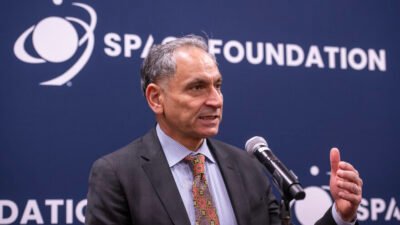
“We can team up four to six or even more like-minded countries,” Jong-Shinn Wu said April 14 during a panel on international partnerships at Space Symposium in Colorado Springs, adding that they could share costs while also contributing local technology expertise.
The proposal echoes Europe’s planned IRIS² sovereign broadband constellation, although Wu framed his concept as a more multinational approach.
It comes as Taiwan looks to leverage its semiconductor manufacturing dominance while responding to mounting geopolitical pressure from China, which Wu said is reshaping how the country approaches space.
“For many nations, space is about exploration,” he said, “but for Taiwan, space is about survival of democracy of a nation. It’s about keeping our democracy alive.”
Wu pointed to several priorities underpinning that strategy, including communications, intelligence and independent access to launch to bolster government operations and situational awareness.
He also stressed how Taiwan’s security has broader global implications, citing its role in international semiconductor supplies and strategic position in the Indo-Pacific.
“For a long time, Taiwan has been isolated diplomatically but space [has] no borders,” he said, adding: “We want to break our isolation through real and practical international technical collaboration.”
Open to partner
While other space agencies on the panel did not directly weigh in on the shared constellation proposal, each echoed the growing importance of international collaboration through their own national strategies.
Jonathan Hung, executive director for Singapore’s newly established space agency, said forging more international partnerships was one of its major priorities, ranging from joint missions to knowledge and data-sharing exchanges.
As many as 60% of the 70-80 space companies in Singapore are based outside the country — “something we warmly welcome,” Hung added, ahead of plans to introduce more business-friendly space legislation in the next two to three years.
Enrico Palermo, head of Australia’s space agency, said the country is focused on ways to include more domestic space businesses in the global supply chain.
“We’ve moved from tech-led to really capability-delivery now,” he said.
Australia and the United Kingdom, which was also represented on the panel, are founding members of the U.S.-led Artemis Accords, a framework enshrining principles for the responsible exploration and use of space that now has 61 signatories.
Miriam Grigg, deputy director for international, resilience and regulation at the UK Space Agency, said such alliances are becoming increasingly important as new technologies reshape the sector.
“Looking at the landscape across our economy and economic security — the transformation that we are seeing through AI, through quantum capabilities — we don’t know where that’s going,” Grigg said.
That “is incredibly exciting and also comes with risks,” she added, “so that’s something we need to partner on, absolutely, and we need to bring together the best minds to innovate.”