COLORADO SPRINGS – After announcing a $5 million seed round in January, Indian startup TakeMe2Space seeks to raise $55 million to establish a 50-kilowatt orbital data center.
“What is key for us is to demonstrate that we can play the orbital data center game globally,” TakeMe2Space founder Ronak Kumar Samantray told SpaceNews. “There’s a lot of liquidity around 50- to 100-kilowatt compute scale, because that’s what will become the building block for a gigawatt orbital data center.”
Samantray established TakeMe2Space after his previous software-as-a-service startup NowFloats Technologies was acquired in 2019 by Reliance Industries. Before founding TakeMe2Space in late 2024, Samantray and colleagues performed spaceflight testing on a proprietary material to protect GPUs from solar radiation.
TakeMe2Space sent its first satellite aloft in December 2024 on India’s Polar Satellite Launch Vehicle (PSLV). The one-unit cubesat, called My Orbital Infrastructure-Tech Demonstration, provided flight heritage for the startup’s onboard computer, edge processor and attitude determination and control system, while remaining attached to PSLV’s fourth stage.
“Three customers uploaded their AI model, did inferencing and got the results,” Samantray said.
Tiered Approach
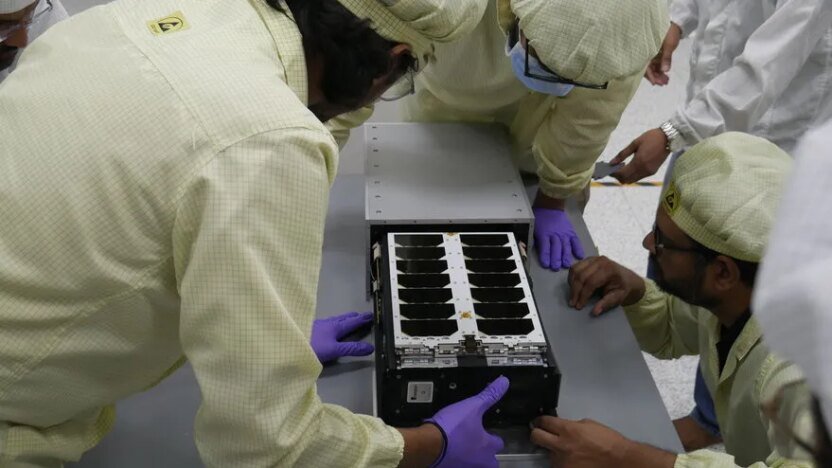
In October, TakeMe2Space will launch a six-unit cubesat equipped with an Nvidia Jetson module on a SpaceX Falcon 9 rideshare. Customers who plan to upload data and task the Earth-imaging cubesat are testing AI models on the satellite’s physical twin.
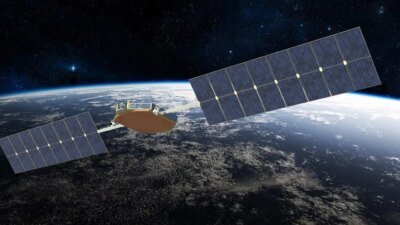
The following mission, launching in 2027 with funding from the recent investment round, will be a constellation of four satellites with a mass of roughly 100 kilograms apiece sharing data through optical inter-satellite links.
“There, the aim is to get to $15 million annual revenue with five kilowatts of compute in orbit,” Samantray said.
Market Analysis
While developing space infrastructure, TakeMe2Space has been evaluating the emerging market for on-orbit compute and data storage. Samantray sees agriculture and insurance firms as early customers because they demand access to inference engines that can ingest Earth-observation data and quickly draw conclusions.
“Of late, there also has been demand for storage in orbit,” Samantray said. “People want to store mission-critical data on satellites as a backup because data centers, unfortunately, have become military targets.”
As a result, TakeMe2Space satellites will provide 100 terabytes of storage capacity.
By 2029 or 2030, Samantray anticipates launch costs will decrease, improving the economic picture for orbital data center infrastructure and prompting customers to begin uploading large datasets for AI training.
Vertical Integration
“Anything that flies in a satellite, except for solar cells and propulsion, is designed and built by us,” Samantray said. “That ensures that our cost of manufacturing the satellite is extremely low.”
Samantray began focusing on space-based computing infrastructure in 2021.
“My idea was very simple. If humans are to become a spacefaring species, there will be a large-scale compute infrastructure,” Samantray said.