1
Following Blue Origin’s milestone of successfully landing a previously flown first-stage booster for the first time on Sunday during the third flight of its New Glenn rocket, the mission’s primary payload — AST SpaceMobile’s BlueBird 7 communications satellite — was deployed into an incorrect, lower-than-planned orbit, rendering it unusable.
The launch itself appeared nominal, following a roughly 40-minute delay that occurred early in the launch window for final vehicle configuration and file uploads.
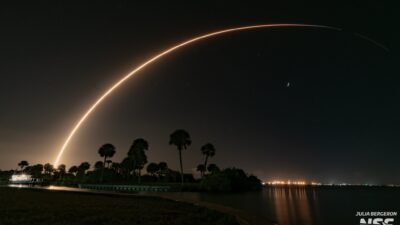
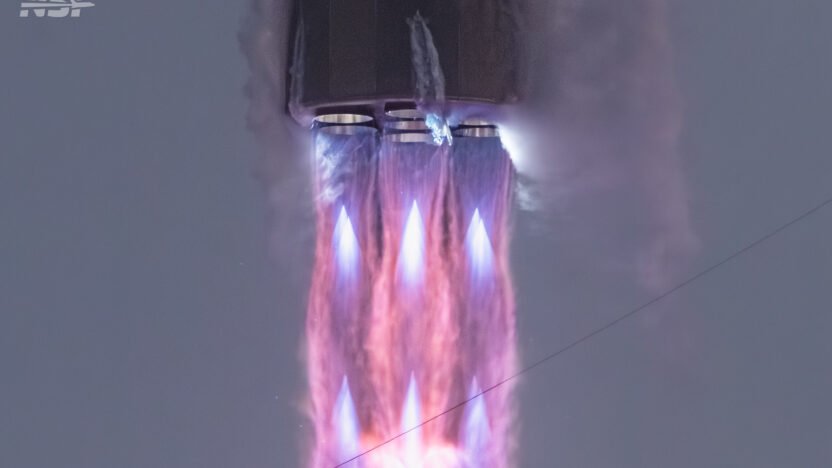
New Glenn lifted off from Launch Complex 36, and after a smooth ascent and stage separation, the first stage — Glenn Stage 1 Serial Number 2, nicknamed “Never Tell Me The Odds” and powered by seven BE-4 engines — performed an entry burn followed by a landing burn.
It touched down on the droneship Jacklyn in the Atlantic Ocean, aiming beside the ship as expected before translating over for a precise landing. A noticeable vent from the aft section was observed post-touchdown, which wasn’t seen during the previous touchdown, likely to purge remaining propellant for safe recovery. This marked the first reflight of an orbital-class New Glenn booster. The stage, which previously flew on New Glenn’s second mission (November 13, 2025), achieved a turnaround time of approximately 157 days — an impressive feat for a maiden reflight.
For context, SpaceX’s first reused Falcon 9 booster (B1021) had a 356-day interval between its debut landing and second flight.
While the booster performed flawlessly, the second stage encountered issues. Blue Origin confirmed payload separation about an hour after the scheduled time, and AST SpaceMobile reported that the satellite had powered on. However, it was placed in an off-nominal orbit.
U.S. Space Force tracking data, noted by astrophysicist Jonathan McDowell, showed the object in a 154 x 494 km orbit at 36.1° inclination at the time of Second Engine Cutoff-1. Planned additional burns to raise the orbit and later dispose of the second stage apparently did not achieve the intended parameters.
AST SpaceMobile later stated that the altitude was too low for the satellite’s onboard thruster technology to sustain operations, and the spacecraft will be deorbited. The company expects to recover the satellite’s cost through its insurance policy. Blue Origin indicated it is assessing the anomaly.
AST SpaceMobile’s BlueBird 7 was the second satellite in the company’s Block 2 constellation. Designed to provide direct 4G/5G cellular connectivity to unmodified smartphones from space, the satellite features a large unfolding phased-array antenna spanning about 2,400 square feet (220 square meters). While this design has raised concerns among astronomers about potential light pollution and interference with ground-based observations, AST SpaceMobile has a formal coordination agreement with the National Science Foundation to mitigate impacts. Unlike larger constellations such as Starlink or Project Kuiper, AST SpaceMobile plans a more modest fleet of around 90 satellites.
This marks the second New Glenn second-stage failure this month, following a recent ground anomaly at the company’s 2CAT (second-stage cleaning and testing) facility on Merritt Island, Florida. That incident involved an overpressure event that damaged the building’s roof and door, though no injuries were reported.
Blue Origin has multiple additional second stages in various stages of preparation, including some that have already undergone static-fire testing.
The company has been aiming to increase its flight cadence, firing up second stages well ahead of their assigned launch targets, and is likely focused on flying them with returned boosters.
Despite the payload setback, the booster recovery was widely celebrated as a major step for Blue Origin.
The company has several upcoming missions, including multiple Amazon Project Kuiper launches, Firefly Aerospace’s Eltra Mission 1, and — potentially as soon as before the end of summer — the first test flight of its Blue Moon Mark 1 lunar lander (“Endurance”). That uncrewed mission will validate technologies for NASA’s Artemis human lunar landing system, including the BE-7 hydrolox engine.
Blue Origin has not yet provided a detailed timeline for the mishap investigation.
Future customers may see slightly higher insurance costs in the near term, though the successful booster reuse demonstrates progress toward the company’s goal of rapid, routine heavy-lift operations.
(Lead Image: New Glenn launches from LC-36 on its third flight. Credit: Max Evans for NSF)