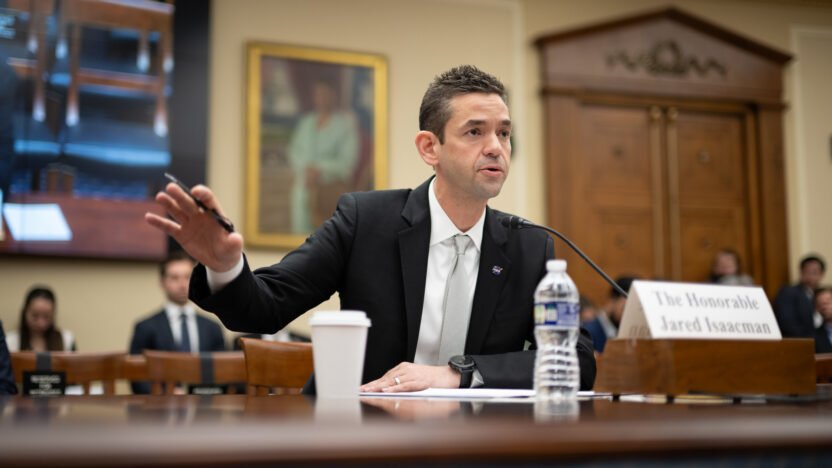
WASHINGTON — Members of the House Science Committee rejected a proposed fiscal year 2027 budget for NASA because of sweeping cuts as the agency’s administrator argued it could do more with less.
During an April 22 hearing by the full committee that spanned nearly four hours, including a lengthy recess for votes on the House floor, members of both parties criticized the budget proposal released April 3 that sought a 23% cut in overall NASA spending with steeper reductions in areas like science and aeronautics.
“I simply do not believe that this budget proposal is capable of supporting what President Trump himself has directed the agency to accomplish over his two terms, nor what Congress has directed by law,” said Rep. Brian Babin, R-Texas, chairman of the committee, in his opening remarks.
Babin described himself as a fiscal conservative who wants to reduce government spending but argued the NASA budget proposal went too far. “Shortchanging NASA is simply not smart,” he said, citing competition with China.
“We see this the same way,” said Rep. Zoe Lofgren, D-Calif., the committee’s ranking member. She laid the blame for the budget cuts on the White House Office of Management and Budget (OMB) rather than on NASA itself.
“Like the ’26 request, OMB tried to argue that NASA and the United States will continue to lead in space and Earth science, human exploration, aeronautics and space technology, while all but exploration would see draconian cuts,” she said.
NASA Administrator Jared Isaacman argued that the agency should be more efficient, citing in his opening statement major budget overruns and delays on programs like the X-59 experimental aircraft, Dragonfly mission to Saturn’s moon Titan, Mars Sample Return and the Space Launch System Block 1B.
“This is not good capital allocation or execution,” he said. “American exceptionalism is being challenged in the high ground of space. To win, we cannot establish programs that are designed to be too big to fail but, at the same time, too costly to succeed.”
“Can we do more with the resources being contemplated in the president’s budget request? I would say absolutely, and I draw that based on the work that I’ve done understanding where our inefficiencies are,” he said later in the hearing.
Members did not appear convinced by the argument that NASA could achieve more despite the reduced funding. “So, you think the 47% cut to NASA’s Science Mission Directorate will still yield the same results?” asked Rep. Suhas Subramanyam, D-Va.
Isaacman cited as one example his belief that the growing capabilities of the commercial Earth observation sector can take over for the decades-long Landsat program after the Landsat-10 mission is launched in the early 2030s. “The constellation providers may reduce costs by 80 or 90%.”
“Do you think we can cut 50% across the board and still yield the same results or better?” asked Subramanyam.
“My commitment to Congress is to maximize the scientific value of every dollar you give us,” Isaacman responded. “We can do far more with the resources available, even with a reduction in the budget.”
Subramanyam disagreed, and other members in the hearing raised similar concerns about cuts to science and aeronautics. Some of the strongest complaints, though, were about the proposed elimination of NASA’s education office, known as the Office of STEM Engagement, or OSTEM. That office received $143 million in 2026, less than 1% of NASA’s overall budget.
The elimination of the office — also proposed in the 2026 budget as well as several budget proposals in the Trump administration’s first term — generated bipartisan criticism because it would eliminate funding for programs like Space Grant and Minority University Research & Education Project.
“The budget request proposes eliminating funding for the NASA Office of STEM Engagement. Can we fix that, do you think?” asked Rep. Randy Weber, R-Texas, after noting the support it offered to universities in his district.
Isaacman told him and other members that NASA offered other ways to support educational institutions through research grants and internship programs, but did not discuss how NASA would compensate for the elimination of the OSTEM programs. He also argued that NASA can best provide educational motivation and inspiration through its activities.
A counterargument came from Rep. Deborah Ross, D-N.C., who, like many members, praised the recent Artemis 2 mission. She noted one of the astronauts on the mission, Christina Koch, graduated from North Carolina State University in Ross’s district. Koch, she added, had received funding from Space Grant to attend a NASA summer program while a student there.
“You stated that a dedicated STEM engagement program is unnecessary because, if we can execute our mission and get the inspiration, the STEM education will take care of itself,” she told Isaacman. “I beg to differ.”
Speed-running the budget
The hearing was the first of what Isaacman, at an April 21 event, described as “the grand hearing testimony tour” on NASA’s 2027 budget request. House and Senate committees did not hold similar hearings for the 2026 budget request because of the delayed release of the final budget proposal and a lack of confirmed NASA leadership.
Isaacman is set to testify before the House Appropriations Committee’s Commerce, Justice and Science (CJS) subcommittee April 27, three days before that subcommittee marks up its spending bill. The Senate Commerce Committee and Senate Appropriations Committee are also expected to hold hearings on the NASA budget proposal in the coming weeks.
That schedule of hearings and markups is faster than usual. “If you had asked me about three weeks ago, I would have said we’ll have these committee markups sometime in May, maybe June,” said Jack Kiraly, director of government relations at The Planetary Society, in a presentation April 22 at a meeting of the Mars Exploration Program Analysis Group.
Instead, the full House Appropriations Committee is scheduled to mark up the CJS funding bill, which includes NASA, on May 13. He estimated Senate appropriations markups will run on a schedule about two weeks behind the House.
“This is a really ambitious timeline,” he said. By June, he estimated, “we very well could have significant action taken on the CJS budget.”