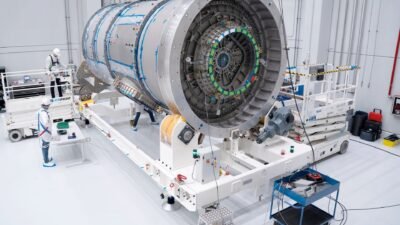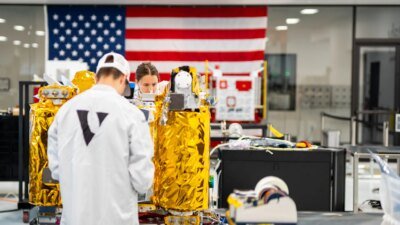

WASHINGTON — Overview Energy, a startup developing space-based solar power systems, announced an agreement to provide energy for data centers operated by Meta.
The companies announced April 27 an agreement under which Overview will transmit up to one gigawatt of power that will be used by Meta data centers when other sources of energy, like terrestrial solar power, are unavailable.
Overview emerged from stealth last December, announcing that it had demonstrated technologies to collect solar power in space and transmit it to Earth through infrared lasers. Those lasers would send power to terrestrial solar farms, allowing them to generate power when they would otherwise be idle, such as at night. Overview plans an in-space demo of its technology in 2028, with commercial service to begin as soon as 2030.
“Space solar technology represents a transformative step forward by leveraging existing terrestrial infrastructure to deliver new, uninterrupted energy from orbit,” said Nat Sahlstrom, vice president of energy and sustainability at Meta, in a statement.
He said the agreement with Overview Energy was part of an effort to diversify its power sources to meet the growing demands of data centers supporting artificial intelligence applications. Meta previously signed agreements with several companies for geothermal and nuclear power and separately announced April 27 a deal to purchase 100 gigawatt-hours of energy storage from a battery startup, Noon Energy.
Those agreements are part of a scramble by AI companies to secure power for their data centers. That has, in some cases, led to public backlash regarding the environmental impacts of those centers and increased energy costs.
“Our approach to space solar energy enables hyperscalers and technology providers to secure clean power with reliable siting, and speed to power,” Marc Berte, chief executive of Overview Energy, said in a statement. “Together with Meta, we’re looking beyond traditional constraints on where and when power can be delivered to meet the growing demand for electricity.”
That energy demand has led some companies to consider moving data centers to space. Over the last several months, several companies have filed applications with the Federal Communications Commission to deploy massive constellations of satellites that would serve as orbital data centers, tapping into solar power that is available continuously, depending on the choice of orbit.
“By directly harnessing near-constant solar power with little operating or maintenance cost, these satellites will achieve transformative cost and energy efficiency while significantly reducing the environmental impact associated with terrestrial data centers,” SpaceX stated in its January filing that sought permission to deploy up to 1 million satellites.
In March, Blue Origin filed plans for up to 51,600 orbital data center satellites, citing “always-on solar energy” as one motivation for its plans. Starcloud, a startup focused on orbital data centers, raised $170 million March 30, shortly after filing an FCC application for up to 88,000 satellites.
Overview Energy, though, has argued it makes more sense to place the power source for orbital data centers in space, rather than the centers themselves. The company thinks attempting to place data centers in space creates needless complexity.
“Put the thing that doesn’t need the maintenance and can last for a long time in space,” Berte said in a December interview. “Put the energy part into space as opposed to putting the processing part in space.”
That argument has won over some observers. “This approach makes more sense to me: beaming the power to existing solar facilities on the ground, so they can generate electricity even after the sun goes down,” Micah Walter-Range, president of consulting firm Caelus Partners, told SpaceNews. Data center operators, he said, could be key anchor customers for space solar power companies like Overview. “Seems easier than putting the data centers in space.”