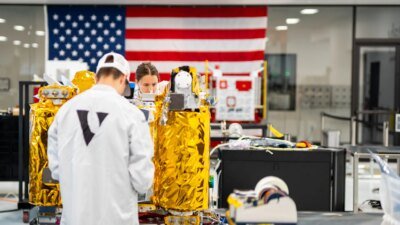
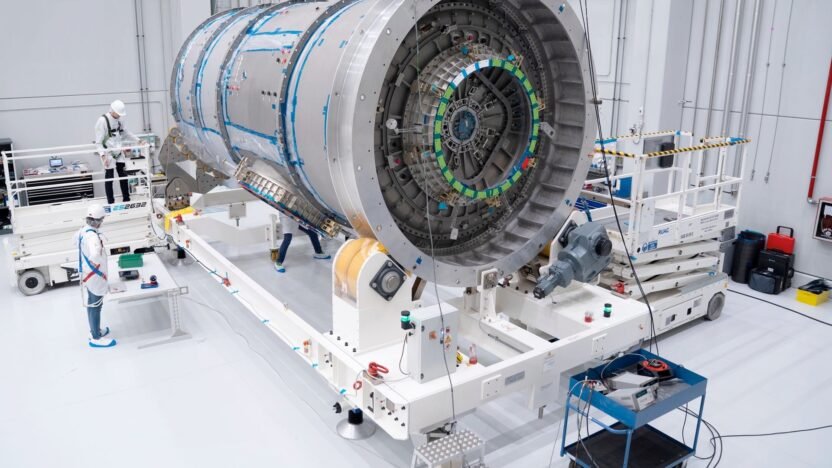
WASHINGTON — A manufacturing issue involving a European company has resulted in corrosion in modules produced for both the lunar Gateway and Axiom Space’s commercial space station.
The problem first gained public prominence in comments by NASA Administrator Jared Isaacman at an April 22 House Science Committee hearing, where he was asked about the agency’s plans to effectively cancel Gateway and focus instead on a lunar base.
“The only two habitable volumes that were delivered both were corroded,” he said. “And that’s unfortunate, because it would have delayed, probably beyond 2030, the application of Gateway.”
The modules in question were the Habitation and Logistics Outpost, or HALO, being developed by Northrop Grumman, and the European Space Agency’s International Habitat, or I-Hab, module. Gateway, Isaacman said, was an example of “a program that took way too long to come to fruition, became too costly, and the hardware that was being delivered as a result was not meeting expectations.”
NASA had hinted at corrosion problems with HALO in recent presentations. Slides presented at NASA’s “Ignition” event March 24, which discussed plans to suspend Gateway development, noted anticipated delays in the launch of HALO because of “HALO corrosion mitigation,” adding that “corrosion mitigation” was a problem for other, unnamed Gateway modules.
NASA, though, has not discussed the corrosion problems with HALO or other modules in detail. An agency spokesperson acknowledged questions from SpaceNews about the topic April 22, and again in an April 27 follow-up, but did not provide answers as of early April 28.
Others involved in the modules have been more forthcoming. “Using NASA-approved processes, Northrop Grumman is completing repairs to HALO after a manufacturing irregularity,” Northrop Grumman said in a statement to SpaceNews April 22. “We expect to complete repairs by the end of the third quarter.”
ESA said April 24 it had been working on similar corrosion issues with I-Hab. “Following the identification of corrosion on HALO, a comprehensive investigation was promptly initiated,” ESA stated, involving a “tiger team” set up by the agency. “Preliminary findings indicate that the issue likely results from a combination of factors, including aspects of the forging process, surface treatment and material properties.”
ESA added that the corrosion “was understood to be technically manageable and did not constitute a showstopper for I-Hab,” and that the module was in better condition than HALO.
The link between HALO and I-Hab is that the structure for both modules was built by the same company: Thales Alenia Space. That company has been a leader in the production of pressurized modules, including modules for the International Space Station and those used on Cygnus cargo spacecraft.
“Our teams are working hand-in-hand with our longstanding customer Northrop Grumman to ensure that the HALO module fully meets the mission’s requirements, using NASA-approved processes,” a spokesperson for Thales Alenia Space told SpaceNews April 27. “A well-known metallurgical behavior was found at the surface of the module, which will be fixed by the end of the third quarter of 2026.”
The company said that it was working with ESA on the I-Hab module, still in the company’s Italian facilities, “to fix soon the same related issue.”
In addition to building the Gateway modules, Thales Alenia Space has also been making the structures for the first modules for Axiom Space’s commercial space station. Those are also affected by the corrosion issue, the company confirmed.
“Axiom Space has encountered a similar phenomenon on our module structures. Limited corrosion spots were observed on the primary structure and have been removed,” Allen Flynt, chief operating officer and general manager of Axiom Station and mission services, said in a statement to SpaceNews April 27.
“Working alongside NASA and Thales Alenia Space, we’ve identified the root cause and developed a mitigation, which is being implemented to restore the modules to their intended state,” he said. “We see no impact to our launch dates, and Module 1 remains on track for 2028.”
None of the companies involved have provided details about what caused the corrosion beyond the ESA comments. Industry sources speculate it may involve some incompatibility among the materials used or how they have been coated or treated.
It’s also uncertain if the issue will affect whether or how the Gateway modules are repurposed for a lunar base or other applications. “HALO can still be repurposed for any mission, and it’s the most mature technology to support a deep space or lunar habitat,” Northrop said in its statement.
At the Ignition event, Carlos Garcia-Galan, program executive for Moon Base at NASA and a former Gateway official, suggested only parts of HALO might be reused for the planned lunar base.
For HALO, “there’s many subsystems and components that potentially we could use in other habitation modules for the moon base,” he said.
“NASA, working together with our industry partners with Gateway and also our international partners, are going to be putting together options and concepts on how we take everything we’ve got and make it work for us toward building the moon base,” he said.