HELSINKI — Chinese launch startup Cosmoleap has secured significant funding for its reusable rocket plans as it works towards a debut launch in 2027.
Cosmoleap, full name Beijing Dahang Yueqian Technology Co., Ltd., announced the $73 million (500 million yuan) funding round April 29, said the round was jointly led by Haiyuan Square, with participation from Houpu Capital, Zhuque Capital, Zhenyuan Capital, Zhikong Capital, Junlian Capital, and strategic cooperation investor Zhongguancun Development Group. The funds will mainly be used for product development, testing and validation, and team expansion.
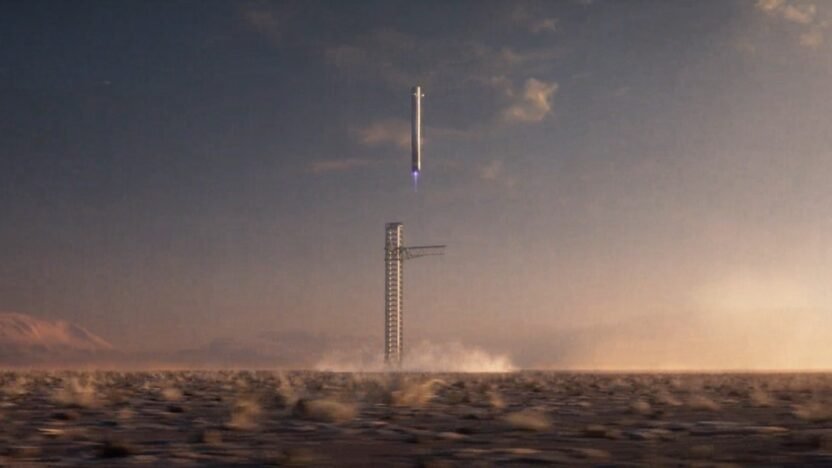
The company statement said the funding will go towards development of the Yueqian-1 rocket and what it describes as China’s first “tower catch and landing recovery” rocket system. The tower recovery system resembles the SpaceX Mechzilla tower system with “chopstick” arms.
Cosmoleap says final assembly and testing of the Yueqian-1 rocket will begin in the second half of 2026, with the debut flight planned for 2027.
The 70-meter-long, 4.2-meter-diameter Yueqian-1, or Leap-1, is designed to launch 18,000 kilograms of payload to low Earth orbit, or 12,000 kg when the first stage is recovered.
The company is developing its own methane-liquid oxygen Qingyu-11 variable thrust engine, stated to be in the 100-ton thrust class, but has also tested the 80-ton thrust class YF-209 methalox engine developed by state-owned contractor China Aerospace Science and Technology Corporation (CASC) for commercial purposes.
Cosmoleap previously raised around $14 million in November 2024. It also performed a chopstick tower test that month. The company announced its existence and start of operations in March 2024, meaning the 2027 debut flight timeline, as well as verifying unproven tower catch technology, is very ambitious.
The funding comes amid a surge of backing for Chinese launch and commercial space sector companies more generally, with strong policy backing from the central and provincial governments. Cosmoleap’s early stage funding appears relatively modest in contrast with more established launch firms securing ever-growing funding rounds and moving towards initial public offerings. Some of these, including Landspace, Space Pioneer and CAS Space, have conducted debut launches of potentially reusable, medium-lift launch vehicles in recent months.
Astronstone, another Chinese company working on a chopstick-style rocket recovery system, secured $29 million in funding last month, aiming for a Q1 2027 debut flight.
CASC is meanwhile preparing for the debut flight of its Long March 10B rocket expected in May, with the test flight having been pushed back from an initial April 28-30 launch window. Landspace is also preparing for a second flight and recovery attempt of its Zhuque-3 stainless steel rocket in May or June, with the rocket recently departing for Jiuquan spaceport in northwest China. Those rockets will use a maritime vessel equipped with a net capture system and landing legs for vertical recovery respectively.
China is pursuing reusable launch capabilities to allow it to boost its flight cadence and access to space as the country moves towards building space infrastructure including broadband megaconstellations and on-orbit data centers. It is also expanding its launch facilities and ramping up the rate of expendable launches to ease a launch bottleneck.