Every generation reshapes how civilization moves goods. Container ships revolutionized the mid-20th century, computing the late 20th century, and as we entered the new millennium so did the internet, and now reusable rockets. Each unlocked new levels of speed, and capability and markets. The next logistics layer isn’t yet widely known, but it is happening.
Since February, more than 600 vessels are stalled in the Persian Gulf, unable to transit the Strait of Hormuz. Major carriers have suspended operations. Oil prices are nearing $100 a barrel. A third of the world’s fertilizer trade is blocked. Airlines froze on a dime and shut down immediately. At the same time, Dubai Airport (the world’s business aviation hub) closed due to incoming missiles from Iran and is still operating at limited capacity today.
The systems the world depends on aren’t just fragile, they’ve fallen behind the needs and realities present day. Supply chains are highly efficient but built around a small number of geographic chokepoints with little redundancy. The Suez Canal carries 12–15% of global trade. The Bab al-Mandab Strait handles roughly 12% of global oil and gas flows. Los Angeles and Long Beach process about 40% of U.S. containerized imports. When any of these nodes fail, due to conflict, disaster, or instability, the effects cascade globally and are slow to reverse.
Disruptions are inevitable and geography doesn’t change. The real question is whether we are willing to build a logistics layer that operates above it. That means solving downmass.
Seventy years of progress and one constraint
History tells us that modern logistics tends to follow the same pattern: identify the bottleneck, then remove it.
In 1956, containerization collapsed shipping costs and made global trade scalable. Computing turned supply chains into information systems. The internet connected them globally, while e-commerce compressed delivery timelines and accelerated automation.
Each wave removed the constraint that came before it. One remains: Geography.
Every piece of cargo still moves through the same physical chokepoints. Logistics is faster and cheaper than ever, but is still bound to the Earth’s surface. And when those chokepoints fail, there are no alternatives at comparable scale.
Rerouting around Africa’s Cape of Good Hope adds 10-14 days to a voyage. Air freight can move high-value, low-volume goods, but succumb to the same geographical constraints. Overland routes exist for some regions but are geographically limited and significantly slower.
Defense and humanitarian operations face the same limits. Sustaining forward operations, delivering aid to disaster zones, or responding to crises all depend on corridors that can be congested, contested, or completely inaccessible. In some cases, getting critical supplies into a cut-off region takes days or weeks. In others, it can’t be done at all.
Chokepoint dependency is a constant structural tax on the global economy, national security, and humanitarian systems.
The missing half: space logistics
For decades, the economics of space was defined by the low cadence and high cost of launch. That reality is changing fast. Larger, reusable rockets are driving costs down and making access to orbit more routine.
But launch alone, ‘the northbound lane’ of a highway does not create a logistics network. A true logistics network is two-way. You unlock global trade by creating a shipping lane in two directions. You build flight by mastering takeoff and landing. And you create a durable through-space system by putting more payloads into low Earth orbit and delivering them back. Safely, precisely, quietly, cost effectively and on demand.
That return capability, downmass, unlocks value across every domain it touches. In defense, it enables rapid delivery into contested environments without relying on vulnerable infrastructure. In humanitarian response, it allows critical supplies to reach any point on Earth in under an hour. Commercially, it is essential for industries like in-space manufacturing of pharmaceuticals, semiconductors and advanced materials, offers clear advantages, but only if products can be returned reliably and at scale.
Launch has been solved, return has not.
And the massive vehicles being built today for launch like Starship, New Glenn and others cannot return mass to Earth beyond the weight of the vehicles themselves. While we see their glorious landings and while it is clear the demand for them will explode over the coming century (one of the many reasons for SpaceX’s potential $1.5 trillion valuation), they cannot return mass to Earth. That means another piece of the architecture is needed. One purpose-built to be the return lane.
Delivery without corridors
The solution to chokepoint dependency isn’t just a better route, it’s a new layer entirely.
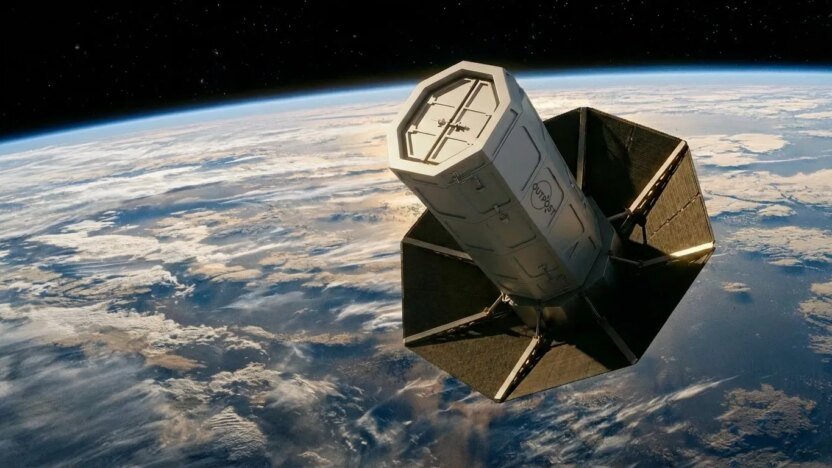
Orbital logistics, also called exologistics, enables the movement of goods to, through and back from orbit. A reusable vehicle launches, reaches orbit in under 10 minutes, remains pre-positioned and re-enters on demand, delivering 10-ton-plus payloads anywhere on Earth, with meter-precision, in under an hour.
No ports. No corridors. No rerouting. The speed of shipping via space, for the cost of air. This is not science fiction. The fundamental technologies exist today. What has been missing is the architecture purpose-built for the return mission.
Still, significant challenges like the following remain: heat shields must withstand repeated re-entry, guidance systems must achieve pinpoint landings, customs frameworks are not yet up to speed and SpaceX and Blue Origin must meet with per-kilogram launch cost targets to compete with air freight.
These are solvable problems, not fundamental barriers; and if you’re paying attention to this, you’ll see that the solutions are unfolding now. The organizations that solve them will define the next era of global trade.
Building what matters
Space logistics should be viewed as infrastructure, not vehicles, the same way prior generations understood railroads, container shipping and aviation networks. Just as Eisenhower pioneered the construction of highways across the nation, helping the U.S. grow into an economic powerhouse, the next era of logistics demands building the highways to and from space.
Launch opened the northbound lane. Space return is the southbound lane. Without both, the highway does not work.
The nations and companies that build the key infrastructure layers will shape the markets, standards and strategic advantages that follow. In the 20th century, containerization transformed global trade. In the 21st, exologistics will do the same.
This transformation will require a shift in focus. That means policymakers, investors, and industry leaders must think beyond rockets alone. Investment must go toward reusable return systems, precision landing capabilities, regulatory frameworks and scalable operational models.
The key question is no longer just how cheaply we can send mass to space, but how we bring it back. Get ready to hear the word downmass a lot, because it will become foundational to space.
The future of space will not be defined by launch providers alone, but by those who make space economically useful — repeatedly, economically, and at scale. That has always been the difference between technological possibility and lasting infrastructure.
Space is reaching that inflection point now. Launch opened the door. Return is what makes the system work.
Amir Blachman is president of Outpost, providing AirDrop, StratoDrop and SpaceDrop downmass for the defense, exploration and in-space manufacturing markets. He was on the founding team as Chief Business Officer at Axiom Space, where he helped launch 14 astronauts and dozens of payloads to the International Space Station, and build partnerships with NASA, SpaceX, Mitsui, Prada and others. He is a seasoned space investment and finance expert, having managed a venture syndicate that seeded some of today’s prominent space companies.
SpaceNews is committed to publishing our community’s diverse perspectives. Whether you’re an academic, executive, engineer or even just a concerned citizen of the cosmos, send your arguments and viewpoints to opinion (at) spacenews.com to be considered for publication online or in our next magazine. If you have something to submit, read some of our recent opinion articles and our submission guidelines to get a sense of what we’re looking for. The perspectives shared in these opinion articles are solely those of the authors and do not necessarily represent their employers or professional affiliations.