WASHINGTON — Interlune, a startup with plans to harvest helium-3 from the moon, has won a NASA contract to develop a payload to test ways to extract the valuable isotope from lunar regolith.
The company announced May 4 it won a Small Business Innovation Research Phase 3 contract from the agency worth $6.9 million. The contract, from NASA’s Space Technology Mission Directorate’s Game Changing Development program, funds development of a payload to be flown on a future lander mission.
“This is going to be the first time that solar wind volatiles have been extracted from lunar regolith in situ on the moon,” Rob Meyerson, chief executive of Interlune, said in an interview.
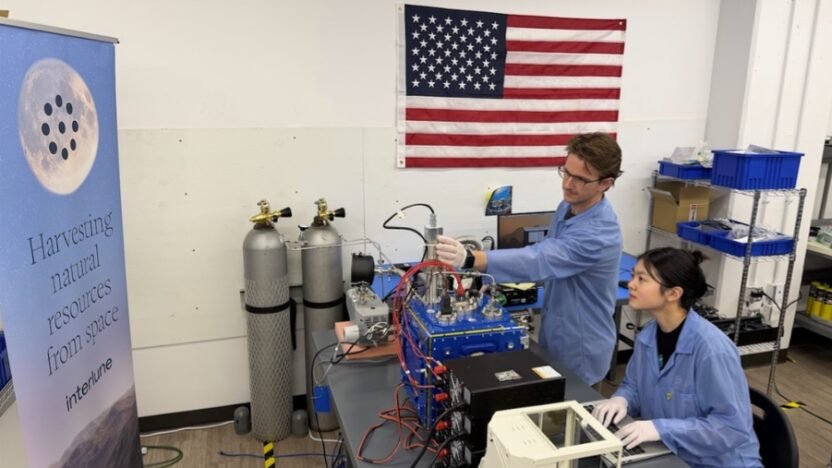
The payload, called Prospect Moon, will include a robotic arm that scoops regolith into the instrument. One sample will be heated to measure volatile gases, such as helium-3 and hydrogen, that are released. Other samples will be subjected to mechanical processing, including size sorting as well as agitation and crushing.
“We’ll calibrate the processes that we eventually want to use on the moon for a full-scale resource extraction operation,” he said. “It will measure the efficiency of our process so that we can use that to go build larger-scale hardware.”
Prospect Moon will be ready to be integrated onto a lunar lander in the fall of 2027 for a 2028 launch. Meyerson said the company is evaluating several lander mission options, with a preference for missions going to the lunar equatorial regions.
Interlune wants to take advantage of a proposed surge of lander missions NASA announced in March as part of a revised lunar exploration plan that includes development of a lunar base. He said the payload is relatively inexpensive to build, enabling the company to produce several copies of it that could be flown on different landers.
“It’s directly related to so many of the things that NASA has as objectives for Artemis and the moon base,” he said. “We think we have a good shot at getting a flight selected as part of the new program.”
This payload will not be Interlune’s first to go to the moon. The company announced last year an agreement to fly a camera on Astrolab’s FLIP rover. The camera will look for concentrations of ilmenite, a mineral considered a proxy for helium-3.
That camera, called Crescent Moon, was delivered to Astrolab, Meyerson said, and is being integrated onto the FLIP rover scheduled to launch later this year on Astrobotic’s Griffin-1 lander.
He said Interlune has seen strong demand for helium-3, with contracts from the Department of Energy as well as quantum computing companies Maybell Quantum and Bluefors worth about $500 million. “It is a strong signal that there is a market for helium-3,” he said. “We have letters of intent for quite a bit more that we’re working to convert to contracts.”
Some of those contracts require starting deliveries of helium-3 in 2028, well before Interlune is ready to harvest the isotope from the moon. The company is working on terrestrial sources of helium-3, including technology to extract the trace amounts of helium-3 present in industrial-grade, or “Grade A,” helium commercially available.
He acknowledged “it’s going to take a few years” to start extracting helium-3 from the moon even if the 2028 Prospect Moon mission is successful. “It’s going to be in the early 2030s when we’re up and operating,” he said. “No earlier than that.”
Meyerson said he does not expect Interlune’s helium-3 mining operations on the moon to be directly a part of NASA’s proposed lunar base because of its location at the south polar region of the moon, which is not a preferred location for the company. However, he said Interlune could leverage many of the technologies and capabilities that would be developed for the base, while the base could make use of Interlune’s technologies.
“The moon base is going to be essential to us, whether we’re operating adjacent to the moon base or not,” he said. “We can serve, and we do serve, as a commercial partner and commercial use case for anyone that’s building infrastructure on the moon.”