DENVER — The director of the National Reconnaissance Office is putting a major emphasis on hiring as the spy satellite agency undergoes one of the most significant shifts in its history.
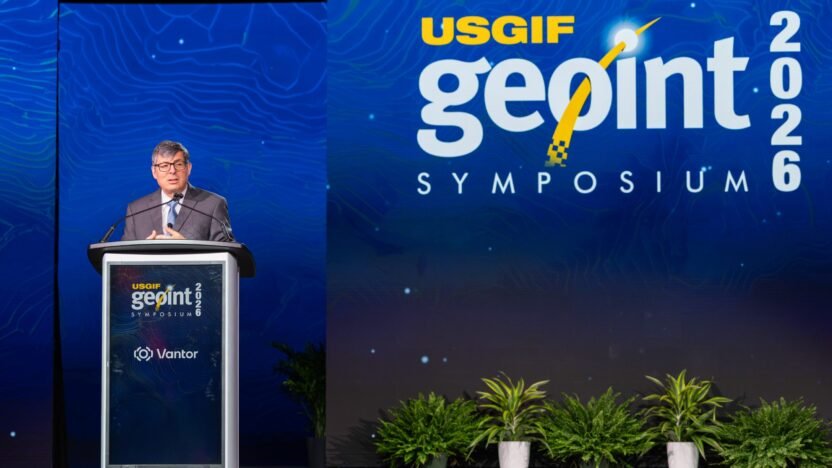
Speaking May 6 at the GEOINT Symposium, the agency’s director Christopher Scolese framed workforce challenges as a central issue for the agency he has led for nearly seven years and is expected to leave later this year.
The concern reflects more than routine staffing gaps. The NRO is moving from a model built around a small number of large, highly classified satellites to a far more expansive and commercially integrated system, one that depends as much on software and data processing as on hardware in orbit.
“We need finance, we need contracts, we need engineers, scientists, mathematicians,” Scolese said, while emphasizing the need for new types of expertise. The agency has long employed data scientists and AI specialists, he noted, but now needs significantly more, and is also recruiting quantum physicists.
The NRO builds and operates the nation’s spy satellites, providing imagery and signals intelligence to military commanders and civilian leaders. Its budget is believed to run into the tens of billions of dollars annually, though details remain classified.
Scolese’s focus on talent comes as the agency absorbs losses from last year’s federal workforce downsizing under the Trump administration’s DOGE initiative, which led to voluntary retirements and buyouts across government. But replacing those departures is only part of the challenge. The NRO is also trying to staff new roles tied to its evolving mission.
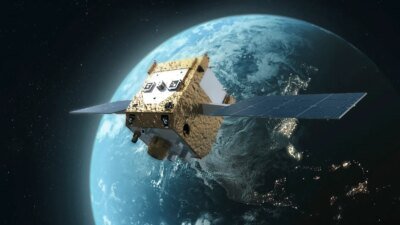
At the center of that evolution is a rapid expansion in orbit. Over the past two years, the NRO has deployed more than 200 satellites in low Earth orbit, creating a proliferated constellation designed to increase coverage, revisit rates and resilience.
That surge has flipped a longstanding dynamic in geospatial intelligence. The bottleneck is no longer collecting data from space, but processing it fast enough to be useful. The result is growing demand for data scientists, software engineers and AI specialists who can build systems to sift through continuous streams of imagery and signals, detect anomalies and prioritize what matters.
The shift also reflects pressure from military users, who increasingly expect near-real-time intelligence. Meeting that demand requires automated pipelines, including computer vision, data fusion and edge processing, that can move information quickly from satellite to operator, even in degraded communications environments.
Artificial intelligence is central to that effort. “AI has found its way in almost every presentation and conversation,” Scolese said, calling it one of the most disruptive technologies the agency is adopting.
At the same time, the NRO is looking beyond current AI applications. Scolese said the agency is hiring quantum physicists to explore emerging technologies such as quantum sensing and secure communications, as well as to prepare for potential risks to existing encryption methods.
The scale of the agency’s new architecture is also forcing operational changes. With hundreds of satellites on orbit and more planned, Scolese warned that human operators alone will not be able to manage the system. Automation and machine learning will be required not just to analyze data, but to task satellites and run the constellation.
“We constantly have to change,” Scolese said, citing adversaries’ efforts to counter U.S. capabilities. He made it clear that the need to adapt across space systems, AI and manufacturing has turned workforce into a strategic issue.