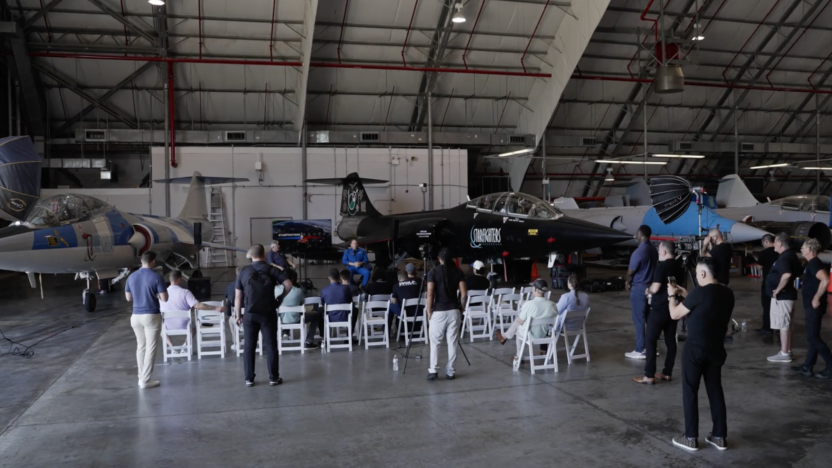
TAMPA, Fla. — Starfighters Space has hired two former Blue Origin New Glenn managers to help advance its air-launch system toward flight demonstrations and operational cadence.
The Cape Canaveral, Florida-based company said May 7 that Jose Arias has joined as vice president of space operations, while Catrina Medeiros was named director of operations for Starlaunch, the service that would use a fleet of supersonic F-104 jets as the first-stage lifting platform for payloads released at altitude.
Arias previously served at Blue Origin as a senior manufacturing engineer and integration and production lead, working across propulsion system hardware. According to Starfighters, he led process improvements that cut integration cycle time from 76 days to 13 days.
Medeiros was operations manager for Blue Origin’s New Glenn Stage 2 and Precision Cleaning Facility programs, where she led cross-functional teams and helped transition work from development into production operations. Before Blue Origin, she spent more than a decade at Lockheed Martin Space Systems as a senior manufacturing planner on NASA’s Orion crew module program.
The appointments come as Starfighters awaits regulatory approval for a debut suborbital mission that had been slated for the end of 2025, while laying the groundwork to deploy satellites in low Earth orbit.
“Jose and Catrina were brought in for their experience scaling complex aerospace and launch operations from development into production and sustained execution,” Starfighters CEO Tim Franta told SpaceNews via email.
“Their focus includes operational integration, process discipline, mission readiness, and throughput optimization across Starlaunch-related programs.”
Suborbital debut
Starfighters says it is making progress to advance Starlaunch after recently listing shares on the NYSE American stock exchange to help raise capital for the program, but is not providing updated timing guidance or customer mission details publicly.
Early missions would be suborbital, focused on demonstrating operational capability and validating the platform architecture.
Franta said the next major test milestone would follow wind-tunnel work that showed the payload could cleanly separate from the aircraft.
However, ramping up launch cadence would require progress across regulatory hurdles, such as Federal Aviation Administration financial responsibility requirements that include insurance to protect the uninvolved public.
“Regulatory approvals remain an important component of the roadmap, but operational execution capability is equally critical to achieving sustained cadence over time,” Franta added.
He said Starfighters is seeing demand from a mix of commercial, civil, research and national security-related applications where responsive flight access, hypersonic testing environments and flexible launch architectures are increasingly important.
The company’s current business is largely built around training and research-support activities tied to its fleet of seven F-104 aircraft, which have historically generated less than $1 million in annual revenue while operating at break-even or a loss.
Starfighters is also continuing to look for business opportunities beyond small satellite air launch.
In March, the company announced a partnership with microgravity flight services provider Mu-G Technologies to pursue missions for NASA, academic institutions and commercial research customers in the United States and Canada.