
Washington is about to pour money into military space at a scale the industry has not seen in decades. The Trump administration’s fiscal year 2027 defense budget would more than double funding for the U.S. Space Force to more than $71 billion, turning what has been a steady growth story into something closer to a blockbuster surge.
On paper, it is difficult to imagine a more favorable setup for satellite manufacturers, launch providers and the broader space supply chain. Demand is rising. Budgets are expanding. National security priorities are aligning around space as a central domain.
In practice, the mood across the industry is more measured.
Executives are not treating the proposed increase as guaranteed revenue. Instead, they are pressing government buyers for clarity on what exactly will be bought, when contracts will be awarded and how quickly money will translate into programs. The Pentagon wants industry to scale production now, while companies want firm commitments before making expensive, long-term investments.
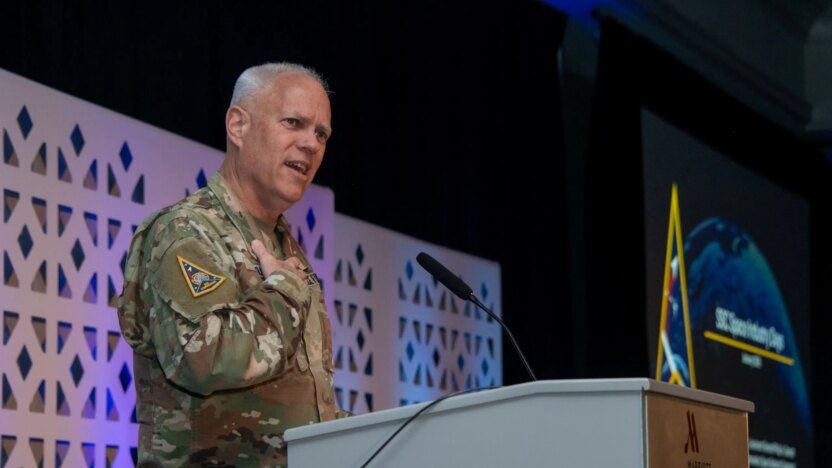
Lt. Gen. Philip Garrant, who leads Space Systems Command, put the issue in plain terms during a speech at the Space Symposium. “The desire for a stronger and clearer demand signal” is a consistent theme in industry feedback, he said, and insisted that the signal has already arrived.
“It’s loud, consistent and unmistakable from every level of our nation’s leadership,” Garrant said, pointing to the budget proposal. The message from the government is that this is not a hypothetical build-up; it is an imminent one.
But the industrial base does not operate on signals alone. It runs on contracts, margins and risk tolerance.
That is where the friction lies. Garrant made clear the Pentagon is preparing to move faster. “We are ready to award and execute at speeds that have never been seen before, but that would be for naught if we aren’t able to produce and deliver at speed and scale,” he said.
To get there, he is asking companies to act ahead of demand. “We’re not just asking you to bid on our programs. We’re asking you to invest in our shared interests, invest in your factories, expand your production lines, upgrade your tooling,” he said.
That is a significant financial leap, and one industry is not eager to take without guarantees. Garrant acknowledged as much. “What we’re asking isn’t easy,” he said. “It requires significant investments and a fundamental change.”
What is emerging is a familiar standoff. Without new capacity, the Pentagon risks bottlenecks as it tries to scale up constellations and supporting infrastructure. Without contracts, companies are unlikely to build that capacity. “Industry says ‘show me the money,’” Garrant said. “We have to get the contracts awarded quickly.”
Complicating matters is a parallel overhaul inside the Pentagon.
The Department of the Air Force is restructuring how it buys space systems, consolidating authority under Portfolio Acquisition Executives. The intent, as described by military acquisition advisor Brig. Gen. Kristin Panzenhagen, is to create a single accountable entity for each mission area, one that can make tradeoffs across programs and accelerate technology adoption. “The PAE is empowered and accountable to deliver capabilities at the speed of relevance,” she said, adding that officials are working with Pentagon leadership “to define the specific budget processes” so those executives have the flexibility to execute.
Conceptually, the model addresses a longstanding criticism of defense acquisition: too many silos, not enough authority to shift resources quickly.
In the near term, however, the transition is introducing uncertainty. Authorities and chains of command are still being defined, and offices are waiting for guidance on roles and responsibilities. The Pentagon is pushing for speed; ambiguity in who controls what could slow decisions at the moment they need to accelerate.
For now, the money is proposed, not appropriated. The acquisition system is being restructured, not yet settled. And the industrial base is being asked to expand on the expectation that contracts will follow.
If those pieces come together, the result could reshape the military space market for a generation. If they do not, the surge in funding risks running into a constraint that has defined the sector in recent years: capacity that cannot keep pace with ambition.
This article first appeared in the May 2026 issue of SpaceNews Magazine.