WASHINGTON — A spacecraft designed to raise the decaying orbit of a NASA astrophysics satellite has passed environmental tests ahead of a launch as soon as June.
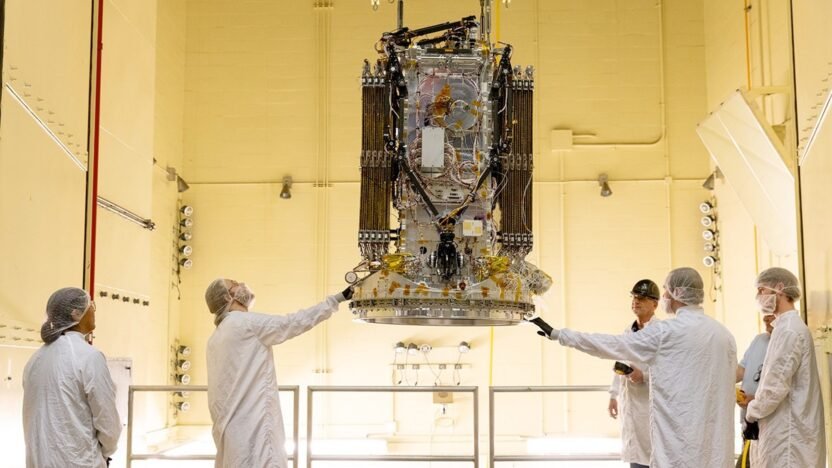
NASA and spacecraft manufacturer Katalyst Space said May 8 that Katalyst’s Link spacecraft successfully completed a series of environmental tests at NASA’s Goddard Space Flight Center.
That work included vibration tests to mimic the environment Link will experience during launch on a Northrop Grumman Pegasus XL rocket. The spacecraft was also tested in a thermal vacuum chamber, including deploying a robotic arm and firing its electric thrusters.
With the tests successfully completed, the spacecraft is now back in a Katalyst facility in Colorado for final prelaunch preparations. It will then be shipped to NASA’s Wallops Flight Facility for integration with the Pegasus rocket in early June, with a launch projected later in the month.
The mission is on a tight schedule to launch in time to reboost NASA’s Neil Gehrels Swift Observatory, a gamma-ray observatory in low Earth orbit. The spacecraft’s orbit is decaying because of atmospheric drag, with reentry expected as soon as late this year.
NASA awarded Katalyst a $30 million contract last September for Link, with the company repurposing a spacecraft originally planned for a demonstration mission to instead grapple Swift and raise its orbit.
That tight schedule required trade-offs. “We’re in an unusual situation where the schedule dictates how much risk we’re willing to accept, rather than the other way around,” Kieran Wilson, Link’s principal investigator at Katalyst, said in a NASA statement. “The clock is ticking on Swift’s descent, so we have to find a balance between testing and problem-solving that gives the mission the best chance of success.”
“The Swift boost attempt is a fast, high-risk, high-reward mission,” said John Van Eepoel, mission director for Swift at NASA Goddard. “Katalyst has gotten to this point in just eight months, and we’re glad they were able to use NASA’s facilities to test Link and draw on our expertise to help tackle questions that popped up along the way.”
Adding to the challenge is that Swift’s orbit was decaying faster than planned. In January, project officials said the spacecraft’s orbit was expected to decay below 300 kilometers, the altitude below which the reboost mission was no longer feasible, between mid-October 2026 and January 2027. Revised models weeks later moved up that milestone to as soon as late May, before Link could launch.
NASA took steps to reconfigure the spacecraft, shutting down most science operations so that the spacecraft could be reoriented to minimize drag. In April, controllers turned off the one instrument that was still operating, the Burst Alert Telescope, to reduce power consumption so that Swift’s arrays could be moved into a position to further reduce drag.
“I would feel really bad if we hadn’t changed the operating mode for Swift,” Shawn Domagal-Goldman, director of NASA’s astrophysics division, said in an April 21 interview, while the environmental tests of Link were in progress. “Because of that, we have enough time for this team to get to the launch pad.”
He said then that should Link make it through those environmental tests, “I will feel really good about that team getting to the launch pad in time to boost Swift.”
He noted, though, that the reboost attempt is high risk, including factors beyond the mission’s control, like the rate Swift’s orbit decays from drag. “It’s a matter of the uncertainty the universe throws our way,” he said. “Even if they do everything right, nature could still throw a curveball and make it not doable.”