
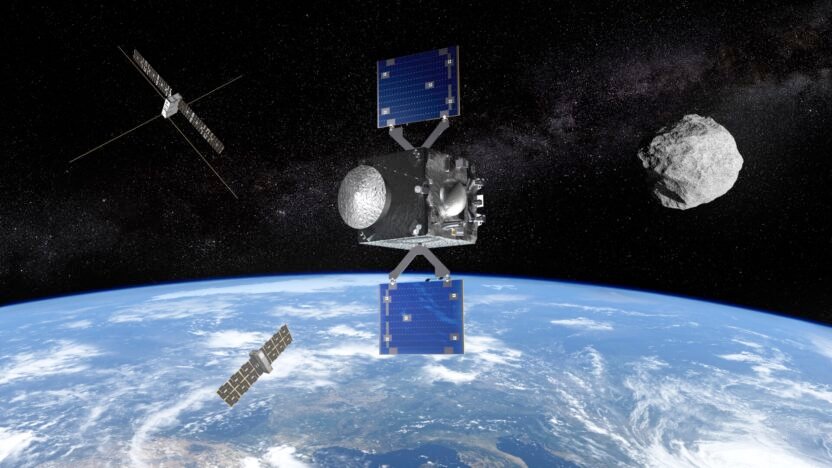
WASHINGTON — The European Space Agency and Japan Aerospace Exploration Agency have finalized an agreement to collaborate on a mission to study the asteroid Apophis during its close flyby of Earth in 2029.
In a May 7 ceremony in Berlin, the heads of ESA and JAXA signed a cooperation agreement for the Rapid Apophis Mission for Space Safety, or Ramses, scheduled to launch in 2028.
Under the agreement, JAXA will provide solar arrays and a thermal infrared imager instrument for Ramses. It will also launch the mission on an H3 rocket in April 2028.
ESA and JAXA announced in November 2024 their intent to collaborate on Ramses, working first to identify potential Japanese contributions to the mission. The agreement came after both agencies secured funding for the mission, including formal adoption of Ramses at ESA’s November 2025 ministerial council meeting.
“With today’s signatures, ESA and JAXA are moving decisively from shared intention to concrete implementation, translating commitment into mission-level cooperation,” ESA Director General Josef Aschbacher said in a statement.
“We sincerely appreciate ESA and its member states, including Italy, and expect this cooperation to further advance international efforts in this field,” said JAXA President Hiroshi Yamakawa. Italian company OHB Italia is the prime contractor for Ramses.
Ramses will arrive at Apophis in February 2029, about two months before the asteroid makes a very close, but safe, approach to Earth, passing as close as 32,000 kilometers from the surface. The close flyby offers a rare opportunity for detailed studies of near Earth asteroids, including how the gravitational effects of the flyby alter the asteroid’s surface.
It is one of several missions proposed or in development to visit Apophis before or after the flyby. NASA’s OSIRIS-APEX, an extension of the OSIRIS-REx asteroid sample return mission, will arrive at Apophis just after the flyby. NASA’s fiscal year 2027 budget proposal offers no funding for the mission, but Congress overrode a similar proposed cancellation in 2026.
Chinese scientists have proposed their own Apophis mission, called CROWN/Apophis, that would send two small spacecraft to the asteroid just after the flyby.
Several other companies and organizations have also offered plans for Apophis missions during the 2029 encounter. That includes ExLabs, which has developed a mission concept that would be supported by revenue from media and sponsorship deals, and Australian space imaging company HEO, which has proposed using a geostationary orbit satellite at the end of its life to fly by the asteroid.