WASHINGTON — White House officials say they will go into a major international conference next year better prepared than ever to defend key radio-frequency spectrum priorities.
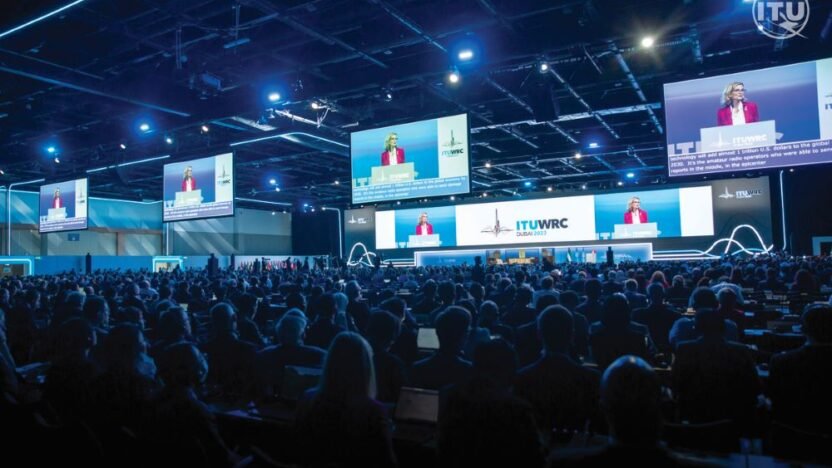
During a panel at the ASCEND conference here May 19, officials said they expect to finalize their positions well ahead of the World Radiocommunication Conference 2027, or WRC-27, which takes place in October and November 2027 in Shanghai.
“This administration is the most serious about winning at WRC than the U.S. has probably ever been,” said Ryan Baasch, deputy director of the National Economic Council. “We will be more prepared for this conference than the U.S. government has ever been, and our north star on this is making sure that U.S. industry is able to thrive in the aftermath of the conference.”
The space industry considers WRC-27 critical because most of the agenda items for the conference deal with space applications of spectrum. Baasch and others on the panel did not discuss specific issues they are considering but emphasized they planned to make clear their stances on them long before the conference starts.
“I think, for the first time, the United States is going to have completed its slate of agenda items and positions well in advance of WRC,” said Charlie Powell, assistant director of space and spectrum at the Office of Science and Technology Policy. “We need to do this well in advance so we can share and champion key U.S. positions with our allies and partners.”
One concern about WRC-27 is the location of the multiweek conference. Some worry that China, as host, may be able to influence national delegations or eavesdrop on their communications.
Powell said the administration was still looking into how it will handle issues such as security and the size of the U.S. delegation, but stressed the importance of participation. “The U.S. government and U.S. industry have a lot to lose if other nations hijack these multilateral fora and tilt standards in a direction against U.S. industry.”
The panel discussion came after a discussion earlier in the day at ASCEND about WRC-27. “Over 80% of the agenda at WRC-27 is directly or indirectly related to NGSO satellite systems,” or non-geostationary orbit constellations, said Alex Epshteyn, head of spectrum architecture and strategy at Amazon Leo.
He said Amazon’s priorities at the conference included securing additional satellite spectrum in V-band and between 17.3 and 17.7 gigahertz. Another priority is revising equivalent power flux density rules to allow NGSO systems to operate at higher power while avoiding interference with satellites in geostationary orbit.
“WRC is very important from a perspective of looking at opening up more spectrum that can be usable for newcomers like us,” said Kim Baum, head of regulatory at Astranis, which produces small GEO satellites. That included an agenda item that would provide more Ku-band uplink spectrum.
While some companies are looking for more spectrum, others are seeking to protect existing spectrum. Danielle Pineres, deputy general counsel at Planet, said her company is concerned about proposals to allow the use of terrestrial mobile services in a portion of X-band used by the company for downlinking imagery, called Earth Exploration-Satellite Service, or EESS.
“We want to ensure that this really critical piece of EESS spectrum is preserved for EESS use, so that we can continue to grow our operations in that band,” she said.
Manny Shar, senior director of growth at Astrolab, a lunar rover developer, said his company is following a WRC-27 agenda item allowing use of certain spectrum bands on the lunar surface. That’s needed, he said, to accommodate the projected growth in lunar missions in the next several years.
He and others emphasized the importance of the WRC even though it can be an arcane process. “It’s a very convoluted process, and it requires strong agreement among the different parties,” he said. However, he added, spectrum “is a finite resource. It’s one of those critical pieces of the technology stack that needs to go right and needs to be considered with as much importance as the technology itself.”