WASHINGTON — The U.S. Space Force is preparing to launch multiple spacecraft to geostationary orbit in 2027 for two separate in-space services demonstrations: one to test satellite refueling and another to test whether a servicing vehicle can dock with and maneuver another spacecraft.
In a space launch mission known as USSF-23, the Space Force will deploy a fuel-transfer spacecraft built by Astroscale U.S., a propellant depot developed by Orbit Fab and a servicing “space tug” from Starfish Space. The spacecraft are intended to demonstrate what the Space Force calls servicing, mobility and logistics — a category of technologies some military leaders see as necessary.
As the military places greater emphasis on maneuverability and survivability in orbit, officials are exploring whether spacecraft can be serviced, repositioned and refueled much like aircraft or ships.
Whether such services become commercially sustainable remains to be seen.
Col. Scott Carstetter, who leads the servicing, mobility and logistics office at Space Systems Command, said his organization has spent the past three years studying whether a viable market could emerge around orbital logistics.
The government has worked with industry to “understand where they stand today, where they see the vision for them in the future, and understand what the business case is for them in these technologies,” Carstetter told reporters May 20. The key question, he said, is whether these services ultimately become commercially provided capabilities “or if the government is going to have to be the leader in some of these areas.”
To help answer these questions, Carstetter’s office to date has funded two demonstrations.
Demonstration of in-space refueling
One of those demonstrations would be the first commercial in-space refueling of a U.S. Space Force asset.
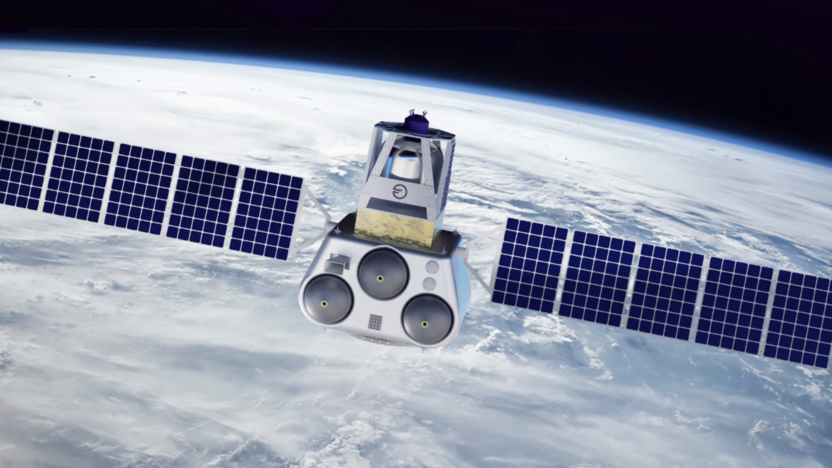
Astroscale’s spacecraft, called Provisioner, is a roughly 300-kilogram vehicle equipped with a refillable hydrazine tank designed to transfer fuel to satellites in orbit. The spacecraft was developed under a September 2023 Space Force agreement that included $25.5 million in government funding alongside roughly $12 million from Astroscale.
Provisioner will attempt to refuel two client satellites known as Tetra-5, which are being developed under a separate program run by the Air Force Research Laboratory. The servicing vehicle would then replenish its own fuel supply from an Orbit Fab depot built on an Impulse Space hosting platform. Orbit Fab developed the depot under a $13.3 million contract awarded by the Defense Innovation Unit in 2022.
“Once we launch all these vehicles, the servicer is going to first mate with the AFRL client, the Tetra-5 vehicle, and refuel it. Then go back to the depot, get more fuel, and then go back and mate with the other Tetra-5 again to refuel,” Carstetter said. The objective, he added, is to understand “how that architecture could work.”
Demonstration of ‘augmented maneuver’
USSF-23 also includes a separate experiment involving Starfish Space’s Otter servicing vehicle, a small autonomous spacecraft designed to dock with and maneuver satellites in orbit.
Otter is intended to dock with an “unprepared” satellite that was not originally designed for servicing.
The Space Force wants to use the vehicle to test what officials call “augmented maneuver” — effectively adding propulsion and mobility capability to satellites that may have limited fuel reserves or maneuvering capability of their own.
“This will be a two-year demonstration docking with a non-operational vehicle that will be moved to a disposable orbit,” Carstetter said. If successful, he said, the same concept could later be used for life-extension missions involving operational spacecraft.
A $37.5 million contract for the demonstration was awarded to Starfish in May 2024 under a cost-sharing agreement paired with roughly $30 million in private capital. Earlier this year, the Space Force awarded Starfish another $54.5 million contract for an operational mission funded through the Pentagon’s APFIT initiative, which is designed to accelerate procurement of emerging technologies.
That operational mission, expected to launch in 2028, would involve augmented maneuver operations for multiple satellites.
Plans to use commercial services
Beyond funding demonstration missions, the Space Force is intends to tap commercial servicing systems such as the Mission Robotic Vehicle, or MRV, built by Northrop Grumman in partnership with DARPA. The spacecraft is designed to dock with and extend the life of satellites in geostationary orbit using robotic arms developed by the U.S. Naval Research Laboratory.
After the MRV launches this summer, “we’ll be looking to set up some level of contracting that we’ll be able to access those resources while they’re on orbit if the need arises,” Carstetter said.
“We’re actually going to be one of the customer partners on the DARPA MRV vehicle once it’s operational,” he said, “so that when there are users that do need that service, they will work through us in order to actually solicit that service through Northrop Grumman.”
‘Orbital Logistics’ industry challenge
The Space Force, meanwhile, is attempting to broaden the supplier base around orbital logistics.
Carstetter said the service is supporting a new $20 million SpaceWERX initiative known as the In-Domain Orbital Logistics Challenge, which will issue an open solicitation this summer for Small Business Innovation Research proposals.
“The evolving strategic environment in space is driving the need for an in-domain logistics capability that delivers bulk and retail propellant, spares, inspection, and repair at forward orbital nodes to support in-space maneuver warfare,” Carstetter said.
The program is expected to include design sprints, tabletop exercises and prototype demonstrations.