HELSINKI — Three Chinese astronauts arrived at Tiangong space station Sunday, with one crewmember expected to become China’s first to stay in orbit for an entire year.
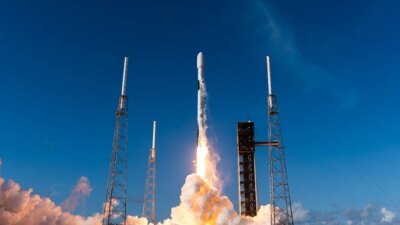
The Long March 2F rocket carrying the Shenzhou-23 spacecraft lifted off at 11:08 a.m. Eastern (1508 UTC; 11:08 p.m. Beijing time) May 24 from the Jiuquan Satellite Launch Center in the Gobi Desert.
The trio aboard were commander Zhu Yangzhu and astronauts Zhang Zhiyuan and Lai Ka-ying. Lai, a payload specialist formerly of the Hong Kong police force, is the first astronaut from Hong Kong to reach orbit. Zhu is a veteran of the 2023 Shenzhou-16 mission, while Zhang formerly served as a fighter pilot in the Chinese People’s Liberation Army (PLA) Air Force.
One of Zhu or Zhang is expected to complete a continuous year in orbit, marking a first for Chinese human spaceflight. The China Manned Space Engineering Office (CMSEO) confirmed the plan during a press conference May 23 without confirming which astronaut would undertake the endeavor.
The move means one of two Pakistani astronaut candidates currently being trained in Beijing will fly to Tiangong on Shenzhou-24 late in the year, spend a few days aboard the space station, then take the seat of one of Zhu or Zhang in Shenzhou-23 for the journey home. It will be the first visit of an international astronaut to the three-module Tiangong space station, which was completed in late 2022.
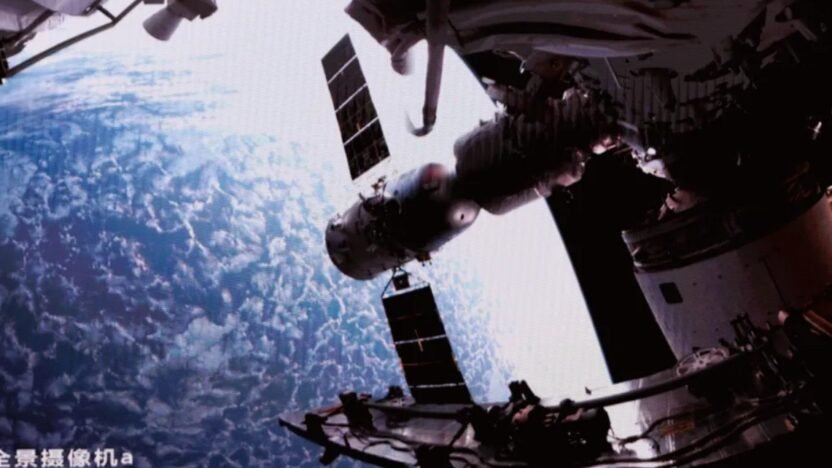
Shenzhou-23 docked with the Tianhe core module’s radial port just over 3.5 hours after launch, at 2:45 p.m Eastern (1845 UTC), according to CMSEO. Zhu and his crewmates will be welcomed aboard Tiangong by the Shenzhou-21 crew— Zhang Lu, Zhang Hongzhang and Wu Fei—who will hand over control of the station in the coming days and return to Earth May 29.
The outgoing Shenzhou-21 crew will, notably, return to Earth aboard Shenzhou-22; an uncrewed lifeboat launched for the crew as a result of suspected debris damage to the viewport window of the Shenzhou-20 spacecraft. The emergency situation required the outgoing Shenzhou-20 crew to return to Earth on Shenzhou-21, prompting the emergency launch of Shenzhou-22. The arrival of Shenzhou-22 also brought fresh supplies, allowing the Shenzhou-21 crew to stay an extra month in orbit beyond the usual six-month-long duration of a Shenzhou mission to Tiangong.
The incident has brought changes to the Shenzhou-23 spacecraft. The viewport window formerly had one layer of anti-ablation glass, He Yu, an official with CASC, told China Central Television (CCTV), but Shenzhou-23 has a total of three layers, with an extra layer added to both inside and outside of the window.
The Shenzhou-23 mission will see the crew conduct a range of experiments in fields including life in space, medicine, human physiology, microgravity physics and new technologies. These include experiments related to lipid metabolism in liver cells, rice plant life cycles and testing two types of perovskite solar cell materials. The crew will also perform multiple extravehicular activities, as well as carrying out the installation, commissioning, maintenance and repair of equipment both inside and outside Tiangong.
China’s human spaceflight plans
CMSEO’s press conference May 23 also provided a few details regarding China’s future human and lunar spaceflight plans, with the country aiming to put two astronauts on the moon before 2030.
Zhang Jingbo, an agency spokesperson, said the Tiangong space station provides support for crewed lunar exploration in three main ways. The first is providing extensive spaceflight experience, while the second includes deploying and verifying a series of key technologies for crewed lunar landings, such as a microgravity environment surface tension tank liquid sloshing test for lunar landing-related spacecraft, which was launched on the recent Tianzhou-10 robotic resupply mission.
The third is that the new Long March 10A rocket and the Mengzhou crew spacecraft will undergo a series of flights to Tiangong over the next two years to validate these technologies needed for the crewed lunar landings. The full, common booster core Long March 10 will launch the Mengzhou and Lanyue lander stack for lunar landing missions.
Zhang added that China will, going forward, complete key test flights of the Long March 10 rocket, Mengzhou spacecraft, and Lanyue lander. He did not offer a timeline for these missions. NASA Administrator Jared Isaacman said earlier in the week that he expects a Chinese crewed mission around the moon in 2027.
Zhang also stated that the Chang’e-7 spacecraft, delivered to Wenchang spaceport in April, is undergoing pre-launch testing and preparations. All work is progressing smoothly according to plan, with launch scheduled for the second half of the year, Zhang said. CMSEO is now overseeing lunar exploration, with the robotic and human spaceflight aspects of lunar exploration being merged under the agency’s control.
Chang’e-7 will attempt a landing near the lunar south pole, with the mission to include an orbiter, lander, rover and an ice-hunting mini flying probe. The mission is a precursor to a planned International Lunar Research Station (ILRS).