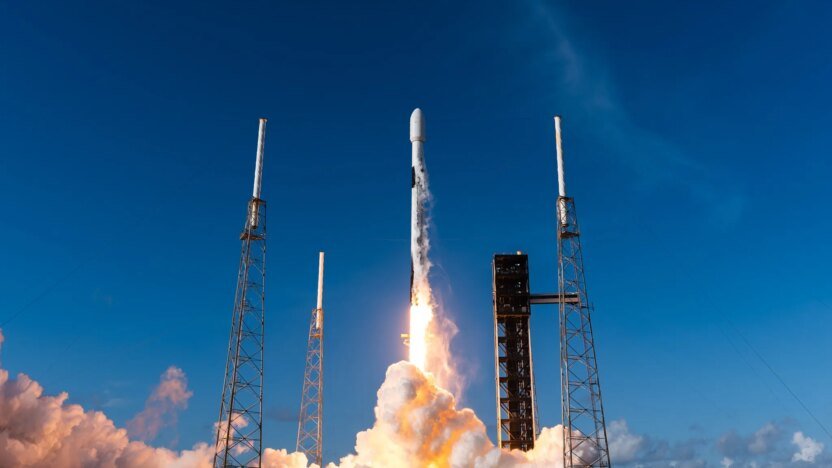
AMSTERDAM — Two companies best known for brokering payload space on SpaceX rideshare launches have each purchased Falcon 9 launches to meet the growing demand for such missions.
In separate announcements May 26 during the SmallSat Europe conference, Germany-based Exolaunch announced it purchased two Falcon 9 launches, while U.S.-based SEOPS announced it purchased one Falcon 9 launch, all for carrying rideshare payloads.
Exolaunch said its Exo-1 and Exo-2 missions are scheduled for launch no earlier than late 2027 and 2028, respectively, while SEOPS is planning a launch of its Waymaker-1 mission in the third quarter of 2028.
The missions are the first time the companies, which have long sold space on and handled payload integration for SpaceX’s own rideshare missions, have purchased dedicated launches for rideshare payloads to low Earth orbit. SEOPS purchased a Falcon 9 launch in late 2024 for a dedicated rideshare mission to geostationary transfer orbit, called Darkstar-1, scheduled for 2028.
Both companies emphasized the high demand for rideshare missions. SpaceX’s Transporter series of missions to sun-synchronous orbit and Bandwagon missions to mid-inclination orbits have been popular among smallsat developers, ranging from organizations seeking to launch individual satellites to companies deploying constellations.
“Waymaker missions act as a relief valve for the growing LEO rideshare market,” said Chad Brinkley, chief executive of SEOPS. “Waymaker and Darkstar rideshare missions give customers more opportunities and certainty that their spacecraft can launch when they want.”
“Demand for reliable and scalable access to space continues to accelerate,” said Kier Fortier, chief revenue officer of Exolaunch. “The Exo-1 and Exo-2 missions will help address the launch needs of the market.”
The companies are bringing their experience working on SpaceX rideshare missions to their own dedicated launches. Exolaunch noted it will use its EXOtube modular payload stacks and separation system to accommodate payloads ranging from 20 to 1,400 kilograms, along with its own cubesat deployers.
SEOPS is working with Maverick Space Systems for the Waymaker mission, accommodating payloads from cubesats to large “cake topper” spacecraft on the top of the stack. SEOPS is also offering space safety services, such as payload identification and collision warnings, for two months after deployment through a partnership with Indian company Digantara.
SEOPS has already sold some capacity on Waymaker-1 to unspecified commercial and U.S. government customers. French launch integrator RIDE! Space also purchased 1,000 kilograms of space on the mission for European customers. The company added it still has space available on its Darkstar-1 GTO mission but that it is seeing “early and growing interest,” particularly from international customers.
Both companies emphasized that, with their own dedicated rideshare missions, they are providing schedule assurance for customers finding it difficult to get on SpaceX launches. SpaceX’s rideshare missions are booked far in advance, and the company noted at the Small Satellite Conference in Utah last August that it has customers manifested on rideshare missions through the end of 2028.
“With Exo-1 and Exo-2, our customers will have predictable and reliable launch opportunities enabled by Exolaunch,” said Jeanne Allarie, the company’s chief investor relations officer.
“Programs such as Waymaker and Darkstar are designed to deliver rideshare capacity in the face of rapidly increasing demand,” said Evan Hoyt, executive vice president of SEOPS.
It also comes amid uncertainty about the long-term future of SpaceX’s own Falcon 9 rideshare programs as the company begins a transition to its Starship vehicle. While SpaceX says it has customers booked on rideshare missions through 2028, its rideshare website lists launch opportunities only through the end of 2027, all of which are fully booked.
At the Small Satellite Conference last August, Ronnie Foreman, SpaceX’s senior sales manager for rideshare, hinted that SpaceX was planning a similar rideshare program using Starship, noting it would likely eclipse the company’s record of 143 satellites on a single launch. The company, though, has not yet formally announced a Starship rideshare program.