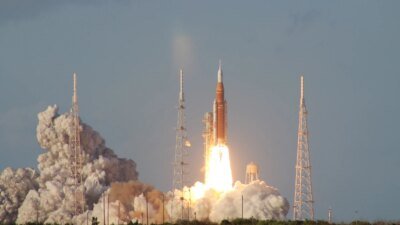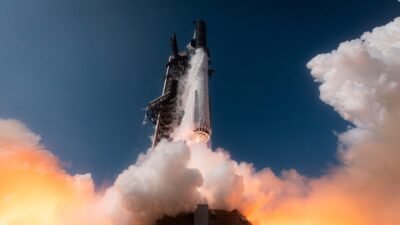
In November, Starcloud sent a small satellite called Starcloud-1 into orbit via a SpaceX launch. The 60-kilogram spacecraft was the first to carry a compute system with an NVIDIA H100 GPU.
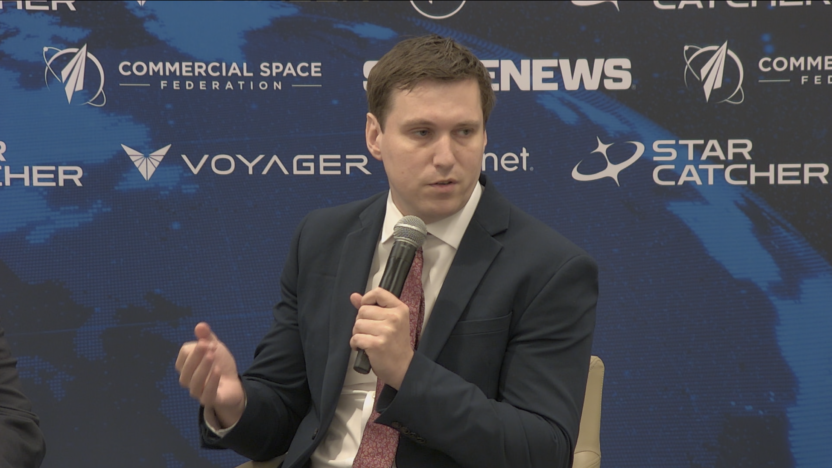
“It’s about 100 times more powerful than any GPU that has been in space before,” said Philip Johnston, Starcloud cofounder and CEO, at the SpaceNews Opportunities for On-Orbit Computing event held in Washington, D.C. earlier this spring. “With that, we were the first to train a model in space, the first to do high-powered inference on SAR data, the first to run a version of Gemini. And so we have an enormous amount of telemetry now on how those high-powered GPUs operate [in space].”
During an interview with SpaceNews senior staff writer Jeff Foust, Johnston discussed Starcloud’s near-term launch plans, the technical challenges of orbital computing and the company’s long-term vision. The interview has been edited for length and clarity.
Jeff Foust: Can you briefly explain the work Starcloud is doing in the orbital datacenter space?
Philip Johnston: Starcloud is building orbital datacenters — initially to provide cloud and edge services for other spacecraft, and eventually to compete with terrestrial datacenters on energy costs and address the AI energy bottleneck.
In eight months, we’re launching our second spacecraft, Starcloud-2, which is an 8-kilowatt spacecraft. Then, the ambition is to scale up to a constellation of 88,000 three-ton 200-kilowatt spacecraft. That will enable us to deploy about 20 gigawatts of new compute.
What’s the roadmap to get to that 88,000 number?
The 88,000 is very dependent on [SpaceX’s] Starship flying frequently. We’re probably looking at the end of this year or early next year for their first Starlink V3 deployments. Then I would imagine another 18 to 24 months before the first commercial customer payloads [such as Starcloud satellites] — so, probably 2029 or 2030.
In the interim, we’ll be sending a few versions of these Starcloud-2 satellites up. Even Starcloud-2 right now will pay for itself with the contracts we’ve signed to provide cloud and edge services.
Where are you seeing the demand? Is it going to be from major AI companies, or more specialized applications?
In the early days, it’s definitely going to be the specialized applications. That’s particularly processing of Earth observation data, and anything that you would rather do on the edge. That’s a much higher-value workload, and you can charge on the order of 100 times or even 1,000 times, in terms of dollars per GPU hour, for that type of processing.
Over time, we really are aiming to compete with all terrestrial datacenters on energy cost. We’re not going to be training any models in space anytime soon, because that requires docking together a large structure. Also, training is only going to be sub-1% of all AI workloads in five years, so it’s not even a great market to go after. Essentially, anybody that wants power and infrastructure at a lower cost base than anything terrestrially, we will be the provider of that.
So, you see yourself as eventually at least being competitive with terrestrial datacenters on a cost per compute basis?
Yes, once Starship is below around $500 per kilo. We will still have a higher cost base than SpaceX, but we will have a lower cost base than all of the hyperscalers. The workload that we’re expecting to run on that is all inference workloads that don’t require sub-50 millisecond latency. So, that’s code generation tasks or back-office business processing agents, or customer service workloads — everything like that.
Is that more about orbital datacenter costs coming down, or terrestrial costs going up?
They’re both trending towards each other. Even if you assume that the terrestrial cost doesn’t go up — which I think it almost certainly will — there’s still a point in the next five years where the cost of doing this in space is cheaper than terrestrially.
What are the key challenges you see in terms of deploying the system, supply chain bottlenecks, and the regulatory process?
The core work of our company right now is focused on the technical challenges. There are two big pieces of engineering that we’re working on. Number one is a very large, low-cost and low-mass deployable radiator. We’ve got that designed and mocked up and in testing now. It’s around 10 times lower mass per watt of dissipation than the ISS radiator, and around 100 times lower cost per watt of dissipation than the ISS radiator. We’ll be launching that in eight months, and so getting through that technical proof point will be a huge milestone.
The second piece of it is making the chips work in a higher radiation environment, and that’s really just a lot of ground testing at this stage. We’ve done three rounds of testing at a cyclotron facility in Knoxville for high-velocity protons, we did one round of testing in the Brookhaven National Lab for heavy ions, and then we use all of that data to inform our choice on shielding and software for the chips.
The FCC is being incredibly supportive and helpful with the application. The supply chain is not an issue yet, because we’re not really at a scale where it would be an issue, but certainly towards the end of the decade as we ramp up, that will be something to think about.
How are you laying the groundwork to produce these satellites in large volumes?
The most significant partnership we have on that front is with NVIDIA. We’re working with them on what they’re calling the [Space-1 Vera Rubin Module]. It’s a chip that’s optimized for mass, thermal and radiation, and we’re working with their ruggedization team on that.
Have you had discussions yet with potential customers?
In these early days, we’re working with various Department of Defense entities on providing them with cloud and edge services, but it’s a much smaller market. We signed an enormous agreement with Crusoe — they’re the people building the datacenter for OpenAI — to provide them with 10 gigawatts of power from the early 2030s onwards. If you can provide energy and infrastructure at a competitive price, there’s no shortage of hyperscalers that want that.
Calvin Hennick also contributed to this article.