AMSTERDAM — A senior German military official said Europe needs a coordinated approach to military space operations and proposed the creation of a European Space Component Command hosted by Germany and open to allied participation.
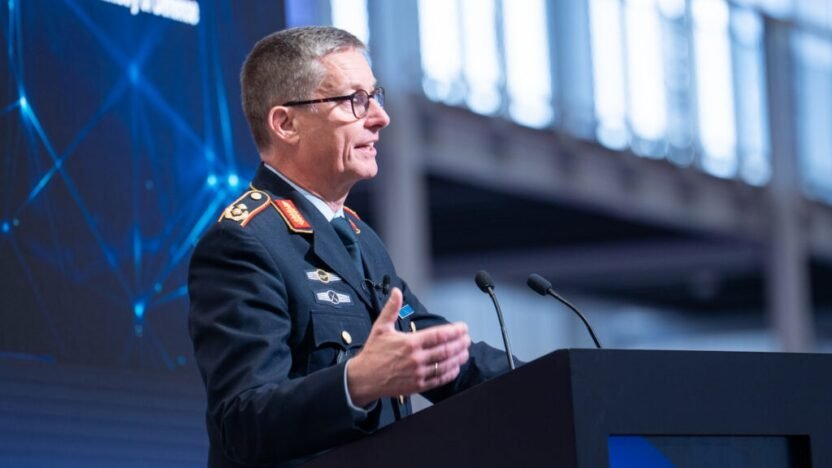
Maj. Gen. Wolfgang Ohl, speaking Tuesday at the SmallSat Europe conference in Amsterdam, said Germany has proposed the idea of a European Space Component Command.
“Right now, everybody is doing their own thing,” Ohl said. “ And there is nobody — not even NATO — coordinating efforts to ensure that three countries are not developing the same capabilities.”
Boris Pistorius, Germany’s defense minister, first announced the proposal during a four-nation meeting of German-speaking defense chiefs last week in Vienna. Pistorius called on countries including Austria, Switzerland and Luxembourg to help shape the initiative rather than simply join it.
Ohl said the idea remains in a preliminary phase and consists of open discussions among Germany and neighboring countries on how such an alliance could be structured, coordinated and what capabilities it should include.
“We are interested in understanding what other countries expect and whether they are willing to contribute,” Ohl told SpaceNews. “Where can Germany help? Are there any gaps that should be filled?”
The announcement comes six months after Germany unveiled a 35 billion euro ($40 billion) investment package to accelerate the development of its defense space sector. The funding also includes the development of the country’s planned 100-satellite national constellation, SatcomBW 4.
Germany had already outlined its ambitions in the Bundesregierung’s “Space Safety and Security Strategy” document, which stated that, “as the largest economy in the EU,” Germany intends to play a “leading role in the development of a European space safety and security architecture.” The document adds that the objective “is to establish a European space safety and security architecture that effectively integrates the space capabilities of the member states and avoids redundancies.”
Pistorius’ recent announcement reinforces a broader German-led, pan-European strategic vision that Berlin had already outlined months earlier.
“What we should do is align the buildup of capabilities across European countries,” Ohl added. “For example, we could pool resources for space situational awareness in order to build a better overall picture. Some countries are collecting data with sensors, but nobody is fusing that information to improve the common picture.”
“The second important goal is to avoid duplication and capability gaps — for example, ending up with three satcom constellations on one hand, but no launch capability on the other.”
Brigadier General Jürgen Schrödl, Chief Division MEO III for the German Federal Ministry of Defence confirmed that the proposal is “a very strong sign that we have to move forward on the European side” and also that Germany, with its leading investments and as main contributor to ESA, has the possibility now to actually move things faster.
“It’s clear that the nations bringing the most to the table will also want to contribute ideas and help shape the discussion. Then, especially on the military side, those ideas have to be discussed politically.”
A German leadership for a European entity?
Germany’s decision to step forward and initiate coordination in the space domain could also reflect the broader fragility of Europe in rapidly coordinating critical infrastructure at a continental level.
“I don’t think it’s fragility,” Schrödl added. “It’s an openness to bring other players together, and our kind of leadership is not a nationally driven leadership. It is a leadership that brings countries together to discuss what is best for the Union. Our idea of leadership is driven by Europe, by the European Union and by multilateral organizations.”
Germany taking such a forward role could nevertheless meet resistance from France, Europe’s second-largest space power.
Nicolas Moulin-Fournier, chief product officer at French startup Look Up Space, said the proposal could provide a framework for multinational coordination efforts.
“I think the French military forces already have a complete set of assets, from telecom to military systems, and there is definitely deep expertise within the French armed forces,” Moulin-Fournier said. “However, I also think that no single country in Europe is strong enough or large enough on its own, so collaboration is definitely necessary.
“It makes sense to split efforts, coordinate, work together and share information. Under which leadership, I don’t know.”