DUBLIN — The explosion of a New Glenn rocket has generated reverberations across the space industry as companies and government agencies address the loss of access to the vehicle for potentially a year or more.
Blue Origin has provided few details about the May 28 incident in which a New Glenn rocket exploded at Cape Canaveral’s Launch Complex 36 during a static-fire test. The rocket was being prepared for the NG-4 launch in early June, carrying 48 Amazon Leo satellites.
Photos of the launch site taken May 29 show extensive damage to the pad and related infrastructure. One lightning tower at the pad collapsed, and the rocket’s transporter-erector was destroyed. The main launch tower was still standing but was damaged, including bent metal beams.
“We have regained some access to Launch Complex 36 and are actively investigating the hotfire anomaly,” Dave Limp, chief executive of Blue Origin, said in a May 30 social media post. “We will start clearing the pad soon and have a good rebuild plan in place.”
The company has not disclosed what that rebuild plan is or how long it will take. When a Falcon 9 exploded at Space Launch Complex 40 during preparations for a static-fire test in September 2016, it took the company 15 months to rebuild the pad.
Kiko Donchev, vice president of launch at SpaceX, did not comment on the timeline for rebuilding the pad in a May 31 post, but noted that simply cleaning up the pad can be difficult.
“In the initial days and weeks, you’re using a scalpel, not a bulldozer,” he said, to both preserve evidence needed for the accident investigation and save components not damaged by the explosion. “Cleanup has to be done with a sense of urgency, but extreme precision. It’s literally launch pad surgery.”
With no other pads available for New Glenn, some in the industry believe it could be at least a year before the rocket can launch again, no matter how quickly Blue Origin completes its investigation into the explosion.
That affects many Blue Origin customers, including NASA. The agency had, just two days before the explosion, awarded the company contracts for two Blue Moon Mark 1 lander missions, launching on New Glenn, to deliver lunar rovers being developed by Astrolab and Lunar Outpost. NASA is flying payloads on four Mark 1 landers, with the first previously scheduled to launch later this year, while also supporting work on the Mark 2 lander for crewed landings.
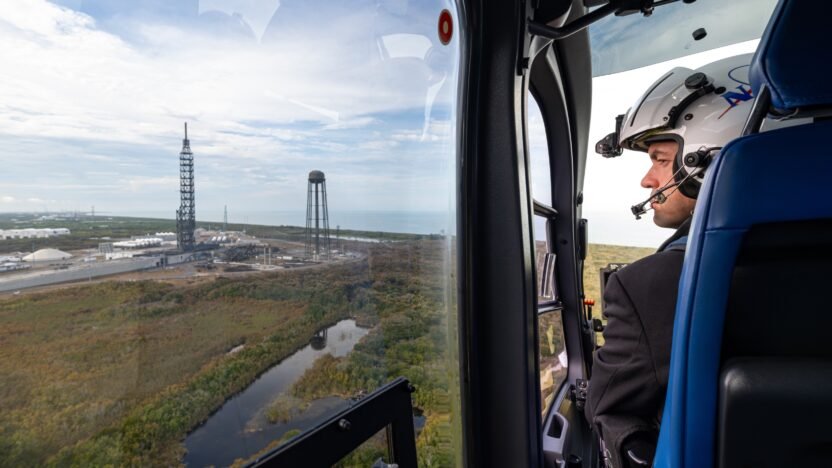
The day after the explosion, NASA Administrator Jared Isaacman toured the launch pad from the air and met with company employees, along with Limp and company founder Jeff Bezos.
He said the agency would take a hands-on approach. “NASA is committed to helping the Blue team recover, continue to advance their lunar lander and get New Glenn back to launching as soon as safely possible,” he said in a May 29 post.
The failure affects other customers. The rocket that exploded was to be the first of 24 launches currently under contract with Amazon. With each launch carrying at least 48 satellites, New Glenn is set to deploy more than a third of the total Amazon Leo constellation of 3,232 satellites, an effort already well behind schedule.
AST SpaceMobile, despite losing its BlueBird 7 satellite on the NG-3 launch in April, was also relying heavily on New Glenn to launch its direct-to-device satellites. Each New Glenn launch can carry up to eight satellites, versus three on a Falcon 9, and was essential to meet the company’s goal of having 45 satellites in orbit by the end of the year.
AST SpaceMobile has not commented on the New Glenn accident, but shares in the company fell nearly 15% in trading May 29.
The company said in a May 11 earnings call that it was considering launching satellites on United Launch Alliance’s Vulcan, which could carry up to five satellites on each launch. However, the company has not announced a launch contract with ULA, and Vulcan has not launched since February on a Space Force mission in which one of the vehicle’s solid rocket boosters suffered an anomaly. Vulcan also has a large backlog of Amazon Leo and Space Force missions.
“Heading towards a rough spot”
The New Glenn failure exacerbates a constrained launch market in which demand for launch has far outstripped supply, with little capacity among existing launch operators for the next few years. That has led to price increases for everything from dedicated launches to rideshare missions.
Even the expected arrival of SpaceX’s Starship is unlikely to change those economics.
“There’s this narrative in industry that Starship is going to dramatically drop the price of launch in the near term. I think that narrative is incorrect,” said Eric Romo, president of orbital transfer vehicle company Impulse Space, during a session of the ASCEND conference May 20.
He said he expected Starship to be primarily used by SpaceX itself initially for launching next-generation Starlink satellites and orbital data center spacecraft, along with supporting NASA’s Human Landing System program. “It’s hard to imagine that being a large part of the mix of commercial space launch in the short term,” he said of Starship.
Moreover, SpaceX will start to shift launches from Falcon 9 to Starship, reducing the Falcon 9 launch rate and effectively increasing the per-launch cost of the vehicle, he noted.
While other companies are developing medium-class and larger launch vehicles, he said it may take several years for them to get them flying at a high cadence.
“I think we’re heading towards a rough spot in 2029 and 2030,” he concluded. “I think it’s going to be a really challenging time for launch.”