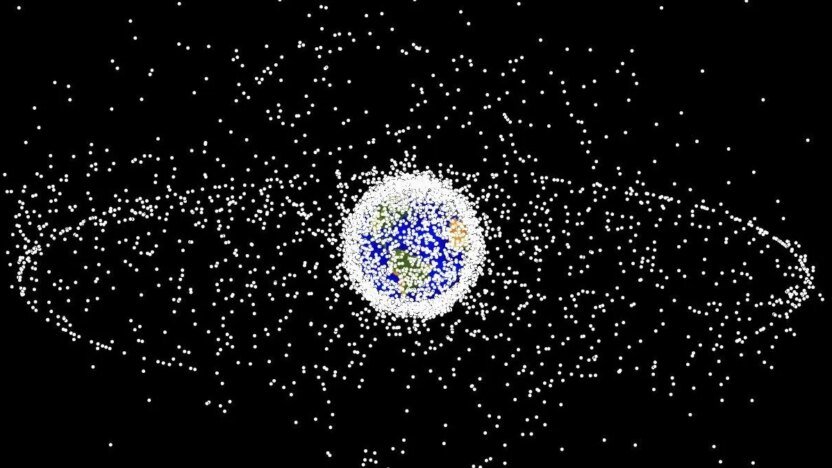
The rapid expansion of human and robotic activity in low Earth orbit makes critically important the need to implement effective space traffic management (STM). This will be one of the most crucial engineering and policy challenges of the 21st century. The emergence of massive communications constellations, orbiting data centers, inhabited space stations and increasing quantities of space debris has intensified orbital congestion and collision risks throughout low Earth orbit (LEO). As a result, determining an “equilibrium state” for STM has become essential for ensuring the long-term sustainability, safety and economic viability of space operations. In this context, equilibrium refers to a dynamically stable orbital environment in which spacecraft launches, operational lifetimes, debris generation and disposal rates remain balanced so that collision probabilities and long-term orbital degradation are minimized.
Earth orbit is a finite environmental resource governed by the laws of orbital mechanics. Unlike terrestrial transportation systems, satellites travel at velocities in excess of seven kilometers per second, meaning that even small debris fragments can cause catastrophic destruction. The growing population of spacecraft significantly increases the probability of conjunction events and accidental collisions. Large communications constellations designed to provide global broadband coverage already involve thousands of satellites operating within narrow altitude bands. Proposed orbiting data centers, which may require large solar arrays and thermal radiators, will further increase congestion because of their large physical size and extended operational lifetimes. Inhabited space stations add another dimension of risk because human safety becomes directly dependent on maintaining a stable orbital environment.
The orbital environment can be modeled as a “source-sink” system. Sources include satellite launches, fragmentation events, anti-satellite tests and accidental collisions. Sinks include controlled deorbiting, orbital decay and active debris removal operations. Equilibrium occurs when the rate at which hazardous objects are added to orbit approximately equals the rate at which they are safely removed. If the rate of debris generation exceeds the rate of debris elimination, orbital instability will progressively worsen over time. Determining orbital carrying capacity through advanced modeling and simulation has consequently become a major focus of modern STM research.
A major source of debris production and orbital congestion is the large number of active and expired satellites within Sun-synchronous orbits (SSO). Over the past 60+ years these orbits have been populated with spacecraft used for Earth observation, reconnaissance and environmental monitoring applications. SSOs are highly attractive because they allow satellites to pass over Earth at consistent local solar times, producing uniform lighting conditions for imaging systems. As a result, government and commercial spacecraft have become heavily concentrated within relatively narrow altitude ranges between approximately 500 and 900 kilometers. Unfortunately, these same regions also contain high concentrations of long-lived debris because atmospheric drag forces barely exist at such altitudes. The combination of dense traffic and persistent debris creates elevated conjunction frequencies and increased collision risks. The continued use and growing SSO population contribute significantly to orbital congestion, because failed and inactive satellites will likely remain in orbit for decades, acting as permanent hazards to operational systems.
The introduction of large orbital infrastructures such as data centers into SSOs and other orbits will further destabilize the environment if not carefully regulated. Consequently, future STM systems must incorporate real-time orbital density monitoring, autonomous collision avoidance, mandatory post-mission disposal requirement and active debris remediation systems.
The concept of space equilibrium is similar to the problem of environmental control of ecological systems. A forest, river or fishery can support only a certain level of activity before environmental degradation becomes irreversible. Earth orbit sustainability presents similar challenges. For example, orbital shells contain finite physical volume, finite maneuvering margins and finite collision-avoidance capacity. If the density of orbiting objects exceeds sustainable limits, conjunction events increase, collision probabilities rise and debris generation accelerates.
More than one hundred million debris fragments are believed to already exist in orbit, with only a small fraction large enough to be continuously tracked. Even millimeter-scale particles possess destructive kinetic energy because of extreme orbital velocities.
In practical engineering terms, determining orbital equilibrium will require the continuous measurement of several key variables, including the number of active satellites within each orbital shell, characteristics of trackable debris objects, conjunction frequencies, maneuver operations, atmospheric drag conditions, solar activity and post-mission disposal activities.
Simply put, “equilibrium” is achieved when the hazardous object population remains statistically stable over time, rather than growing uncontrollably. However, orbital equilibrium is far more complex because conditions vary across altitude bands and orbital inclinations. Some orbital regions are naturally self-cleaning due to atmospheric drag, while others, such as SSOs, retain debris for centuries.
A realistic STM equilibrium framework might require continuous tracking of orbital capacity within specific orbital shells. This is conceptually similar to air traffic control sectors that limit the number of aircraft operating within a defined airspace volume. In a future STM system each orbital shell could have a dynamically calculated carrying-capacity threshold based on factors such as collision probability, maneuver capability, debris density and tracking uncertainty. Once traffic density approaches unsafe thresholds, the STM authority might restrict additional spacecraft deployments or require enhanced disposal guarantees.
There is little doubt that artificial intelligence will play a critical role in maintaining orbital equilibrium. Human operators cannot manually process the millions of conjunction calculations expected in future mega-constellation environments. AI-driven STM systems may continuously evaluate traffic patterns, predict future congestion trends, optimize maneuver timing and coordinate autonomous collision avoidance between spacecraft operators. Think of these systems as the orbital equivalent of terrestrial autonomous air traffic management networks.
A yet-to-be defined STM authority will likely be responsible for maintaining orbital equilibrium. Today, no single international authority possesses comprehensive regulatory authority over Earth orbit. The responsibility is fragmented among national licensing agencies, military organizations, commercial operators and international treaty frameworks. National governments would likely retain responsibility for licensing and regulating spacecraft launched under their jurisdiction. Logically, future STM management may resemble international maritime governance. This would be a globally coordinated authority that establishes orbital zoning standards, debris mitigation requirements, mandatory maneuver coordination protocols and orbital carrying-capacity thresholds. The implications are complex. For example, commercial operators would likely be required to share real-time ephemeris data and participate in coordinated conjunction resolution systems. And, operators deploying very large constellations or orbital infrastructures such as data centers might be required to fund active debris removal programs proportional to their orbital footprint.
Marshall H. Kaplan, PhD, is CEO of Launchspace Services, an educational and consulting firm. He has been conducting research on orbital debris technologies since 1970.
SpaceNews is committed to publishing our community’s diverse perspectives. Whether you’re an academic, executive, engineer or even just a concerned citizen of the cosmos, send your arguments and viewpoints to opinion (at) spacenews.com to be considered for publication online or in our next magazine. If you have something to submit, read some of our recent opinion articles and our submission guidelines to get a sense of what we’re looking for. The perspectives shared in these opinion articles are solely those of the authors and do not necessarily represent their employers or professional affiliations.