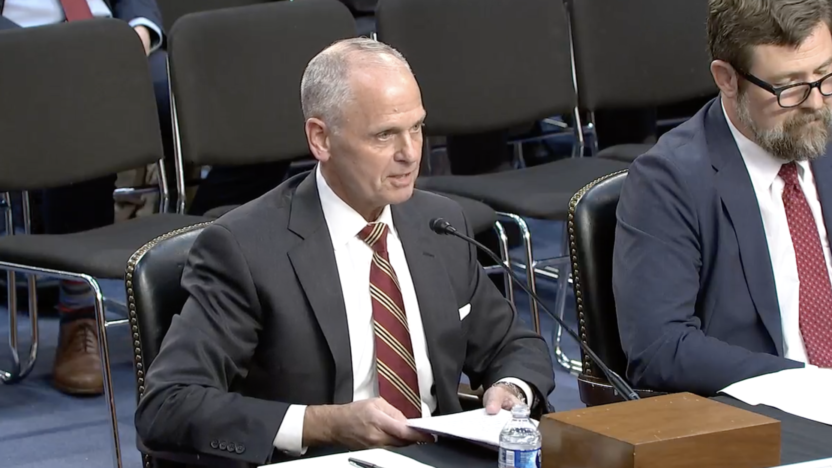
WASHINGTON — Roger Mason, President Trump’s nominee to lead the National Reconnaissance Office, told senators that the nation’s spy satellite agency is navigating a period of rapid innovation in commercial space and artificial intelligence that is transforming space-based intelligence.
Appearing June 2 before the Senate Intelligence Committee for his confirmation hearing, Mason described the National Reconnaissance Office, or NRO, as being in the midst of a transformation driven by commercial innovation, growing volumes of intelligence data and increasing threats to U.S. assets in space.
“We are in a space renaissance where the pace of technology advancement, speed of innovation and promise of the future has drawn unprecedented investments,” Mason said.
Mason, currently chief growth officer at V2X Corp., would succeed Christopher Scolese, who has led the NRO since 2019.
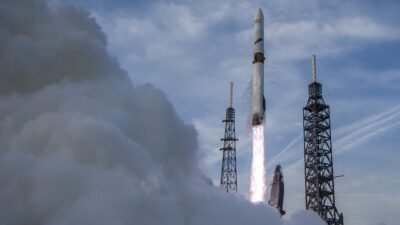
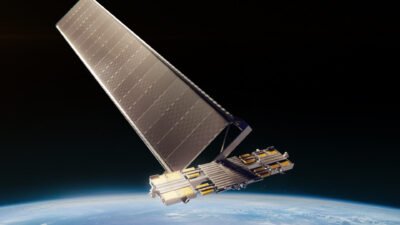
The NRO operates the nation’s spy satellites and acquires commercial satellite imagery used by military commanders and civilian policymakers. Under Scolese, the agency has embraced commercial launch and satellite technologies while deploying a proliferated low Earth orbit imaging constellation that now exceeds 200 satellites.
Several senators pressed Mason on how he would work with industry and support military forces that increasingly rely on space-based intelligence for operations.
Mason said maintaining strong ties with private industry would be essential as the agency expands its satellite architecture and seeks access to emerging technologies.
“The relationship between industry and NRO clearly is critical,” Mason said, adding that he would continue using acquisition approaches designed to broaden opportunities for startups and nontraditional suppliers.
He said government agencies must provide clear signals to industry about future requirements.
“The things that most well-run companies want is, first of all, predictability in terms of demand,” Mason said. Companies need visibility into government priorities not only one or two years ahead but over five- and ten-year periods in order to justify investments, he said.
Mason said the NRO’s growing fleet of satellites is generating increasing amounts of intelligence data that require new methods for prioritizing collection and distributing information.
The agency’s low Earth orbit constellation is part of a broader effort to increase resilience by distributing intelligence collection across hundreds of satellites.
Artificial intelligence and machine learning will play a central role in managing that architecture, Mason said. With a proliferated constellation of imaging satellites on orbit, AI is becoming necessary to synchronize operations and process information at speeds that would be difficult for human operators alone, he said.
Mason said he supports the NRO’s existing approach to AI governance, including policies that address risk management and oversight alongside operational benefits.
He also emphasized the importance of protecting U.S. space capabilities as rival nations develop weapons and technologies designed to target satellites.
Like the Pentagon, the NRO views space as a contested environment in which adversaries may seek to disrupt intelligence collection through anti-satellite missiles, cyber attacks, electronic jamming and other means. In response, the agency has focused on building a more resilient architecture capable of continuing operations even if individual satellites are degraded or lost.