Concerns that America’s launch infrastructure may not keep pace with rising demand are reviving interest in an unconventional workaround: sea-based rocket launch.
Long viewed as a technically difficult niche with a history of commercial failure, companies and defense officials are giving offshore launch a second look as they search for ways to expand United States launch capacity.
A May report commissioned by the Commercial Space Federation warns that expanding satellite constellations could strain U.S. launch infrastructure and force policymakers to consider “non-traditional” launch sites, including inland and sea-based spaceports, to relieve pressure on Cape Canaveral Space Force Station in Florida and Vandenberg Space Force Base in California.
National security concerns are also at play as officials warn that space launch sites could become targets in an armed conflict. Mobile offshore launch systems potentially offer a more distributed and difficult-to-target alternative.
But sea-based launch also is being viewed through the lens of strategic competition with China.
China has leaped ahead of the U.S. in operational sea-based launch infrastructure. A report published last year by Air University’s China Aerospace Studies Institute detailed how Beijing’s Oriental Maritime Space Port in Haiyang, Shandong province, has already conducted multiple offshore orbital launches while integrating rocket manufacturing, launch operations and maritime infrastructure into a single state-backed industrial hub.
The CASI report said China has conducted 13 sea launches carrying 75 satellites since 2019 and views offshore launch as a way to improve flexibility, increase launch cadence and reduce risks to populated areas.
China’s maritime launch missions are mostly compact solid-fueled rockets that are easier to launch offshore, although the CASI study said Beijing intends eventually to support larger liquid-fueled launch systems. More recent Chinese media reports indicate the country is preparing offshore platforms designed to support reusable liquid-propellant rockets.

Commercial efforts in the United states
In the U.S., meanwhile, a handful of companies are attempting to revive offshore launch concepts under very different market conditions from earlier efforts. One new entrant is Seagate Space, a Florida startup founded in early 2025 by former maritime industry executives Michael Anderson and Sean Fortener, who previously worked at transportation and logistics company Crowley Maritime.
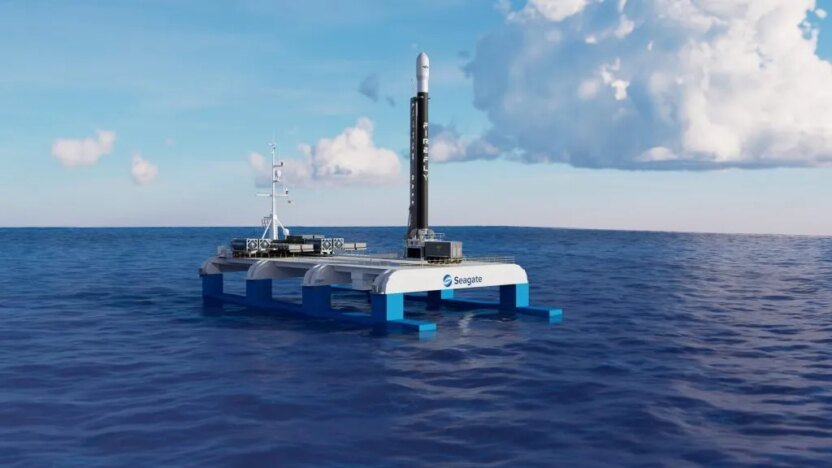
The company is developing what it calls the Gateway Series, a semi-submersible offshore launch platform intended to support uncrewed launches of liquid-fueled orbital rockets.
Rather than adapting oil rigs or repurposed barges, company officials said they are designing a purpose-built launch platform that would have the needed stability and reliability for orbital-class missions. Payload processing and horizontal rocket integration would occur onshore before rockets are transported to the platform and loaded at port.
Seagate recently received “Approval in Principle” from the American Bureau of Shipping under new offshore spaceport guidelines. The designation does not certify the platform for operations, but it provides an early engineering and maritime-safety validation of the concept.
Seagate has recently signed collaboration agreements with Firefly Aerospace and Lockheed Martin.
“We got to know some of the customer needs in the space industry, and we had a very strong belief that there was an opportunity for an upstart to fill in this void within the maritime and space domains,” Anderson told SpaceNews.
The company has conducted subscale tests focused on hydrodynamics and platform stability, which Anderson described as one of the central engineering hurdles.
As part of its work with Firefly and Lockheed Martin, Seagate is adapting its design to support larger rockets than originally envisioned. Firefly’s Alpha launch vehicle, for example, is larger than the class of rockets Seagate initially planned to support offshore.
“Firefly is one that we’ve announced, but then there’s an array of others that we’ve done other sorts of unannounced collaborations,” Anderson said. “What we heard from them was they would certainly consider offshore launch, and it’s getting really difficult to operate from current spaceports.”
The company is targeting an initial demonstration launch in 2028.
Seagate envisions beginning with smaller rockets roughly in the 40- to 80-foot range. Anderson said the corresponding offshore platform would likely remain under 200 feet in length at the outset.
Lockheed Martin executive Johnathon Caldwell said launch-range congestion is becoming an issue not only for commercial satellite deployment but also for missile-defense testing and weapons development.
“You think about the launch industry today, the three sites in the U.S. are getting reasonably congested,” said Caldwell, who is vice president and general manager of strategic and missile defense systems at Lockheed Martin Space.
“If you look over the next five years about what’s predicted for the Cape, for Vandenberg, for Wallops, the volume of launches just to put satellites into space, much less future weapon systems, it only makes sense to look at other options,” he said.
Offshore launch infrastructure could be useful for testing systems tied to the Pentagon’s planned layered homeland missile-defense architecture known as Golden Dome for America. “We believe that the test ranges need some diversity,” Caldwell said.
Reducing air space disruptions
The Commercial Space Federation report outlined potential advantages of sea-based launch systems. Offshore launch pads could reduce airspace disruptions and provide access to orbital trajectories that are difficult to reach efficiently from fixed U.S. launch ranges.
“For example, instead of a dogleg maneuver from the Cape, a launcher on a sea-based platform could take off from a spot in the Atlantic Ocean where it directly flies a southwest trajectory between Florida and the Bahamas,” the report said.
Likewise, launches originating farther into the Pacific Ocean could allow West Coast launches to reach lower-inclination orbits without the payload penalties associated with complex flight-path maneuvers.
The report also argues that sea-based launch infrastructure could eventually become scalable if operational and regulatory challenges are solved. A distributed fleet of offshore launch platforms, for example, could make U.S. launch capacity more resilient against natural disasters or military attacks.
But skepticism remains.
Sea-based launch systems face difficult logistics, complicated licensing requirements and substantial maritime-safety challenges, the report notes. Fueling orbital-class rockets at sea, especially with cryogenic propellants, adds operational complexity.
Late-stage technical issues may also be harder to address because payload integration occurs onshore before the rocket is transported offshore.
Lessons from ‘Sea Launch’
The industry’s caution is shaped heavily by the collapse of Sea Launch, the multinational venture created in the 1990s by U.S., Russian, Ukrainian and Norwegian partners.
Sea Launch used a converted offshore oil platform and a command ship to conduct commercial launches of geostationary communications satellites from equatorial waters in the Pacific Ocean. Between 1999 and 2014, the venture carried out dozens of launches and demonstrated that offshore orbital launch was technically viable.
But the business struggled financially as launch competition intensified. The company suffered launch failures, including a major explosion on the launch platform in 2007, and ultimately collapsed under a combination of economic and geopolitical pressures.
Anderson noted that the market has changed substantially since then.
Sea Launch was built around the economics of launching large geostationary communications satellites from the equator. Today’s market is dominated by proliferated low Earth orbit constellations, defense launches and growing concerns over launch-range congestion.
The Pentagon’s emphasis on responsive launch has also altered the equation. Defense planners increasingly worry about being too dependent on the fixed infrastructure at Cape Canaveral or Vandenberg.
“The idea of responsive launch is now a priority for the Pentagon,” Anderson said.
Startup gets DIU backing
The Defense Innovation Unit, the Pentagon’s commercial technology arm, has already begun exploring some of those concepts through small-scale investments. In 2024, it awarded The Spaceport Company a $2.5 million contract tied to offshore launch infrastructure development.
In its justification for the award, DIU said “a sea-based launch platform is a strategically significant capability that increases equatorial launch access while enabling responsive launch coordination by avoiding high-traffic airspace.”
The Spaceport Company is a four-year-old startup focused on suborbital missile launches.

Chief executive Tom Marotta said the company to date has conducted six launches for defense agencies and commercial customers, including Lockheed Martin.
“We’re on contract to launch at least four more times this year,” he said. Most launches take place off the Gulf Coast.
Marotta said demand for launch pads and test ranges is rising faster than infrastructure capacity. “The supply of facilities that can support those launches is essentially static,” he said.
The company has been approached by weapons developers seeking additional capacity for hypersonic-missile and drone testing.
Marotta said he expects that orbital sea launch will eventually emerge as a commercial market.
Even so, Anderson acknowledged that the industry has good reason to be cautious about offshore launch.
“There should be skepticism,” he said. “If this weren’t such a hard challenge it would have been done successfully.”
Seagate has brought in veterans from the earlier Sea Launch effort, including former Sea Launch president Jim Maser, who served from 2001 to 2006 and now sits on the company’s advisory board.
“We are taking a lot of learnings from that,” Anderson said.
This article first appeared in the June 2026 issue of SpaceNews Magazine.