WASHINGTON — SpaceX launched the first test flight of its Starfall reentry capsule June 23, but the mission remained as secretive as the program itself.
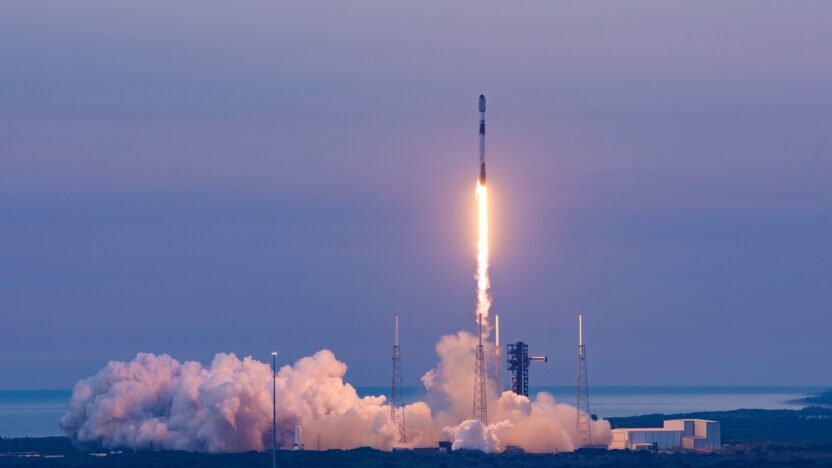
A Falcon 9 lifted off at 6:53 a.m. Eastern from Cape Canaveral Space Force Station’s Space Launch Complex 40 on what SpaceX called its Starfall Demo mission.
The launch was the first time SpaceX publicly discussed Starfall, an effort to develop vehicles for in-space manufacturing and point-to-point cargo delivery. Most of the information about the program came from other sources, including a Federal Aviation Administration environmental assessment published last month.
“Today’s mission includes a demo of a new vehicle that will enable affordable, routine access to the microgravity environment for scientific research and in-space manufacturing,” the company said on social media. “After demonstrating controlled flight, the spacecraft will splash down in the Pacific Ocean.”
“SpaceX has developed a new spacecraft called Starfall, which is, at its core, a microgravity lab that researchers and entrepreneurs can leverage to develop their products and innovations,” the host of the company’s launch webcast said. “There is a huge opportunity to benefit life on Earth through microgravity research and in-space manufacturing.”
The company provided no other details about Starfall during its launch coverage beyond stating that the primary purpose of this flight was to demonstrate controlled flight of the vehicle and perform a controlled reentry and splashdown in the Pacific Ocean.

The launch itself was treated like a classified mission. SpaceX did not broadcast any video from the rocket’s upper stage, something it normally does on commercial flights like those for its Starlink constellation. The company’s post-liftoff timeline ended with the first-stage landing, excluding typical milestones such as when the second stage would shut down or when the Starfall payload would be released.
The only update the company issued after the successful first-stage landing was a social media post more than three hours after liftoff stating that deployment of Starfall was confirmed. SpaceX did not state whether the spacecraft survived reentry or was recovered after splashdown.
Other aspects of the mission led to speculation that the launch carried a classified payload in addition to Starfall. In its environmental assessment, the FAA said that the Starfall spacecraft’s two components weigh about 2,100 kilograms and that it could carry about 1,000 kilograms of payload. However, the first stage landed on a droneship in the Atlantic Ocean when launches of the much heavier Dragon spacecraft feature first-stage landings back at the launch site, a capability available only for lighter payloads.
While SpaceX said that Starfall will provide “routine access” to microgravity, the company has not disclosed long-term plans for the vehicle, including any additional test flights or when commercial service would begin. The FAA environmental assessment covered two test flights of Starfall, launching on either Falcon 9 or Starship.
SpaceX’s entry into the microgravity research and in-space manufacturing markets comes as several other startups develop and fly their own vehicles. Varda Space Industries has flown six missions of spacecraft equipped with reentry vehicles for microgravity research and hypersonics testing, and several other companies are also actively developing and testing spacecraft.
Some industry sources suggest that SpaceX’s entry into this market could disrupt those startups in much the same way SpaceX’s rideshare launches adversely affected companies developing small launch vehicles.
However, there is little evidence those companies have been deterred by SpaceX’s entry into the market. ElevationSpace, a Japanese company developing spacecraft for microgravity research equipped with reentry vehicles, announced June 19 it raised $40 million in a Series B funding round to support spacecraft development.