
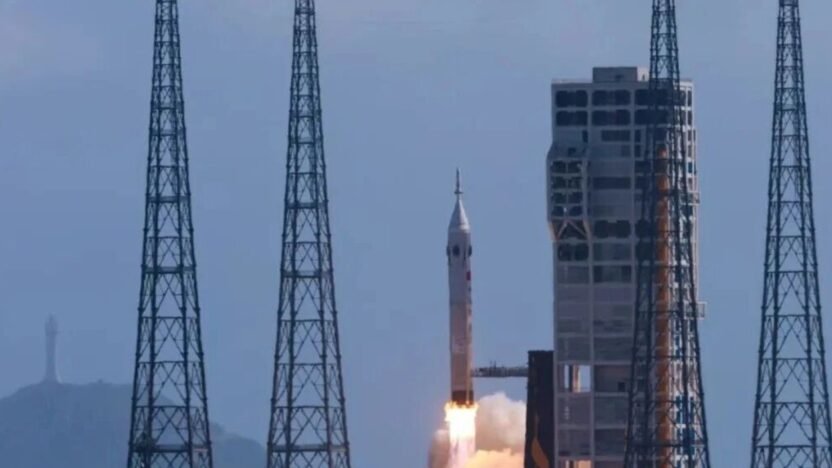
HELSINKI — China is set for a debut flight of its Long March 10B rocket in July and attempt to recover the first stage at sea.
Recently issued airspace and maritime warning notices indicate that the first Long March 10B reusable rocket, to launch from Hainan Commercial Space Launch Site, Hainan island, now has a launch window opening July 10, running between 1:00 a.m. and 5:00 a.m. Eastern (0500-0900 UTC), with repeat daily windows scheduled through July 13.
The two-stage kerosene-liquid oxygen Long March 10B is a cargo variant of the Long March 10A, a rocket designed to launch a new crew spacecraft to low Earth orbit. Both launchers are part of the wider Long March 10 series designed to get Chinese astronauts to the moon. The Long March 10B launch will be the first orbital mission for the series, and thus is a crucial early orbital flight test for the program.
China conducted a wet dress rehearsal of the Long March 10B back in April, with the launch initially expected in the weeks that followed. The debut flight of the 5.0-meter-diameter rocket was, however, delayed for unspecified reasons. State-owned space contractor CASC and its key rocket-making institute, the China Academy of Launch Vehicle Technology (CALT), have provided few official updates of the program, with unofficial images shared on social media providing insights into the progress of the launch campaign. A recovery vessel equipped with a net capture system is also on the move and expected to be in position downrange to catch the Long March 10B first stage.
A Long March 10A single-stage demonstrator was used in February to conduct an in-flight abort test for the Mengzhou crew spacecraft in an important precursor to a first full flight of the spacecraft. The stage went on to perform a controlled propulsive descent and splashdown near the recovery vessel. The debut of the full Long March 10A is expected to follow later in the year, while a further Long March 10A is also set to fly, in combination with an upper stage from commercial outfit CAS Space, for a translunar mission.
The Long March 10B first stage recovery attempt could be China’s third such attempt, following those made by the Zhuque-3, developed by commercial firm Landspace, and the Long March 12A, from CASC’s Shanghai Academy of Spaceflight Technology (SAST), in December last year. However, the second Zhuque-3 rocket appears to be vertical on the pad at Jiuquan spaceport’s commercial launch zone, with a static fire test possible in the near future.
The Long March 10 series is based on the expendable kerolox Long March 5 rocket series which debuted almost decade ago and facilitated China’s lunar sample return missions, a first interplanetary mission, and the construction of the Tiangong space station. The new, reusable Long March 10 series uses the same diameter cores and upgraded, variable thrust YF-100 series engines.
China will use two launches of the three-stage, common booster core Long March 10 to separately launch Mengzhou and a lunar landing stack into lunar transfer orbit. The country aims to land its first pair of astronauts on the moon before 2030.
The planned Long March 10B debut follows a relatively busy June for China, with 10 launches conducted to date. The latest mission, using a Long March 7A rocket, lifted off at 10:10 p.m. Eastern, June 22 (0210 UTC, June 23) from Wenchang Space Launch Site on the southern island province of Hainan.
The payload was revealed post-launch to be the Tongxin Jishu Shiyan-26A (TJS-26A), or communication technology test satellite-26A. The classified satellite was inserted into geostationary transfer orbit. It follows the launch of TJS-25 on the much larger Long March 5 rocket earlier this month.
Kuaizhou-11 update, China on course for national launch record
Meanwhile, the curious incident of the June 17 launch of a Kuaizhou-11 has been resolved. While an announcement of launch success for a mission of this profile would likely come around an hour after liftoff, official silence followed for around a day. Such a silence is usually followed by a terse announcement of launch failure some hours after liftoff. Yet, U.S. Space Force tracking cataloged objects in orbit associated with the launch, before Chinese media confirmed June 18 that the Kuaizhou-11 had successfully deployed the Centispace-05 group of navigation enhancement satellites into low Earth orbit.
China conducted 92 orbital launch attempts in 2025, setting a new national record for launches in a calendar year. This year, the country is expected to conduct more than 100 launches for the first time, potentially targeting as many as 140 launches. The country had conducted 35 launches by the end of June last year, and is already on 44 this year, putting it on course to surpass the 100 mark. China’s launch calendar typically sees greater activity in the second half of the year.