SAN FRANCISCO – Weather Stream, a Boulder, Colorado, commercial weather satellite operator, is collecting global atmospheric observations with its GEMS2-Amethyst satellite.
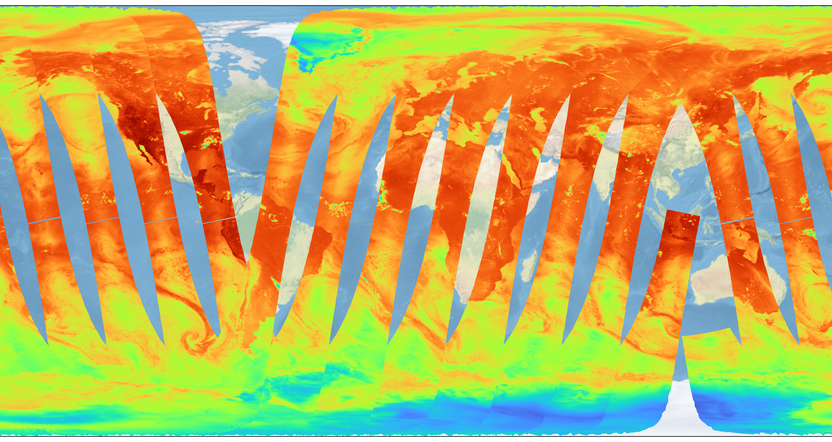
Launched March 30 aboard the SpaceX Transporter 16 rideshare mission from Vandenberg Space Force Base in California, GEMS2-Amethyst is equipped with a commercial microwave radiometer to provide 3D atmospheric temperature and moisture profiles.
“Weather affects everything. From forecasting severe storms to supporting military operations to helping the insurance industry assess risk, the observation gaps we are filling with GEMS2-Amethyst touch decisions that billions of people depend on every day,” Weather Stream founder and CEO Michael Hurowitz said in a statement.
Because microwave sounding plays an important role in numerical weather models, government agencies including the National Oceanic and Atmospheric Administration and the U.S. Air Force have awarded contracts to encourage companies to build and deploy the instruments.
On June 18, NOAA awarded a $2.7 million contract to Orbital Micro Systems, a subsidiary of Weather Stream, and a $7.3 million contract to Boston-based Tomorrow.io to “assess the quality and impact” of commercial microwave sounder “data on NOAA forecast models and tropical cyclone forecasting,” according to a NOAA news release. “Successful studies are intended to lead to sustained commercial data purchases to enhance the government backbone supporting NOAA’s operational forecasts.”
Weather Stream’s GEMS2-Amethyst carries a dual-band passive microwave radiometer integrated in a GomSpace bus. The radiometer measures atmospheric temperature and humidity profiles across a nearly 2,000-kilometer swath and provides global coverage approximately every 12 hours. The GEMS2-Amethyst satellite is expected to remain in a 600-kilometer sun synchronous orbit for more than five years.
In 2019, Weather Stream launched the first commercial microwave radiometer in a cubesat. The first GEMS satellite, a three-unit cubesat, gathered temperature data until the spacecraft reentered Earth’s atmosphere in 2021. GEMS2-Amethyst, a six-unit cubesat, observes atmospheric humidity and precipitation in addition to temperature.
Weather Stream plans to establish a GEMS commercial weather data constellation to gather data as frequently as every 15 minutes.
A 2021 NOAA report, “Satellite Microwave Sounding Measurements in Weather Prediction,” determined that microwave sounders on polar-orbiting weather satellites “have been the most impactful remote sensing observations in numerical weather prediction models for the past two decades, and are expected to continue to be so in future.”