HELSINKI — China has established a national very low Earth orbit industry alliance, as multiple satellites demonstrate sustained operations below 300 kilometers and propulsion startups attract investment.
China established a national VLEO Technology Innovation and Industry Development Alliance on June 27, co-founded by 34 organisations including leading universities, research institutes and commercial space companies, at a conference in Shenzhen attended by six academicians and more than 250 industry experts, Chinese media Economic Daily reports.
The development follows progress in orbit and within the ecosystem. Orbital data reveal that China currently has two experimental satellites operating in orbits below 300 kilometers, demonstrating the ability to maintain these low orbital altitudes despite considerable drag, while funding activity indicates a demand and backing for related technologies.
Very low Earth orbit (VLEO), sometimes defined as orbits below 300 kilometers in altitude, has become an area of interest in recent years, with China engaged in this area, along with other major space actors. VLEO offers potential significant advantages for Earth observation and communications, such as higher resolution imagery, lower signal latency and reduced power requirements over operating in higher orbits. This reduces costs and means swift reentry post-mission. The challenge, however, is to overcome much greater atmospheric drag which swiftly pulls satellites back into the atmosphere without active compensation, placing extreme demands on propulsion systems.
Shiyan-25, a technology demonstration satellite developed by the China Academy of Space Technology’s (CAST) DFH Shenzhen subsidiary and launched in June 2023, has maintained an altitude of approximately 270 kilometers since September 2023. The satellite is operating roughly 150 kilometers below the International Space Station where atmospheric density is around 10 times greater for more than 20 months. Its propulsion system has not been publicly disclosed.
Jonathan McDowell, a former astrophysicist at the Harvard-Smithsonian Center for Astrophysics who tracks orbital activity, told SpaceNews that Shiyan-25 appears to be testing a specific operational mission profile. “Shiyan-25 has been consistently maintaining its 270 km altitude since Sep 2023,” McDowell said. “I conclude SY-25 is testing a specific operational mission profile for a future system.”
Another mission is operating at similar altitudes but apparently with different objectives. Qiankun-1, developed by commercial firm C-Space and launched in July 2023 on a Galactic Energy Ceres-1 rocket, has been progressively lowering its orbit. The satellite carries test payloads for hyperspectral imagery, visible light cameras and intelligent image processors, and uses a wide-range Hall electric propulsion system developed by Yidong Space, covering 100 to 1,350 watts of power and 6.5 to 84 millinewtons of thrust. The satellite is currently sitting at a mean altitude of around 252 kilometers.
“Qiankun-1 has been progressively lowering,” McDowell said. “It will be interesting to see if it dips further in the next few months. I conclude QK-1 is on a research ‘how low can you go’ mission.” McDowell noted that Japan’s Tsubame satellite operated at even lower altitudes in 2018-2019, establishing that sustained sub-300 km operations are technically achievable, though China is now doing so across multiple concurrent programs.
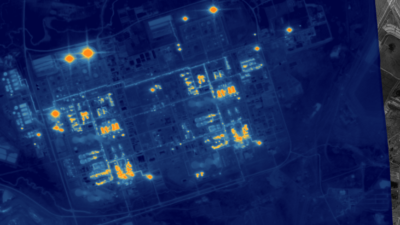
Another spacecraft entered the scene in December 2024 with the launch of Haishao-1, an 80-kilogram X-band synthetic aperture radar (SAR) satellite developed by the Aerospace Information Research Institute of the Chinese Academy of Sciences in collaboration with AIRSAT Technology Group, a CAS spinout established in 2020. Unlike the polar sun-synchronous orbits used by most SAR satellites, Haishao-1 operates at 43-degree inclination and is currently at approximately 370 kilometers, much lower than a typical orbit for a SAR satellite. AIRCAS documentation states that VLEO improves radar performance, enabling resolution better than one meter in stripmap mode while reducing power requirements, with the low-inclination orbit targeting the equatorial and tropical regions underserved by conventional polar-orbiting SAR systems. The satellite is the first in a planned series.
These missions are not China’s first efforts. Tianxing-1, developed by the CAS Institute of Mechanics and launched in June 2022, maintained approximately 290 kilometers for around eight months before reentering in March 2023. A follow-on, Tianxing-1 (02), launched in January 2024 and reentered in September 2025. CASIC’s Chutian program, which aims to establish a VLEO constellation, launched a technology demonstrator in May 2024 that reentered in May 2025.
The propulsion challenge that makes sustained VLEO operations challenging is now also attracting commercial investment in China.
Shanhai Xingyao, a Chengdu startup founded in August 2025, closed a seed round in May led by Jinjiang Talent Fund, a vehicle under Chengdu Science and Innovation Investment Group. The company is developing what it describes as China’s first air-breathing helicon plasma engine. The system that ingests residual atmospheric gas as propellant rather than carrying conventional propellant onboard, eliminating the main constraint on mission lifetime at very low altitudes. The company says it has achieved successful prototype ignition verification in a simulated VLEO environment, with key performance metrics claimed to be at globally leading levels.
Meanwhile, Fudan University in Shanghai announced in March that it has also developed air-breathing plasma propulsion technology for VLEO applications, directly capturing nitrogen and oxygen from the thin atmosphere to use as propellant. It stated plans for a satellite demonstration constellation.
China is far from alone in identifying VLEO’s potential, with a number of new developments worldwide. Clarity-1, launched by Albedo in March 2025, with another mission being prepared, Bellatrix and TelePIX planning a 2028 air-breathing VLEO imaging demonstration, funding for NordSpace in Canada, and UK startup NewOrbit recently raising funding. The US Space Force and NASA have launched DiskSat experiments, while Redwire has secured a DARPA contract for its Otter VLEO mission.
While many initiatives in this arena are in the early stages, China has a combination of demonstrated in-orbit endurance in VLEO, emerging propulsion investment, and has now formally institutionalised the entire sector, suggesting China’s VLEO activity is ready to move from experimental missions to systematic programs.