
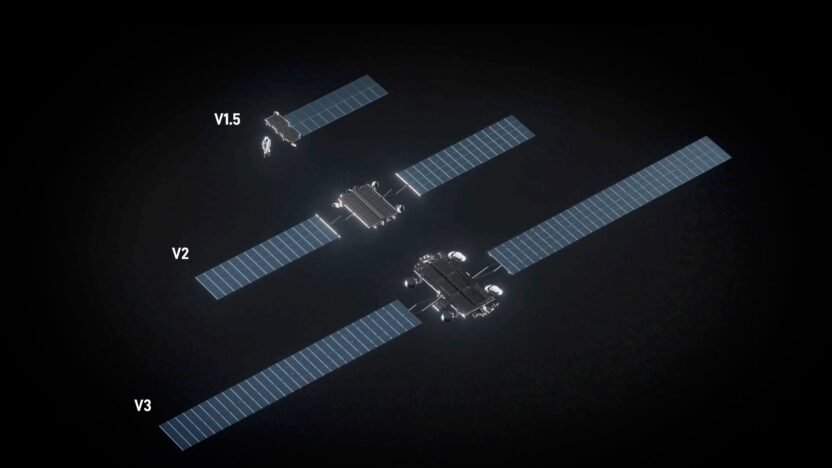
Amazon wants more than 5,000 satellites in orbit. Blue Origin has proposed another 5,400. Chinese companies have filed plans encompassing vastly more. Elon Musk has talked about a constellation numbering 1 million.
There is one issue: building all of them.
The unprecedented rush to put satellites into low Earth orbit is colliding with shortages of specialized components and materials, suppliers struggling to keep up and competition from the booming artificial intelligence industry. The squeeze is forcing satellite companies to rethink designs, accept delays and confront a more fundamental question about the timelines for what’s possible.
Competition for scarce resources and supplies amid surging demand is forcing tradeoffs in industry that threaten to delay launches and may push companies out of the market or trigger greater consolidation.
“Companies right now are just looking at where they might be able to take additional risk,” said Steve Jordan Tomasweski, vice president of space systems for the Aerospace Industries Association. He participated in a supply chain analysis with audit firm PricewaterhouseCoopers earlier this year that involved talking to dozens of industry representatives.
Tomasweski said supply chain challenges have companies looking for “where they can maybe downgrade something to not using a space-qualified component … Maybe they’re okay waiting a year for a certain type of valve because they know that’s going to be something they really have to deliver on.”
The 54-page analysis isolated nine critical components contributing to supply chain bottlenecks due to an inability to keep up with demand, ranging from valves and actuators to switchgears and transformers. The report incorporated insights from about 30 professionals representing various parts of the satellite supply chain.
“We hear from companies that because demand is so high and capacity is not keeping up with demand,” Tomasweski said. “That’s what’s forcing them to really make some of those hard decisions.”
According to some estimates, the next few years could mean the nearly 19,000 satellites now in LEO joined by 70,000 more. And while analysts who spoke with SpaceNews were, across the board, unwilling to speak to companies’ plans and challenges on the record, they agreed that the coming demand signal will only exacerbate already-felt bottlenecks around limited and necessary resources.
As space companies face a ramp-up in competition from Earth-based data centers for the minerals and materials they need to launch megaconstellations, experts say something’s got to give, in the form of delays, industry consolidation, material substitutions or favorable new policies. And, amid increasing global instability, certain industry shocks could be sudden and severe.
Unstable rare earth supply
One bottleneck stems from access to the rare earth minerals that are crucial for electronic components.
Carla Filotico, partner and managing director at the European consulting firm Novaspace, told SpaceNews she’s particularly concerned about gallium nitride (GaN) and germanium, two minerals used to build high-efficiency solar cells. For common satellite materials like aluminum, the possibility of running out isn’t much of a concern, she said.
“If we assume an average of 500 kilos of mass per satellite, and we make a pure calculation of the amount of aluminum necessary, we can say that, from the primary aluminum production that is currently quite large globally, this space sector is still a niche,” Filotico said.
Space applications make up a few percent of the market demand for GaN, on the other hand, and China’s chokehold on production, at around 98%, leaves U.S. and European companies vulnerable, she said. China is also a dominant producer of germanium, for which space applications make up an even larger market share.
She added that any restrictions on gallium export could cause a shortage for the space sector that could hit at any time.
Even aluminum has become more scarce and costly amid shipping disruptions in the Strait of Hormuz caused by the U.S.-Iran conflict.
“Supply chain resilience has been a topic that has been very popular since COVID, but it’s just accelerated with more and more of these conflicts and disruptions,” said Doug Anderson, a partner at PwC’s Operations and Supply Chain Services practice who collaborated on the joint AIA report on space supply chain bottlenecks, released in March.
“The Strait of Hormuz has impacted aluminum, has impacted helium. These are things that are very important for the space supply chain,” he said.
It’s a problem with a dangling threat but no clear solution, although the last year has seen efforts to establish new mineral supply pipelines, such as a May 2025 agreement between defense prime RTX and Emirates Global Aluminum to start up gallium production in Abu Dhabi. Filotico said the worst of the resource squeeze is likely to be felt in the next five years, with the planned peak of the new constellation launch wave set to hit by 2030.
A trade disruption or geopolitical crisis that disrupts access to GaN and germanium “could certainly cause space sector shortage,” Filotico said.
And megaconstellations, due to the realities of scaling and maintenance, exacerbate the hazard of a sudden disruption to mineral supply. At one to two solar arrays per satellite, a single megaconstellation can easily require 10,000-20,000 solar panels.
“We are talking about thousands of satellites per company per year at least, because you need to replenish the satellites every four or five years, depending on the orbital height,” Filotico said.
Key subcomponents
The PwC-AIA analysis earlier this year revealed, among other things, that parts shortages are due not only to an inability to move faster and produce more, but also an unwillingness to do so.
The report described suppliers who were passing up changes to bid on space work, “citing high complexity requirements and low return on effort.” It described one case specifically in which a legacy supplier opted not to rebid on making composite overwrapped pressure vessels, needed to store high pressure gases, because the work would take about one-third of all the available engineering time while only generating “low single-digit revenue.”

At the Air Force Association’s Air Space & Cyber conference in September, Gurpartap “GP” Sandhoo, director of the Space Development Agency, said his organization continues to face supply-chain throughput and quality problems as it builds out its missile-tracking and data-transport constellations.
“We have had a demand signal, but the quality control and being able to produce things at scale has been a challenge,” Sandhoo said.
He pointed to optical communications hardware and focal-plane arrays as areas where suppliers have struggled with throughput, as well as the difficulty of manufacturing hardware that can withstand launch.
Compounding the challenges, Tomasweski said, are a surfeit of parts pipelines with just one or two suppliers, leading to single points of failure, and new customer competition in the form of AI data centers.
Some suppliers are approaching changing buying patterns by designing parts that can scale to perform in both critical and risk-tolerant mission scenarios, Ken Stoler, a space business development lead for Arrow said on SpaceNews’ Space Minds podcast. He argued that a strong supply chain must be resilient and diverse.
The demand for data centers has notably increased even in the months since the supply chain report was released, he said, and the builders of those centers may represent a more attractive and profitable customer for suppliers of critical components than satellite constellation-makers. With switchgears and transformers specifically, the report found AI companies were “gobbling these things up at scale” and creating years-long parts backlogs.
“For a space company to come in and say, ‘Hey, we want to buy 10 of these for a new factory’ — compare that to … a big artificial intelligence company or data center company buying 10,000 of these things,” Tomasweski said.
“The scale of it, even with the surge in space, isn’t big enough to kind of change the trajectory of where those electrical boxes are going.”

Measurement challenges
A challenge to broader efforts to ensure space companies have what they need to execute on their launch plans is a consistent and continual way to measure available resources, he said. There’s no guarantee, he added, that the nine critical components highlighted in March would still be at the top of the list today, and no simple way to find out.
“It’s been the problem with space that there hasn’t been kind of consistent awareness of where those issues are across programs, across you know national security space, civil space and commercial space,” Tomasweski said.
That kind of data could also make it easier to enact policy interventions. For example, Tomasweski proposes a “skip the line” authority that would allow the space industrial base to get in front of data centers and other competitors for resources.
“If we want to deliver on all these great capabilities from space and explore the solar system and beat China, you know, back to the moon, we might need to make sure that space is prioritized amongst all the other national priorities that we have,” he said.
Tomasweski said he was encouraged by steps from the federal Office of Space Commerce to allow government and industry players to strategize over supply chain issues and discuss possible regulatory moves that could help.
“One big thing I think really still needs to get figured out is where the belly button is for fixing supply chain issues, especially at different government agencies,” he said. “Supply chain is a challenge because it is everybody’s problem, but it’s also nobody’s problem.”
Another unspoken reality, according to multiple experts, is that some megaconstellation launch plans simply won’t come to fruition, at least not as originally envisioned. Space-watchers expect to see an increase in vertical integration, in which larger companies fold parts of their supply chain into themselves. But they also anticipate industry consolidation, along with some companies dropping out of the market as they find themselves unable to achieve their objectives on their own.
“Ten, 12 years ago, when the applications were submitted with the FCC for constellations of low Earth orbit satellites, no one expected all of them to move forward, and some of them just decided not to move forward with their plans,” said Doug Stroup, president of the Satellite Industry Association. “I suspect that we’ll see some of the same thing happening with respect to the recent round of applications that have been filed.”
This article first appeared in the October 2026 issue of SpaceNews Magazine.