
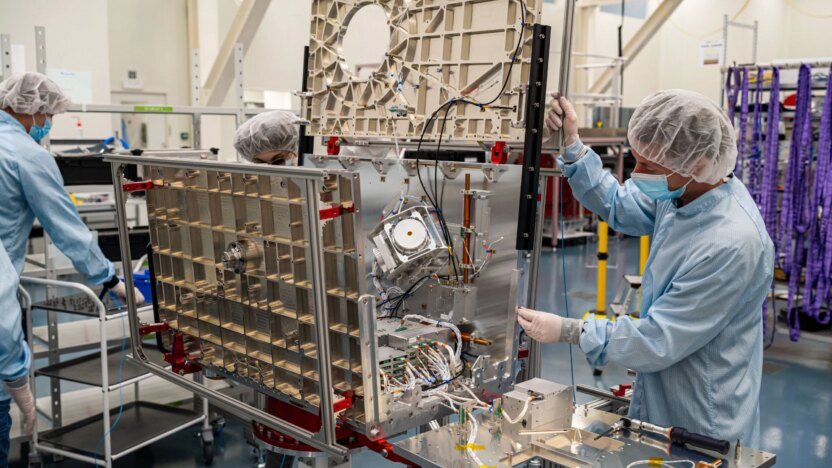
WASHINGTON — Belgian satellite manufacturer Aerospacelab has won a contract to build eight spacecraft for California-based startup Xona Space Systems, which is developing a commercial positioning, navigation and timing service designed to complement and back up GPS.
The companies said Jan. 13 that Aerospacelab will serve as Xona’s transition manufacturing partner for the initial deployment of Xona’s Pulsar constellation, supplying satellite platforms and systems integration expertise while Xona develops its own production capabilities in California. The value of the contract was not disclosed.
Xona is building Pulsar as a low-Earth orbit constellation intended to provide PNT signals that can augment GPS and continue operating in environments where traditional navigation signals are degraded or denied. Interest in LEO-based PNT has grown in recent years as governments and commercial users look for alternatives to GPS, which operates from medium Earth orbit and is vulnerable to jamming, spoofing and other disruptions.
Aerospacelab previously built Xona’s inaugural spacecraft, Pulsar-0, which launched to orbit in June 2025.
“Aerospacelab allows us to accelerate early Pulsar deployment using proven commercial manufacturing capacity while we build out our own satellite production capabilities in California for long-term scale,” a Xona spokesperson said in a statement. “This approach lets us move quickly today without compromising our ability to vertically integrate as the constellation grows.”
Xona expects to launch four of the eight satellites later this year, with the remaining spacecraft projected to launch in 2027. Initial PNT services are expected to begin in 2027, with coverage expanding as additional satellites are placed in orbit.
“Capability ramps progressively with deployment rather than switching on all at once,” the spokesperson said. “In our early timekeeping customers, for instance, we’re able to address unmet user needs with even intermittent coverage, providing an additional layer of redundancy for critical infrastructure.”
The company secured a series of U.S. military contracts to demonstrate its navigation technology for defense use cases, including a roughly $4.6 million award from the Air Force Research Laboratory to test Pulsar’s performance in GPS-challenged environments.
Aerospacelab, which supplies satellite platforms to commercial and government customers, is expanding its manufacturing footprint. The company is building a factory in California and plans to open a “megafactory” in Belgium.