WASHINGTON — Astrobotic said Dec. 19 it has won $17.5 million in NASA and military contracts to develop three new reusable suborbital vehicles for technology demonstrations and other applications.
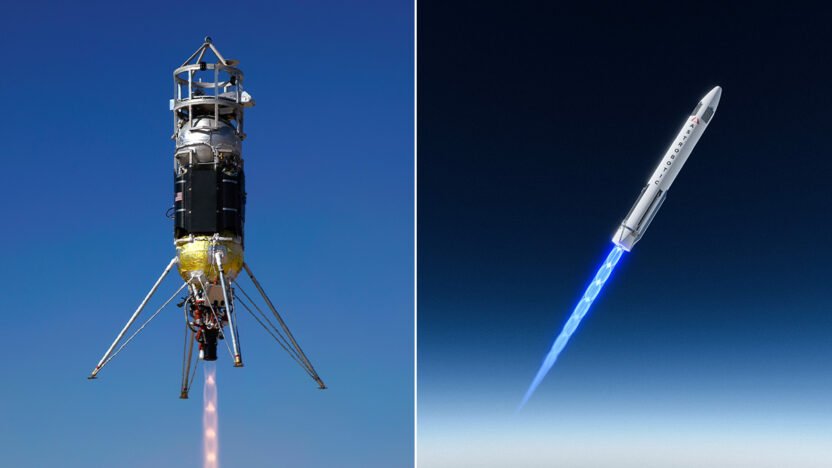
The Pittsburgh-based company said the contracts will support work on two low-altitude vehicles that are successors to the company’s Xodiac vertical-takeoff-and-landing vehicle, as well as an upgraded version of Xogdor, a vehicle capable of flights above 100 kilometers. Astrobotic acquired those programs in 2022 when it purchased assets of Masten Space Systems, which had filed for bankruptcy.
The awards include a $1.6 million NASA Small Business Innovation Research (SBIR) Phase 3 contract for Xodiac-C, a vehicle focused on testing entry, descent and landing technologies.
“Xodiac-C is the closest thing to a direct replacement for our Xodiac-A vehicle, which we learned a lot over 175 flights,” said Sean Bedford, senior director of business development at Astrobotic, in an interview. The original Xodiac vehicle crashed during a May 28 flight at the company’s Mojave, California, test site.
Bedford said there is strong interest in a new Xodiac for testing technologies for lunar and other planetary landings. “There are more people flying to the moon than ever before in human history,” he said. That includes Astrobotic, which flew its Peregrine lander mission in early 2024 and is working on its larger Griffin lander for a 2026 mission.
“We’re seeing increased demand right now for approach, descent and landing payloads to get those sensors ready for missions to the moon, missions to Mars, even missions to deep space like Europa and comet sample return,” he said.
Xodiac-C will support larger payloads than the original Xodiac, as well as longer flight durations and increased maneuverability. “We wanted to make sure we were giving those customers exactly what they were looking for, and we think Xodiac-C is going to be exactly that,” Bedford said.
A separate $1.9 million SBIR award from the U.S. Space Force and the Air Force Research Laboratory (AFRL) will support development of another version of Xodiac, called Xodiac-B. The vehicle will be used to test rotating detonation rocket engines, or RDREs, a technology that promises increased efficiency over conventional engine designs.
“This is something we’ve been working very closely with our partners at AFRL on to design a system that’s going to be able to get RDREs to flight faster,” Bedford said.
While Astrobotic is developing its own RDRE, Bedford said that design will be “a little bit too large” for Xodiac-B, which is intended to test engines with about 1,000 pounds of thrust. Instead, the vehicle will serve as a testbed for other companies developing such engines, with an initial customer already identified but not disclosed.
The third and largest award is another NASA SBIR Phase 3 contract, valued at $14 million. It will support upgrades to Xogdor, a larger suborbital vehicle the company has been developing for several years. Unlike Xodiac, which is used for low-altitude testing, Xogdor is designed to reach altitudes of 100 kilometers or more.
Xogdor is intended for multiple applications, including microgravity experimentation and tests of entry, descent and landing systems for Mars spacecraft. Astrobotic said the vehicle will be able to carry up to 200 kilograms of payload and is designed for multiple flights per week.
Bedford said the high planned flight rate makes Xogdor well suited for experimentation. “We think that brings incredible value because of the cadence and what that’s going to enable, in terms of how quickly people can refine ideas and get validation for them in their preferred environment,” he said.
The vehicle could also support national security applications, Bedford said, noting that Xogdor is similar in size to short- and medium-range missiles with comparable concepts of operations. “To a lot of sensors, it’s going to look like a missile,” he said.
He added that Xogdor’s high flight rate could support collecting flight data needed for missile defense initiatives such as Golden Dome. “Whatever ultimate form that takes, they’re going to need a lot of flight testing, they’re going to need to be able to test things quickly and at an affordable price point,” he said. “We think Xogdor is going to deliver all three of those.”
Astrobotic’s current schedule calls for Xodiac-C to enter service in late 2026, followed by Xodiac-B in 2027 and Xogdor in 2028. The company did not disclose whether additional funding will be required to complete development of the vehicles.
Bedford said Astrobotic has about 40 employees working on the vehicles. The company has been flying Xodiac at the Mojave Air and Space Port and signed an agreement in September to fly Xodiac from Andøya Spaceport in Norway. The timing of the first flight from Norway remains uncertain, he said, but added that the company is “very excited” to fly the vehicle there.
Astrobotic is also considering flying its vehicles from Edwards Air Force Base, a short drive from its Mojave facility. Doing so would demonstrate the company’s ability to deploy its vehicles while accessing a larger, less congested test range.
When Masten Space Systems established operations at Mojave nearly 20 years ago, “there was no one there,” Bedford said, making vehicle testing relatively easy. “Now, there are a lot more people, and there’s a little bit of deconfliction that has to happen. But there’s plenty of space at Edwards, so that does give us some flexibility.”