
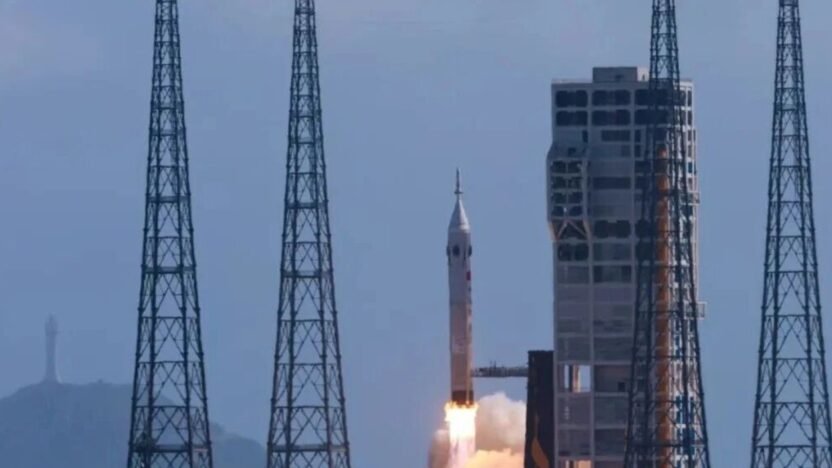
HELSINKI — China has conducted what appears to be a wet dress rehearsal for its Long March 10B, paving the way for a potential launch within weeks.
The wet dress rehearsal took place over the weekend at the Hainan Commercial Space Launch Site near the national Wenchang spaceport, Hainan island, . Unofficial images and footage shared over Chinese social media platforms in recent days showed rollout of the rocket and apparent integrated tests, with images suggesting the first and second stages had been filled with, and vented, propellant.
The 5.0-meter-diameter rocket could now launch for the first time in the coming weeks. There is currently no official word of, nor airspace closure notices indicating, an imminent launch, as is typical for a state-led launch campaign.
The kerosene-liquid oxygen Long March 10B is a cargo variant of the Long March 10A, a rocket designed to launch a new crew spacecraft to low Earth orbit. A single-stage test article of the 10A was used in February to conduct an in-flight abort test for the Mengzhou crew spacecraft. The stage went on to perform a controlled propulsive descent and splashdown near a recovery vessel.
The success of the latter test may allow a full recovery attempt with the orbital launch of the Long March 10B. The 10A and 10B first stages are expected to be recovered using a vessel equipped with a net system, catching hooks attached to the stage, eschewing the need for landing legs.
Previous statements on the Long March 10B, which first indicated a potential launch of the rocket in the first half of 2026, suggest it will be capable of carrying 11,000 kilograms of payload to a 900-kilometer-altitude at 50 degrees inclination, capabilities pertinent to the Guowang megaconstellation.
The rocket is one of a number of new reusable launch vehicles designed by China’s state-owned space contractor CASC as the country aims to increase its launch cadence and the mass it can place in orbit, and facilitate missions such as a crewed lunar landing in the coming years. The full Long March 10 will be a common booster core launch vehicle, designed to send separate crewed spacecraft and lunar lander stacks into trans-lunar injection.
The series is based on the expendable kerolox Long March 5 rocket series which debuted a decade ago and facilitated China’s lunar sample return missions, a first interplanetary mission, and the construction of the Tiangong space station. The new, reusable Long March 10 series uses the same diameter cores and upgraded, variable thrust YF-100 series engines.
The Long March 10 series is being developed by CASC’s China Academy of Launch Vehicle Technology (CALT). The Long March 10A is also expected to debut this year, carrying the Mengzhou spacecraft. That mission will likely be contingent on the success of the Long March 10B, given their commonalities. The Long March 10A is also set for another flight this year, in combination with an upper stage from commercial outfit CAS Space, for a translunar mission. While CAS Space confirmed the existence of the mission to SpaceNews, the 921 office under CMSEO, China’s human spaceflight agency, has not revealed the payload or objectives for the mission.
The Shanghai Academy of Spaceflight Technology (SAST), another major rocket designed under CASC, has already launched the 3.8-meter-diameter Long March 12A from Jiuquan, northwest China, making a failed downrange propulsive recovery attempt with landing legs in December 2025. It conducted a static fire test for the similarly-reusable Long March 12B in January. Commercial company Landspace is also expected to make a second flight and recovery attempt with its stainless steel Zhuque-3 rocket in the second quarter of 2026.