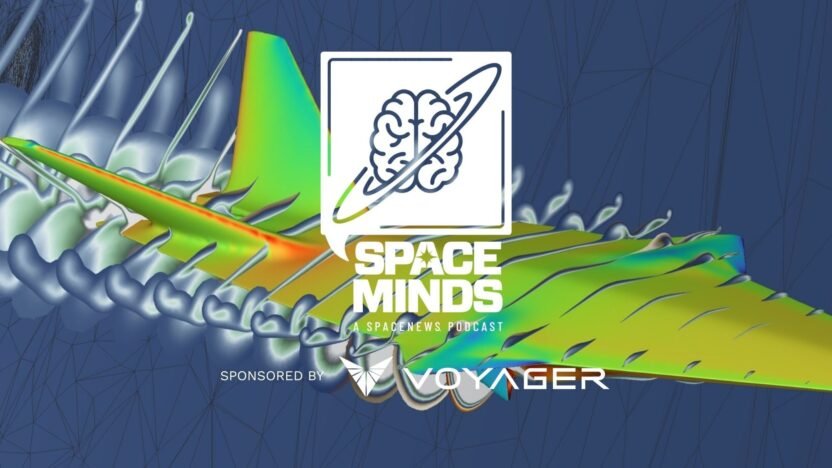
In this episode of Space Minds, host David Ariosto speaks with Juan Alonso — CTO and Co-founder of Luminary Cloud and professor at Stanford University — about the rapid transformation underway in aerospace engineering.
Alonso breaks down how advances in computational fluid dynamics and physics AI are enabling designers to simulate complex aerodynamic behavior in seconds, dramatically accelerating how rockets, aircraft, and hypersonic systems are conceived and tested.
The conversation also explores the ecosystems powering this shift — from Silicon Valley’s unique concentration of interdisciplinary talent to the global collaborations now shaping cutting-edge aerospace work. Alonso highlights how industry, academia, and defense partners are rethinking traditional workflows to keep pace with emerging technologies and rising international competition.
Starlab Space is a US-led global joint venture and partner network that is ensuring a continued human presence in low-earth orbit. Led by Voyager Technologies, Starlab is the most advanced commercial space station under development, bringing together decades of ISS experience, Al-enabled design and global partnerships into a platform designed to scale science and industry in space. From manufacturing and life sciences to defense applications and international collaboration, Starlab is built for real work, real discovery and real continuity, providing a seamless transition from the International Space Station to the new commercial space station era.
Time Markers
00:00 – Episode introduction
00:39 – Juan Alonso’s background and role at Luminary Cloud
00:53 – What computational fluid dynamics is and why it matters
03:06 – The rise of physics-driven AI in simulation
05:73 – Risks, accuracy, and the limits of algorithmic design
07:53 – Silicon Valley vs. global innovation ecosystems
10:10 – Childhood inspirations and early exposure to aerospace
12:35 – Hypersonics, national defense, and technological competition
15:31 – Collaboration with Northrop Grumman
17:04 – Blurred lines between atmospheric and orbital tech
18:37 – The next big leaps in aerospace engineering
21:20 – Society’s and policymakers’ ability to keep pace
23:19 – The data revolution and why it matters
24:21 – What’s next? Where are the opportunities?
Transcript – Juan Alonso Conversation
This transcript has been edited-for-clarity.
David Ariosto – Juan Alonzo, you are the founder and director of the Aerospace Design Laboratory, and also the co-founder and CTO of Luminary Cloud. It’s so great to have you on the program.
Juan Alonso – It’s a real pleasure to be with you, David.
David Ariosto – You know, maybe just to start us off, to kind of give the audience who aren’t perhaps experts — some of them may be, but perhaps not all — a sense of computational fluid dynamics and the growing need for simulations, for analysis and design, and how all this plays into performance, IP issues, adaptation, and the mountain of things you’re doing at Luminary and at Stanford more broadly. Give us a little primer on what Luminary is and what you do. What’s the nature of computational fluid dynamics and how is it changing? I realize there’s a lot wrapped in there, but maybe let’s start with Luminary. What is it?
Juan Alonso – Yeah, Luminary is a company that was created to give customers the end-to-end capability to generate physics AI models. So these are models of the physical world, like computational fluid dynamics, that can be way faster and just as accurate as the models we’ve been using for a long, long time.
So you asked about computational fluid dynamics. Computational fluid dynamics is nothing but solving the equations of how air flows around, let’s say, a rocket during launch, or inside a rocket engine or a thruster, as we’ll talk about later today — how to understand all of that through numerical simulation inside a computer.
Of course, that’s had tremendous impact in our industry for a very long time, but frankly, at Luminary, we believe it’s slowing down the process — the fact that those simulations take a long time to complete. So at Luminary, we’re generating tremendous amounts of data very quickly, and then turning those simulations, through what we call physics AI, into models that are just as accurate but way, way faster.
Eventually, the objective of the company is to accelerate design and certification processes so we can deploy much more capable systems more quickly, allowing us to react faster to commercial and defense threats — and much more.
David Ariosto – This is why I found your company so interesting, because it’s almost like you’re the tip of the spear in this new paradigm shift — the nexus between AI, machine learning, new nanofabrication techniques coming online — all of which promise an iterative approach to aerospace unlike anything we’ve seen before.
I find your perspective especially interesting because of the long history of academia, the commercial sector, and defense all working together. I want to explore that ecosystem — because on one hand we have this brave new era of technologies, and on the other, it’s a tried-and-true recipe for advancement throughout the years, right?
Juan Alonso – I think that’s a fair characterization. Engineering has always been a data-driven discipline. From the early days of splines, we’d put data points together in some way and fit models through them with straight or curved lines.
Over the last 10 years, the amount and availability of data has exploded — nothing like what we used to have. At the same time, the world of AI — not for the physical world, but for other applications — has taken the world by storm, together with a revolution in machine-learning methods that are very different from what we used to use.
Some ideas came from academia, some from leading companies trying to incorporate these methods into design, and some from collaborations between startups like us and large companies like Northrop Grumman. It’s taking the world by storm — the ability to query the physical world and ask, “How is this rocket going to perform?” and within a second or two get an answer, when we used to wait 10 to 12 hours for just that.
David Ariosto – Does that give you pause — the increased reliance on simulations and algorithms that inform design and processes? The speed is remarkable, and the level of detail you can scrutinize is incredible. But is there a part of you that wonders whether we might rely too much on this?
Juan Alonso – Over the last 15 years, numerical simulation and high-performance computing have made simulations more accurate. But no simulation is perfect. Sometimes we miss things in the real world. We know simulation plays a big role in design, but we often still need tests to verify predictions.
The physics-AI revolution takes us to the next level by adding more data — both simulations and experimental data — into a single model. It can be better than simulation alone, more credible, and give more confidence in predictions and designs.
So yes, I’m always concerned about accuracy and uncertainty in simulations, but I’m hopeful because the new paradigm lets us reduce those risks by combining data sources.
David Ariosto – What about the physicality of location? In this modern era, the world has shrunk, yet proximity still seems to matter — like with Taiwan’s semiconductor hub. Could you do what you’re doing outside Silicon Valley? Do physical meetings, proximity, and time zones matter for a startup like Luminary?
Juan Alonso – That’s an extremely interesting and insightful question. Silicon Valley is a unique place. Talent comes together in ways that allow giant leaps — cloud computing, GPU computing, physical analysis, security, data visualization — all these disciplines have to come together.
But talent also exists globally. The Zoom revolution lets us bring in that talent to complement the team.
David Ariosto – Talent is global, but it also comes with shared stories. Many people enter aerospace because of early experiences. I know you wanted to be an astronaut. Your father worked in aerospace. These childhood impressions matter. Walk me through that.
Juan Alonso – I always wanted to be an astronaut. As a young child, I devoured books about space. Lots of Asimov, pictures of the U.S. space program, the competition with the Soviet Union. Jules Verne. My mother indulged me — bought me a new book every week.
My father worked for an airline — not a pilot, but in charge of scheduling. We had many friends who were pilots. As a six- or seven-year-old, I’d fly from the Dominican Republic, where I was born, to Spain, in the cockpit of a 747. You can imagine how transformative that was.
But at age eight, I realized two things: I wore glasses, and I lived in a country without a space program. So I decided the next best thing was to design these systems.
David Ariosto – Isn’t that interesting? That was then — but now dozens of countries have space programs, and access to orbit is more accessible than ever. It feels like we’re at the onset of a new age — maybe even a factory floor in orbit.
But you also mentioned the Soviet Union and the first space race — and how today’s competition is with Beijing. Hypersonics were pioneered in the U.S., but others have leapfrogged ahead. On battlefields in Ukraine and in programs in Iran and North Korea, hypersonics are proliferating.
It seems that to push the envelope — not just in development but also in response — computational simulations and design are paramount. Can you speak to that?
Juan Alonso – We are much closer to space than ever. Our students build satellites, put them in orbit, and operate them from the building we’re in.
On hypersonics and systems with national-defense implications, yes — it is a race. People recognize the value of these systems and the advantages they confer. We need to design systems more intelligently and more quickly. That’s what simulation enables — and what physics AI accelerates.
Our collaboration with Northrop Grumman is an example of rethinking how to embed new technologies into engineering workflows to explore more design space and come up with better solutions faster.
David Ariosto – Let’s talk about the collaboration with Northrop.
Juan Alonso – Luminary aims to be the first company providing end-to-end capabilities for physics AI. This involves generating data through numerical simulation and absorbing data from physical testing, then training models that the entire organization can query instantly.
Northrop Grumman is one use case — in the aerospace and space side. But we’ve also worked on aircraft, industrial manufacturing, turbomachinery, automotive, and more.
David Ariosto – It also strikes me that the line between orbital and atmospheric technologies is blurring. These used to be distinct worlds, but now the ecosystems around them feel more interconnected. Is that your sense?
Juan Alonso – Yes, that’s a good observation. The fundamentals are similar across commercial aviation, hypersonics, space-access systems, and re-entry. If you have the capability to ask how a system will perform without ever building it — accurately and quickly — then you can apply that capability across disciplines.
It all comes down to physics.
David Ariosto – Thinking about the lifecycle of new technologies — how long it takes to bring ideas to market — what’s next? What are the biggest untapped opportunities, especially given how fast things are moving?
Juan Alonso – We believe the data revolution leading to the physics-AI revolution will take the engineering world by storm. People don’t quite understand how much this will change design.
Immediate information about hypothetical systems, exploration of hundreds of alternatives, finding solutions far better than before — it’s a true revolution. Companies must rethink how they embed these tools into their workflows, not just make things 10% faster, but 10× faster.
Northrop Grumman was a great collaborator because they had advanced thinkers willing to prototype new workflows.
David Ariosto – The engineering is better, competition faster — but can policymakers, culture, regulation keep up? As systems move at warp speed, are we equipped to adapt?
Juan Alonso – When I was younger, I thought these systems might replace humans. Now I realize the number of alternatives we can explore is growing but still limited. I see these tools as an assistant — like Iron Man’s Jarvis — providing options, helping engineers rethink problems.
These technologies assist clever designers, helping them reach higher confidence and lower risk, much faster.
My first PhD student in this area finished in 2012. At the time, we thought there wouldn’t be enough data, or methods wouldn’t generalize. But that’s changing every day. Over the next five to ten years, it will be transformative.
David Ariosto – Data itself — the investment in data centers, the bottlenecks in handling it — where are the opportunities?
Juan Alonso – Competitors are coming up to speed quickly, so what matters is accumulated knowledge — represented by data. Companies realizing that their value lies in their data will be the winners.
It’s daunting because training physics-AI models requires massive amounts of data. It isn’t “a bunch of folders” anymore — it requires data strategies, data centers, curation, availability, controls.
Physics AI depends on data generated inside Luminary or through experiments. Companies must think seriously about data organization, storage, controls, accessibility — a corporate-wide effort.
David Ariosto – I think that is a good place to leave it. Juan Alonso, CTO and co-founder of Luminary Cloud, founder and director of the Aerospace Design Laboratory — it’s been an absolute pleasure. I could talk to you for hours. This is fascinating and really feels like the vanguard of where we’re heading. Thanks so much for being here.
Juan Alonso – A real pleasure to be with you, David. Thank you so much.
Space Minds is a new audio and video podcast from SpaceNews that focuses on the inspiring leaders, technologies and exciting opportunities in space.
The weekly podcast features compelling interviews with scientists, founders and experts who love to talk about space, covers the news that has enthusiasts daydreaming, and engages with listeners. Join David Ariosto, Mike Gruss and journalists from the SpaceNews team for new episodes every Thursday.
Be the first to know when new episodes drop! Enter your email, and we’ll make sure you get exclusive access to each episode as soon as it goes live!
Note: By registering, you consent to receive communications from SpaceNews and our partners.