
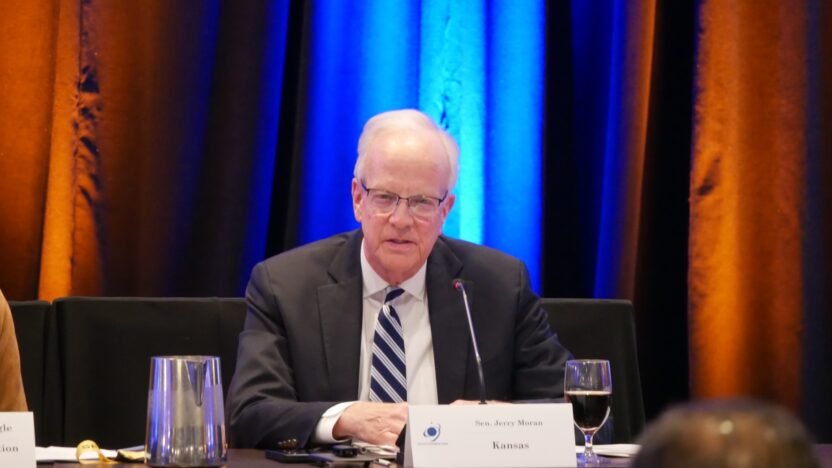
COLORADO SPRINGS — The chairman of the Senate appropriations subcommittee that funds NASA says he opposes proposed cuts to part of NASA’s budget and will seek to fund the agency at levels similar to last year.
At a space policy roundtable of government and industry officials here April 12 ahead of the 41st Space Symposium, Sen. Jerry Moran, R-Kan., discussed the need for a NASA budget that balances resources across the agency’s key mission areas.
“I’ll work to make sure our subcommittee and our full committee in the Senate supports a robust and balanced NASA appropriations bill that is balanced between exploration, science, aeronautics and workforce,” said Moran, who chairs the Commerce, Justice and Science (CJS) subcommittee of the Senate Appropriations Committee.
“I understand that a strong NASA requires stability, predictability and balance,” he added.
NASA’s fiscal year 2027 budget proposal, released April 3, arguably lacks those characteristics. The administration proposed a 23% cut to NASA’s overall budget, to $18.8 billion, with even steeper cuts in science, space technology and space operations.
Moran told reporters after the roundtable that he will work to reverse those proposed cuts in the spending bill his committee will craft.
“I’m going to try to lead a subcommittee and a full committee to put us in a position where we are funding NASA and NOAA and our other agencies in a way that is pretty similar to what we did last year,” he said.
The final fiscal year 2026 spending bill provided $24.438 billion for NASA, close to 2025 levels, and Moran said his goal is to provide a similar amount for 2027, reversing the cuts in science and other areas.
“I think it would be a mistake to put money only in the missions related to exploration and not into science and the others,” he said. “I wouldn’t start with the premise that exploration is the only important aspect of the budget.”
Moran said his subcommittee doesn’t have a schedule yet for developing a CJS appropriations bill as it awaits more details on the administration’s proposed budget beyond the “skinny” budget released April 3. “Before we have the capability of actually having solid hearings necessary to evaluate the President’s budget request, we have to have the President’s budget request,” he said.
He said that his subcommittee has scheduled a hearing on the NASA budget proposal with the agency’s administrator, Jared Isaacman, testifying, but did not give a date. Neither House nor Senate appropriations committees held hearings on the fiscal year 2026 NASA budget proposal.
Moran joins several other members of Congress who have been publicly critical of the proposed NASA budget. Immediately after the release of the proposal, top Democrats on the House Science Committee stated their opposition to the budget, calling it “dead on arrival.”
Reps. Judy Chu, D-Calif., and Don Bacon, R-Neb., the co-chairs of the Congressional Planetary Science Caucus, also opposed the budget in an April 9 statement. “We are deeply alarmed that the administration is once again proposing significant budget cuts to NASA and its science programs,” they stated. “These drastic cuts would create enormous chaos and uncertainty for critical missions, the scientific workforce and long-term research planning.”
While critical of the budget request, Moran said he supported efforts by NASA to accelerate the pace of Artemis missions. “I’m pleased that the administrator is, in a very hands-on way, moving NASA forward more quickly than what we’ve seen in the past,” he said. “The NASA administrator, in my view, is pointing NASA in the right direction on the timetable that we ought to make every attempt to achieve.”
He added he had not seen details about the cost of new exploration initiatives that the agency announced March 24, including plans to develop a lunar base over the next decade and develop nuclear propulsion technologies.
“One would think if you’re doing things faster and doing big things faster, it would require more resources,” he said, but noted there may be roles for increased commercial and international partnerships. “I’m open to the conversation about the needed resources and then make the attempt to achieve that goal.”