7
CAS Space and Space Pioneer have both debuted new Chinese commercial launchers within days of each other, with more set to follow. Meanwhile, China conducted its first commercial demonstration of a robotic arm designed for in-space refueling, and outlined plans for future deep-space missions, including an asteroid redirection test and updated details of its crewed lunar landing program.
Recent launches and vehicle developments
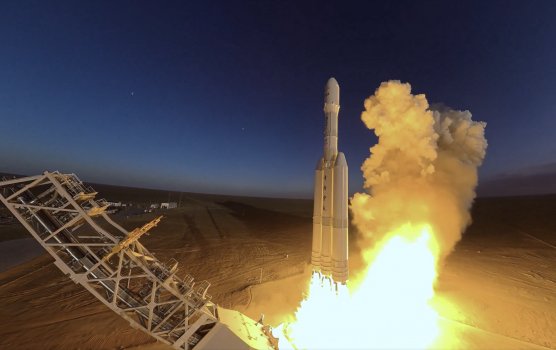
Eight launches took place from China during March, the last of which saw the much-anticipated debut of CAS Space’s Lijian-2 (or Kinetica-2) on March 30th. This was the first of a series of maiden launches of new designs from commercial providers expected in the weeks ahead.
This three-core medium-lift launch vehicle carried a prototype of the Qingzhou cargo spacecraft on its maiden flight — one of two new craft contracted in 2024 to commercially supply the Tiangong space station. Designated as Xinzhengcheng 02 (or New March 02) on this mission, Qingzhou is a lightweight and low-cost solution that will complement the larger Tianzhou craft currently supplying the station.

Qingzhou prototype (left) and render of the craft approaching Tiangong (right). (Credit: CAS Space)
Qingzhou will carry up to two tonnes of cargo, and the first operational flight model is expected in the last quarter of 2026, when it will dock at the station. The prototype will conduct a series of experiments and verification tests at different orbital altitudes between 200 and 600 km. Lijian-2’s successful first mission also placed two additional satellites into polar orbit.
Lijian-2 stands 53 m high and is engineered around a common booster core architecture, each measuring 3.35 m in diameter. The vehicle can fly in a zero, two, or four booster configuration to deliver two to 20 tons to low-Earth orbit. A forthcoming Kinastra-1 kick stage will then support higher energy missions to geostationary orbits.
CAS Space will soon begin operations at a superfactory in the Zhejiang Province, capable of manufacturing 12 Lijian-2 rockets per year. The company has been testing its new Liqing-2 (or Kinecore-2) engine this month, which burns liquid kerosene and oxygen. This reusable engine has a wide range of throttling to support precise landing burns and will later replace the more established YF-102 engines, which are currently used on the Lijian-2’s first stage and burn the same propellants. The company plans to propulsively land all three cores together when it introduces reusability from 2028.

Lijian-2 (Kinetica-2) in flight after launching from Jiuquan on March 30. (Credit: CAS Space)
The inaugural flight of Space Pioneer’s Tianlong-3 had been expected since January, and it finally flew on April 3rd. The launch had been progressively delayed during the week, first being deconflicted with the Lijian-2 launch and then moved again from the 2nd, which would have seen the vehicle launch two years to the day since its sibling Tianlong-2 took its maiden, and only, flight. Tianlong-3 experienced an anomaly during ascent and failed to reach orbit, and Space Pioneer has yet to provide details.
While many new vehicle designs feature the grid fins and landing legs that have become synonymous with the Falcon 9, this launcher is the closest to SpaceX’s workhorse in both dimensions and visual appearance.
Standing at around 71 m tall and 3.8 m in diameter, the Tianlong-3 is marginally larger and somewhat heavier, weighing nearly 600 tonnes. Powered by nine Tianhuo-12 engines, the Tianlong-3 spec indicates a slightly lower but comparable payload to orbit to that of the Falcon 9, aiming for similar cost reductions through reusability and a rapid launch cadence. The vehicle had been undergoing testing at the Jiuquan Satellite Launch Center since late last year.

Tianlong-3 vertical on the launch pad in November 2025. (Credit: Space Pioneer)
A later mission will carry a batch of 18 satellites for SpaceSail’s Qianfan satellite internet constellation. The network had seen no launches in almost six months until a Chang Zheng 8 lofted another batch of 18 satellites on April 7th, bringing the total in orbit to 126. Both Space Pioneer and Landspace have been testing satellite release mechanisms for stacked satellites such as these, and both were contracted by Shanghai Spacesail last August to carry at least one batch to orbit by the end of March.
Deep Blue Aerospace has also been preparing its reusable Xingyun-1 (Nebula-1), which is powered by nine Leiting-R (or Thunder-R) engines, each producing 20 tonnes of thrust at sea-level. These are primarily 3D-printed and burn liquid oxygen and rocket-grade kerosene. The vehicle has been vertical on the pad at the Haiyang launch site on Lianli Island since early March. It is expected to take a suborbital flight trajectory on its debut, attempting a controlled vertical landing at sea.
The Oriental Spaceport announced this month that the Dongfang Hengyuan command ship has been successfully launched to support recovery operations and that the recovery platform is now ready to support future liquid rocket recoveries at sea. This debut vehicle, however, has grid fins but no landing legs for this flight.

The first Xingyun-1 (Nebula-1) is prepared for launch. (Credit: Deep Blue Aerospace)
On March 12, a Chang Zheng 8A (CZ-8A) ended a month-long break in Chinese launches when it deployed the 20th group of Guowang satellites from the Wenchang Space Launch Site. With another mission carrying five more on April 8th, the state-backed internet constellation now has 168 satellites in orbit, with plans to reach 310 this year and climb to 3,600 per year from 2028. It is just over a year since the CZ-8A took its maiden flight. The CZ-8 series is set to fly another thirteen times before the end of the year as it increases its launch cadence.
Robotic arm demonstration
Chinese commercial space services provider Sustain Space has completed the first series of tests for a flexible robotic arm that will eventually be used for refueling.
The tests involved directing the arm towards a port using a target on the Xiyuan-0 satellite, which has been in orbit since March 16th. The craft was launched from the Jiuquan Satellite Launch Center as Yuxing-3-06 — one of eight payloads onboard the fifth Kuaizhou-11 to fly. Developed with Hunan University of Science and Technology, this pathfinder set out to demonstrate an autonomous approach to “docking” with a port on the same spacecraft.

Robotic arm testing aboard Xiyuan-0. (Credit: Sustain Space)
The flexible hollow arm is driven by a rear-mounted transmission system. During the test, the arm translated to its target port, where it remained in position before demonstrating a safe retraction. Teams also used real-time video feeds to manually control the arm.
In late 2025, the state-owned Shanghai Academy of Spaceflight Technology conducted remote proximity operations (RPO) between the Shijian-25 and Shijian-21 craft in geostationary orbit, refueling the Shijian-21. The two craft parted during January. Sustain Space’s demonstration this month highlights a commercial enterprise entering the field. The company plans to evolve the design into a refueling prototype in the future and has been developing different approaches to grappling with a target satellite for several years.
As the company name implies, Sustain Space is focused on both the life extension of orbital craft through in-orbit servicing and vehicle end-of-life management. As a second technical demonstration, Xiyuan-0 also carries an inflatable “drag-increasing sphere” with a 2.5 m diameter when fully deployed. At the completion of all testing, the device will increase the spacecraft’s atmospheric drag, thereby reducing the Xiyuan-0’s deorbit and disposal time from decades to less than a year.

Astronaut’s perspective as Zhang Lu operates the robotic arm during the second Shenzhou-21 EVA. (Credit: CCTV)
A robotic arm of a different kind was utilized this month when astronauts Zhang Lu and Wu Fei left the Tiangong space station on March 16 to conduct routine checks and install additional debris protection. This spacewalk, lasting around seven hours, was the second Extravehicular Activity (EVA) for the Shenzhou-21 crew, which has now spent almost 150 days in orbit. The spacewalk tied Zhang Lu with Chen Dong for a record six spacewalks across multiple missions.
Asteroid deflection test
China is planning its first asteroid redirection test, with a targeted launch date in late 2027. The mission was one of several discussed at the recent Two Sessions meetings held in Beijing, in which the government laid out strategic roadmaps, including a periodic “Five-Year Plan.”
The latest plan, covering 2026 through 2030, is the 15th of its kind and looks beyond the Moon to a mission that would explore the heliosphere, potentially using Jupiter for gravity assists to reach interstellar space. The sessions also discussed another deep-space mission to Neptune as part of a broader push to close the gaps with NASA and ESA in solar system exploration.

Asteroid 2016 WP8 and its orbital relation to Earth. (Credit: NASA JPL Solar System Dynamics)
Target asteroids for this first planetary defense mission have changed since its inception, moving from 2019 VL5 to 2015 XF261 more recently. The mission now plans to launch from Xichang in December 2027 aboard a Chang Zheng 3B, carrying a pair of craft that will rendezvous with 2016 WP8 — a near-Earth asteroid that crosses our orbit at a 13.3 degree inclination and is thought to measure around 40 m in size.
An observer craft will conduct a flyby of Venus before arriving at its target in early 2029, in time to view the impactor craft as it slams into the asteroid at roughly 10 km per second. This impact will be greater than the 6.6 km per second impact speed of NASA’s Double Asteroid Redirection Test (DART) mission in 2022. NASA has since proven that it not only slowed the orbit of moonlet Dimorphos by 33 minutes but also slightly altered the mutual orbit of its parent asteroid, Didymos, shifting the system’s center of mass and orbital mechanics in a measurable way.
China’s kinetic impact mission design is still in development and aims to alter its target’s orbit by three to five centimeters through the high-velocity collision. This mission targets a much smaller change on a more compact asteroid and will also be informed by data from the Tianwen-2 asteroid sample-return mission, which will reach its target, 2016HO3/469219 Kamoʻoalewa, this summer.
Lanyue lunar lander
As China advances towards its ambition to put boots on the Moon by the end of the decade, additional details have emerged about its crewed Lanyue (“Embracing the Moon”) lander in papers published in the Chinese Space Science and Technology journal.
The documents emphasize that lunar landings and liftoffs are among the riskiest and most challenging phases of crewed lunar exploration missions. They analyze a variety of abort scenarios and redundancies, with astronauts’ safety as the top priority. Of the 40+ lunar landing missions attempted worldwide to date, key failure modes cited include propulsion system issues (for example, Japan’s SLIM lander losing power in one engine during landing) and control and navigation problems (for example, with India’s Chandrayaan-2).
The design of the approximately 26-tonne Lanyue system draws lessons from these past missions by adopting a two-module architecture that improves efficiency and reduces overall propellant needs compared to a single-module design. Lanyue consists of a propulsion module and a lander module.

The complete Lanyue Lander stack (left) and the lander during ascent and touchdown testing in August 2025 (right). (Credit: Chinese Space Science Technology/CCTV)
The propulsion module, powered by a single YF-58-1 engine burning monomethylhydrazine (MMH) and nitrogen tetroxide (N2O4), handles translunar injection corrections, lunar orbit insertion, and the initial powered descent from lunar orbit.
For the final descent and landing phase, the lander module takes over using its four variable-thrust YF-36 engines, which burn the same propellants. These same engines later perform the ascent from the lunar surface and rendezvous with the Mengzhou spacecraft in lunar orbit. The four YF-36 engines are arranged circumferentially around the lander’s main structure, which lowers the center of gravity and improves landing stability.
During descent, the combined stack performs major deceleration burns. When the vehicle is a few kilometers above the lunar surface, the propulsion module jettisons and separates from the lander module, lightening the vehicle for the final approach. The discarded propulsion module is expected to perform a controlled impact on the lunar surface at a safe distance from the landing site.

Illustration of Chinese astronauts on the lunar surface with Lanyue lander and Tansuo rover (Credit: CMSA)
Using obstacle-avoidance sensors and algorithms, Lanyue will use its four YF-36 engines for precise braking, to cancel residual horizontal velocity and hover near the selected landing site, targeting a vertical velocity of about one meter per second for a smooth touchdown. Should one of the four YF-36 engines fail during descent or ascent, its opposite engine will also shut down to preserve thrust symmetry. This allows the vehicle to continue at a reduced thrust level, enabling a slower but controlled descent or ascent.
Lead image: Lijian-2 (Kinetica-2) launches from Jiuquan on March 30 – Credit: CAS Space