
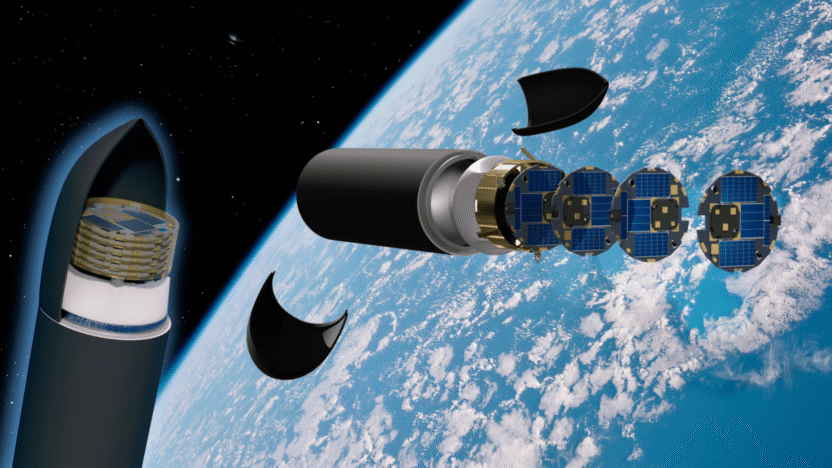
WASHINGTON — A U.S. Space Force and NASA experiment is set to launch later this week to test a new small-satellite architecture designed for operations in very low Earth orbit.
Four flat, disk-shaped satellites known as DiskSats are scheduled to launch no earlier than 12:00 a.m. Eastern on Dec. 18 aboard a Rocket Lab Electron rocket from the Mid-Atlantic Regional Spaceport at Wallops Island, Virginia. The mission, designated STP-S30, was accelerated from an initial target of spring 2026.
The Space Systems Command said Dec. 16 the mission aims to characterize the performance and utility of the DiskSat bus, demonstrate they can generate as much as 100 watts of electrical power primarily through solar cells mounted on the disk-shaped body, and maneuver to multiple orbital regimes, including very low Earth orbit, or VLEO. Secondary payloads aboard the spacecraft will support experiments in communications and space environment sensing.
The launch is being conducted under the military Space Test Program, which provides access to space for experimental systems with potential military utility. The Space Force awarded Rocket Lab a $14.4 million contract for STP-S30 in 2024.
A different approach to small satellites
DiskSat was developed by the Aerospace Corp. with NASA funding as a potential alternative to the cubesat standard. Each spacecraft is roughly three feet in diameter and shaped like a flat plate, optimized to fly in a low-drag orientation through the upper reaches of Earth’s atmosphere.
According to NASA, the disk-shaped design provides more surface area than traditional small satellites, enabling greater power generation and more room for instruments. The configuration is intended to support a wider range of missions than is typically possible with cubesats of similar mass.
The design is tailored to the payload volume of Rocket Lab’s Electron rocket. For launch, multiple DiskSats are stacked inside a dispenser and deployed individually once the rocket reaches orbit.
The Space Force is providing launch and on-orbit operations support under an agreement with NASA.
Targeting very low Earth orbit
One of the goals of STP-S30 is to demonstrate sustained operations in VLEO, generally defined as altitudes below about 300 kilometers. Satellites in this region experience significant atmospheric drag, which rapidly reduces orbital altitude and typically limits mission lifetimes to days or weeks without continuous propulsion.
Despite the challenges, lower altitudes can enable higher-resolution Earth imaging, improved signals for remote sensing and lower-latency communications.
The DiskSat architecture is intended to address the challenges of VLEO by minimizing drag through its flat, edge-on flight orientation and by using high-efficiency electric propulsion to counteract orbital decay.
Rocket Lab said in a Dec. 16 news release that Electron will deploy the four DiskSats into a circular orbit at about 550 kilometers. From there, Aerospace will test the satellites’ maneuverability, the dispenser mechanism and their ability to change orbits using electric propulsion.
If successful, the demonstration could inform future defense and commercial constellations designed to operate in an orbital regime that has so far remained largely inaccessible to sustained satellite operations.