1
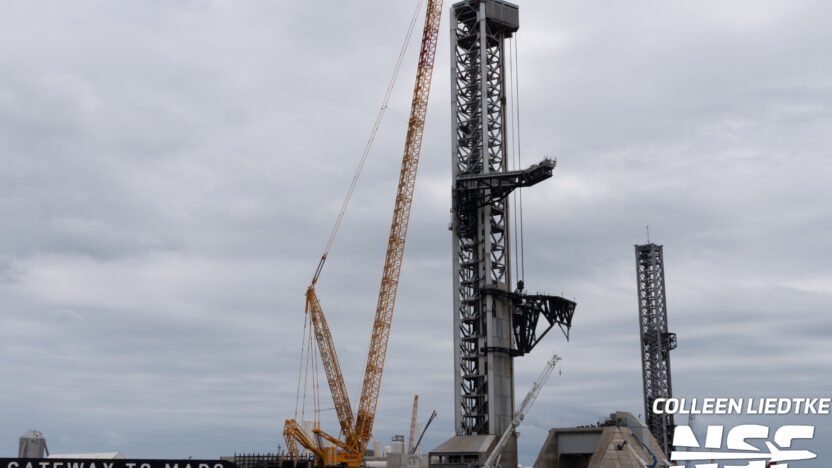
SpaceX’s Pad 2 at Starbase is continuing to refine its preparations for the return of Booster 19, with deluge testing and even load testing the Ship Quick Disconnect (SQD) arm.
This time, Flight 12’s booster will be sporting its full complement of 33 engines, with the subsequent Static Fire test the biggest milestone for the pad ahead of launch in May.
Teams have focused on reinforcing key components of the tower and launch mount, incorporating design lessons from Pad 1 to support faster turnaround times between flights.
On the tower, work has progressed on the Ship Quick Disconnect (SQD) arm, which connects to the Starship upper stage for propellant loading.
This week, technicians added steel reinforcements to the lower side of the arm’s shoulder section. These additions are believed to strengthen the structure while enabling the arm to retract more quickly during launch. A faster swing-out reduces the risk of damage from the intense exhaust plume of Super Heavy’s 33 Raptor engines at liftoff. This improvement should minimize post-launch refurbishment and contribute to a higher launch cadence.
The core work on the SQD arm itself appears largely complete, and scaffolding may soon be removed as final preparations continue.
Interestingly, the water bags made another appearance on Tuesday in relation to the SQD arm. Normally, these bags are used for load testing on the chopsticks.
It is possible they are being used to simulate downward forces on the arm, such as the weight of prop flowing through the pipework, or the forces of thrust from the rocket pushing down on the arm during launch and catch.
Elsewhere on the tower, installation of a new roof structure is visually complete. The roof segment was recently lifted into place and is being welded securely. Its primary function is to shield the upper section of the tower from the exhaust of Starship’s three Raptor 3 engines during catch-and-recovery operations.
Ship’s catch is different from the Booster, with the “flip and burn” technique. In a tower catch, the returning Starship approaches from behind the structure before reorienting and sliding between the “chopsticks” (Mechazilla arms).
Additional protection comes in the form of exterior panels being installed along the top segment. These encase and safeguard critical hardware, including components of the drawworks system that powers the chopsticks. Maintaining the integrity of this mechanism is essential to prevent any failure that could compromise future catch attempts.
Attention has also turned to the Orbital Launch Mount (OLM) on Pad 2. With Booster 19 now back in Mega Bay 1 for engine installation, scaffolding has reappeared around the two Booster Quick Disconnects (BQDs) — one for liquid oxygen and one for liquid methane.
On top of the BQDs, proximity sensors have been installed to assist with the precise alignment of the booster’s aft section as it is lowered onto the mount.
Unlike the earlier alignment pin system used at Pad 1 — which required manual removal, welding the holes to protect against launch damage, and reinstallation for each subsequent booster — the new sensor-based approach on Pad 2 promises a more streamlined process.
The dual BQDs provide multiple reference points for measuring distance and making fine adjustments in position, rotation, and lateral movement. This eliminates the inefficiencies of the single-point system on Pad 1, where sensors inside the mount would only become useful after the booster was already partially lowered. Notably, the sensors were initially placed on top of the BQDs, an area exposed during launches and landings. SpaceX is now relocating them into protective hoods on the BQDs to ensure they survive repeated operations and support rapid reusability.
In related activity on the OLM, alignment hemispheres were temporarily removed for unspecified modifications or inspections, possibly informed by data from hold-down arm retraction tests. They were later reinstalled, followed by further testing of the hold-down arms to verify performance.
The pad’s deluge system has also seen recent activation, including a prominent test coinciding with NASA’s SLS/Artemis 2 activities.
Very impressive top deck deluge test today on Pad 2!
📹 @NASASpaceflight pic.twitter.com/jln5cY0Zaq
— Colleen (@colleenliedtke) April 5, 2026
During one such test, the chopsticks demonstrated noticeable movement. The actuators controlling the arms have been upgraded from a hydraulic to an electric system, displaying impressive speed even in initial post-swap operations.
This change is expected to improve responsiveness and reliability during booster and ship catches.
These incremental but purposeful modifications at Pad 2 reflect SpaceX’s iterative approach to refining Starship infrastructure and provide a template for the new pads at 39A and 37 on the East Coast.
By addressing potential points of wear, improving alignment precision, and enhancing protective features, the company aims to make both the launch mount and tower more robust and efficient — key steps toward achieving the high-frequency, fully reusable operations envisioned for the Starship program.
Further testing, including potential static fires with Booster 19, is anticipated in the coming weeks as Pad 2 nears operational readiness.
It is understood that both the Booster and the Ship for Flight 12 have all their engines installed, pointing to dual Static Fire flows at Pad 2 and Massey’s, respectively, in the coming week or so.
(Lead Image via Colleen Liedtke for NSF).