
TAMPA, Fla. — AI advances and rising geopolitical tensions are helping usher in a new phase of investment in space infrastructure, according to quarterly research released April 14 by early-stage investor Space Capital.
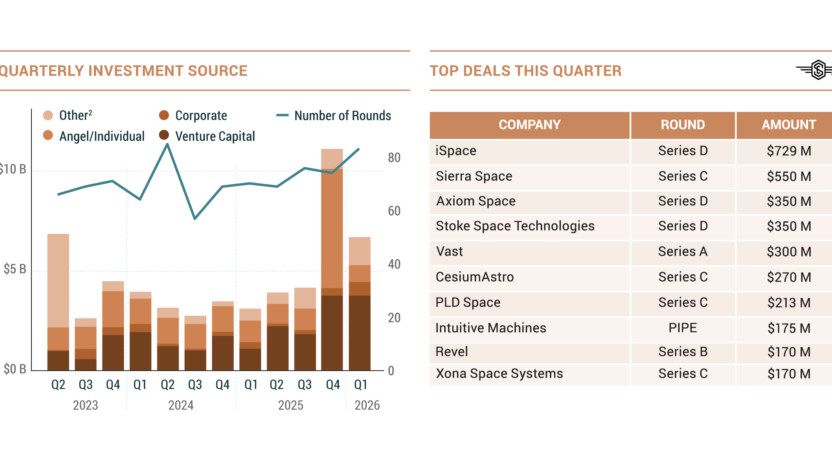
Global investment in space infrastructure more than doubled year-over-year to $6.7 billion in the first quarter of 2026, marking the third-largest quarter on record for the hardware and software used to build, launch and operate assets in orbit.
The report also said those investments are on pace to exceed an annual record set last year, following the emergence of “orbital data centers as a credible, well-capitalized candidate to be the first heavy industry to move off-planet,” as SpaceX, Blue Origin and other deep-pocketed players jostle for position.
Starcloud raised $170 million during the quarter in a Series A round valuing the space-based data center developer at $1.1 billion, less than two years after being founded.
The report also highlighted significant momentum in other emerging segments such as space stations, in-orbit logistics and manufacturing as investment spreads beyond traditional infrastructure.
Around $1.2 billion was raised for these companies during the quarter, approaching the total recorded for 2025 for the Emerging Industries subset of the report’s Infrastructure category, which excludes orbital data centers that are still classed as satellites, despite their novel use cases.

Space Capital said heavy-lift launch vehicles under development, such as SpaceX’s Starship, are set to play a critical role in facilitating the larger payloads that underpin much of this emerging infrastructure.
“Heavy launch will unlock a new paradigm in Infrastructure development and advancements in AI and communications will accelerate the integration of space technologies into the global economy,” the report noted.
Growth stages remain tricky
While North America continued to dominate Infrastructure investment, a $730 million Series D funding for Chinese rocket developer iSpace topped a list of 83 Infrastructure rounds Space Capital tracked for the quarter.
U.S.-based Sierra Space came in second with a $550 million Series C to help the reusable spaceplane developer further focus on national security space efforts.
A total 700 Infrastructure companies have raised a seed round since 2009, yet only 17 have progressed to late-stage Series E funding.

A 2.4% end-to-end graduation rate is the lowest among the report’s other segments: Distribution, covering software to connect, process and manage space-based data; and Applications, encompassing companies like Uber that rely on data from orbit.
Still, the report tracked $4.6 billion in investor exits across 14 Infrastructure deals in the quarter, including one initial public offering, launched by York Space Systems.
Record-breaking year?
According to Space Capital CEO Chad Anderson, SpaceX’s upcoming IPO could drive a fundamental repricing of infrastructure companies in public markets as demand from defense customers continues to rise.
A total of $36 billion was invested across all segments covered in the report, which Anderson said marks the largest quarter on record and puts 2026 on track to surpass the $55.3 billion raised in 2025.

The analysis aligns closely with themes set to dominate this week’s Space Symposium in Colorado Springs, Colorado.
“The four themes dominating the agenda this week — AI and space, national security convergence, lunar economics and the commercial LEO transition — are exactly where the capital is moving,” Anderson said via email.
“And sitting above all of it is the SpaceX IPO, which is forcing every institutional allocator in that room to ask a simple question: how much of this market do I own, and is it enough? The window to get positioned ahead of that moment is closing fast.”
Geopolitics reinforces space’s strategic role
“What’s happening in the world right now is actually the best argument for space investment we’ve ever had,” Anderson said.
He pointed to how tariffs and trade fragmentation are exposing GPS-dependent supply chains as critical infrastructure, while Russia’s war in Ukraine and initiatives such as the Pentagon’s Golden Dome missile defense program underscore the importance of space-based sensing and communications.
“Every nation watching that has accelerated their own sovereign space ambitions, which is exactly what we see in the data: sovereign demand is now the single biggest driver of Infrastructure investment globally,” he said.
“Space was once a strategic advantage, but it is now a geopolitical necessity.”