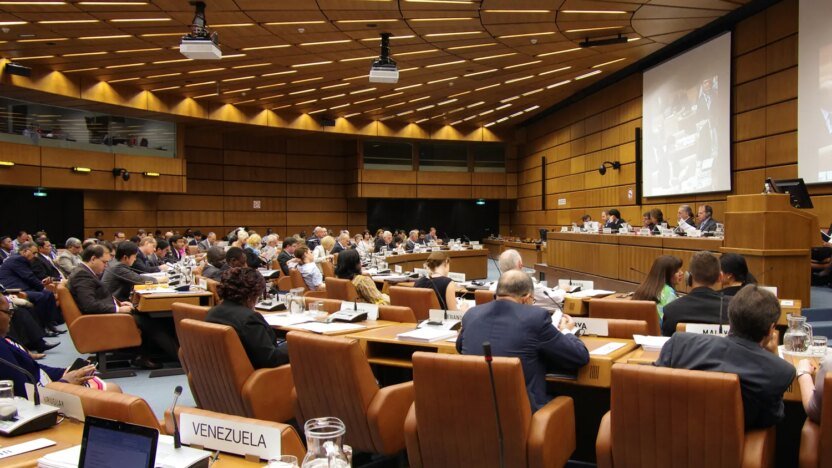
The 63rd Session of the Scientific and Technical Subcommittee (STSC) of the United Nations Committee on the Peaceful Uses of Outer Space (COPUOS), held in Vienna in February, highlighted a reality that is becoming increasingly clear to those working in the international space community: The space environment has changed dramatically, and the institutions created at the dawn of the space age are under growing pressure to keep pace.
COPUOS remains the only global forum where all established and emerging space nations sit together to discuss the technical, legal and policy dimensions of outer space activities. With more than 100 member states participating and space activity expanding rapidly, the Vienna process is becoming increasingly important. As activity in orbit continues to increase and plans for sustained lunar operations move forward, the need for a venue where these issues can be discussed openly and constructively becomes even more critical.
In substantive terms, STSC 2026 illustrated that COPUOS remains highly relevant to the real issues shaping the future of space activity.
One of the most striking aspects of the discussions in Vienna was how operational the agenda has become.
Long-term sustainability continues to serve as the central framework for discussions, but the conversation has moved well beyond general endorsement of sustainability principles. Delegations discussed practical issues such as maneuver coordination, ephemeris sharing, post-mission disposal practices, debris mitigation metrics and spectrum management. These discussions reflect a growing recognition that orbital congestion and interference risks are real operational challenges requiring coordination among all space actors.
Similarly, the topic of dark and quiet skies has evolved significantly. What began several years ago as a concern raised primarily by the astronomy community has developed into a structured policy discussion involving mitigation techniques, radio-frequency protection and coordination between satellite operators and observatories. As satellite constellations expand and astronomical instruments become increasingly sensitive, these questions are likely to remain central to the international policy agenda.
Another clear indication of the next phase of space development is the increasing attention to lunar infrastructure. Nuclear power sources were widely discussed, with multiple delegations highlighting the importance of reliable energy systems for sustained lunar activity. The U.S. delegation referenced NASA’s announced work toward a 100-kilowatt lunar reactor, while other states outlined concepts for power systems capable of supporting long-duration operations on the moon. In parallel, discussions within the Action Team on Lunar Activities Consultation continue to explore mechanisms that could support transparency and coordination as lunar missions increase.
Taken together, these developments reflect a broader shift in how the international community views space activity. Space is no longer episodic, limited to a small number of superpowers, or driven solely by government exploration programs. It is becoming continuous, broadly international, increasingly shaped by commercial activity, and an essential component of modern infrastructure. This transformation is visible across the space sector, from the rapid expansion of satellite constellations in low Earth orbit to renewed plans for sustained lunar activity later this decade, and in the growing participation of emerging space nations, which are increasingly shaping how these challenges are understood and addressed.
This substantive evolution is a genuine success story for COPUOS. At the same time, one outcome of this year’s meeting highlighted the growing institutional pressure COPUOS may now be experiencing.
The subcommittee adopted what is known as a procedural report rather than a traditional narrative report. This approach documents decisions and progress on workstreams, rather than compiling extensive narrative summaries of national interventions.
What made this especially notable was that the procedural difficulty did not appear to stem from deep substantive disagreement on the major policy issues before the Subcommittee. In many areas, discussions reflected broad alignment on the technical and policy challenges facing the space community.
Delegations differed in how they interpreted the significance of this procedural outcome, reflecting the challenges of maintaining consensus in an increasingly complex multilateral environment.
In a multilateral environment that now includes more than 100 member states, and at a time when the United Nations system faces significant liquidity pressures, questions of efficiency and institutional focus are becoming harder to avoid. Discussions during the session reflected an interest in ensuring that COPUOS remains efficient, responsive and capable of addressing emerging space challenges.
A procedural report can still preserve meaningful progress and document important workstreams. But the events of STSC 2026 also highlighted how the consensus process can become strained when longstanding language is contested.
STSC 2026 therefore highlighted an important distinction. COPUOS remains highly relevant in the issues it addresses, but the institution itself may now be under increasing pressure to adapt if it is to remain fully effective in carrying that work forward.
Even as institutional processes evolve, the central role of COPUOS remains unchanged.
There is no other forum where governments, international organizations and observers from across the global space community gather to discuss the shared challenges of space governance. Issues such as space traffic coordination, lunar operations, optical and radio-frequency interference and the management of large satellite constellations cannot be addressed by any single nation alone. They require dialogue at the global level, and COPUOS provides the venue where that dialogue can take place.
The discussions in Vienna demonstrate that the international community recognizes both the opportunities and the challenges created by the rapid expansion of space activity. While governance frameworks will continue to develop, the importance of maintaining an inclusive and functioning global forum is widely recognized.
STSC 2026 may be remembered less for the substance of its agenda than for the institutional strains it exposed. Whether or not it is ultimately seen as a true crisis, it underscored a process under growing pressure as COPUOS works to keep pace.
The space environment is changing rapidly. Commercial actors are driving innovation, lunar infrastructure is being planned, and orbital congestion is increasing. As space activities become more continuous and interconnected, COPUOS will face growing pressure to balance inclusivity with institutional effectiveness. It has faced moments of challenge before. If it is to remain the central global forum for space governance, it may need to evolve again.
There is simply no other forum in the world like COPUOS. As the next phase of space development unfolds, defined by sustained lunar activity, expanding commercial infrastructure and increasing orbital congestion, the importance of a global forum for dialogue will only grow.
Like many institutions created during the early decades of the space age, COPUOS now faces the challenge of operating in a new era of space activity, one defined not only by exploration, but by sustained presence, infrastructure, and a truly global space community. Meeting that challenge will be essential if the international community is to preserve the value of this unique forum.
Fredrick Jenet is a board member of the National Space Society and Vice Chair of its International Committee, where he leads engagement with the United Nations Committee on the Peaceful Uses of Outer Space. He is an astrophysicist and founder of Expanding Frontiers, a nonprofit organization focused on advancing space science, technology and entrepreneurship through international collaboration and workforce development. Jenet holds a PhD in Physics from the California Institute of Technology and a S.B. in Physics from the Massachusetts Institute of Technology.
David Schuman is a member of the National Space Society’s International Committee. He is a retired member of NASA’s Office of General Counsel where he was lead counsel for the James Webb Space Telescope. His current class at the University of Vienna is, “Recent Developments in International Space Law and National Space Law.”
Cecilia I. Silberberg is a professor in the PhD and Master’s programs in International Relations, Law and Political Science at the University of Belgrano (Argentina), where she teaches International Organizations and International Law. She holds a PhD in International Law and International Relations from the Universidad Autónoma de Madrid and a Law degree from the Universidad Nacional de Córdoba. Cecilia Silberberg’s contribution to this article is made in her personal capacity. The views expressed herein do not, under any circumstances, reflect or represent the official position of the institution where she is employed.
SpaceNews is committed to publishing our community’s diverse perspectives. Whether you’re an academic, executive, engineer or even just a concerned citizen of the cosmos, send your arguments and viewpoints to opinion (at) spacenews.com to be considered for publication online or in our next magazine. If you have something to submit, read some of our recent opinion articles and our submission guidelines to get a sense of what we’re looking for. The perspectives shared in these opinion articles are solely those of the authors and do not necessarily represent their employers or professional affiliations.