COLORADO SPRINGS — The U.S. military’s top space commander is pressing for a fundamental shift in how the Pentagon thinks about satellites — from fixed infrastructure to maneuvering assets that can move, adapt and survive in a conflict.
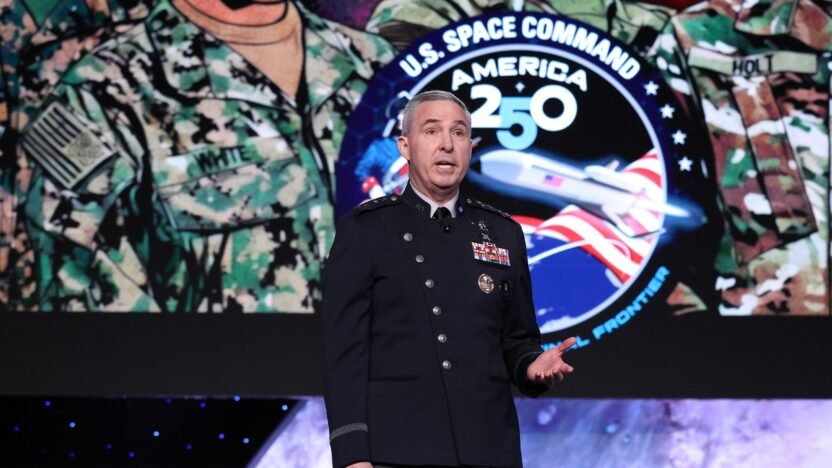
Gen. Stephen Whiting, head of U.S. Space Command, said satellites capable of changing position in orbit are no longer optional but a “necessity,” as rivals demonstrate new ways to operate and sustain spacecraft in space.
“The necessity of maneuver in space has intensified over the past year, as we’ve watched China demonstrate their orbital refueling and logistics prowess,” Whiting said April 14 in a keynote address at the Space Symposium. “Movement and maneuver is a joint function and maneuver is a principle of war.”
The argument reflects a broader reassessment inside the Pentagon as space shifts from a relatively permissive environment into one where U.S. satellites could be tracked, targeted or interfered with during a conflict.
From fixed orbits to moving targets
For decades, most military satellites have been designed to conserve fuel and remain in predictable orbits. Whiting argues that makes those systems easier to locate and potentially to target.
He is advocating a different model. Instead of treating satellites as stationary nodes, he described a future in which they can move when needed to avoid threats, shift coverage or monitor other spacecraft.
“We need a different strategy to deter and win a global, protracted conflict against a great power,” he said. “That strategy is maneuver warfare.”
In practical terms, that means satellites would be designed with more propulsion, allowing them to change orbits more quickly and more often. It also opens the door to new types of spacecraft, including so-called inspector or “bodyguard” satellites that can approach others.
The concept, often described as “dynamic space operations,” centers on movement that is frequent and sometimes unpredictable, complicating an adversary’s ability to plan attacks.
The idea goes beyond hardware. It implies a change in how space operations are conducted.
A maneuver warfare approach would introduce more real-time decision-making, with operators determining when and how to reposition assets, similar to how commanders maneuver aircraft or ships in a conflict.
That shift would require new doctrine and operational concepts, as well as a clearer articulation of what missions maneuvering satellites are meant to perform. Formalizing a strategy, as Whiting is proposing, would also translate into new requirements for the Pentagon’s acquisition system.
A downstream effect is likely to be pressure on the U.S. Space Force to fund more maneuverable spacecraft and supporting systems.
The missing piece: logistics in orbit
A central constraint is one the Pentagon has largely sidestepped: logistics.
Maneuver warfare in any domain depends on fuel, maintenance and resupply. In space, capabilities such as on-orbit refueling, servicing and replacement remain limited and largely experimental.
Whiting has repeatedly pointed to that gap, arguing that maneuvering satellites at scale will require an ecosystem of supporting infrastructure that does not yet exist.
Programs are beginning to emerge. The Space Force’s RG-XX effort, for example, is aimed at procuring refuelable satellites for space domain awareness missions in geostationary orbit. But such initiatives remain early-stage and fragmented.
At the same time, some Pentagon officials question whether the cost of building out space logistics can be justified, particularly if satellites can be replaced rather than serviced. Others expect commercial providers to mature these capabilities before the government commits to large-scale investments.
Whiting’s push comes as U.S. officials increasingly cite China’s advances in space operations, particularly demonstrations of satellite docking and reported refueling.
“Our opponents realize this need to maneuver,” Whiting said.
“A satellite which is locked in a predictable orbit is fighting from a fixed position,” Whiting said. “And it’s a target. It’s a known position on a map waiting to be bypassed or neutralized.”
By contrast, he added, “a force that can maneuver, however, and not be limited by the fuel that it was launched with, and reposition as operationally needed, is the one that holds the initiative.”
Testing the concept in wargames
To move the idea from theory to practice, Space Command is turning to wargaming.
Whiting said the command is standing up an initiative called Apollo Maneuvers, modeled on the Louisiana Maneuvers — the large-scale Army exercises that helped validate new concepts of mechanized warfare before World War II.
The goal is to replicate that approach in space, simulate sustained, contested operations in orbit and test how maneuvering satellites would perform over time.
A team of analysts and wargaming experts is examining “this tough problem of how we must transform to a maneuver warfare strategy for space,” Whiting said.
Such exercises could expose gaps not just in tactics but in infrastructure for refueling and servicing.