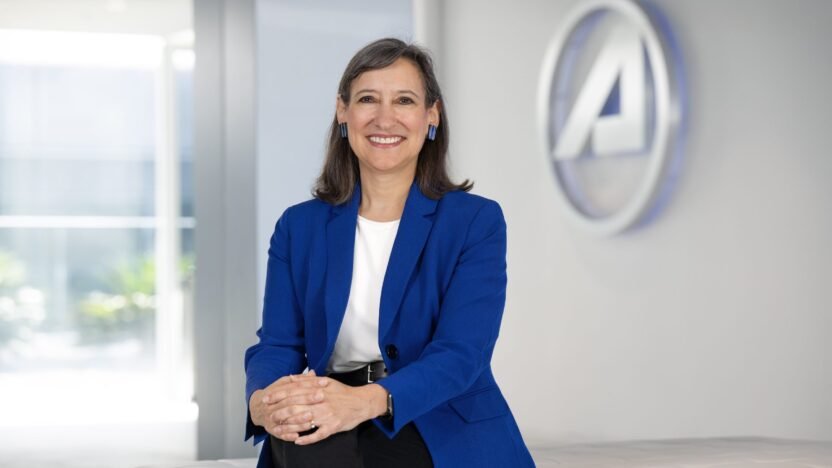
Aerospace Corp. is swimming in data. After testing spacecraft and components for more than 65 years, the Federally Funded Research and Development Center (FFRDC) is training artificial intelligence models to inform spacecraft designs and speed up anomaly diagnosis, Tanya Pemberton, Aerospace CEO and president since September, said in a recent interview.
United States government agencies including the U.S. Space Force, the National Reconnaissance Office and NASA rely on Aerospace to recognize evolving threats, bolster innovative technologies and serve as a bridge to the commercial space sector.
Pemberton, a former Hughes Space and Defense aerospace engineer who spent two decades at the NRO and National Geospatial-Intelligence Agency (NGA), sees an evolving role for Aerospace in helping the government harness private-sector innovation. Through a new initiative, called government-furnished talent, Aerospace is giving companies access to the FFRDC’s technical staff and infrastructure. The following interview has been edited for clarity and brevity.
SpaceNews: The space ecosystem is changing rapidly. What impact is that having on the Aerospace Corporation’s work?
Pemberton: It is a pivotal time in the space ecosystem with three big drivers. The first is the commercialization and commoditization of space, which has taken us to a realm of highly proliferated constellations. The other thing we’re seeing is space is clearly a contested environment, and space is interwoven in the fabric of everything that we do so. Then there are disruptive technologies such as artificial intelligence and automation. Those are having a huge impact on the space side.
One thing that has not changed is the space environment is still brutally hard and unforgiving. Once you launch a satellite, you’re probably going to live with whatever you have launched. Aerospace has 65-plus years of experience with that very difficult environment. Seeing what’s going on across the private sector and the changing relationship between the government and private sector, we are now at the forefront of helping to harness what the private sector is bringing to the table so that the government can use these new capabilities.
The Space Force Space Systems Command, NRO and NASA talk about moving quickly to integrate commercial capabilities. How do you support that work?
We are in discussions with our government sponsor to figure out new and better ways to help harness the private sector. One example of that is a concept that we call government-furnished talent. It’s a little bit like the idea of GFE, government-furnished equipment.
We’re trying to implement a way for the government to make the expertise, the lab capabilities and all of the domain experience available to the private sector and especially to new entrants that might not yet understand some of the things that they need to worry about in space. For example, understanding the radiation environment of space and making sure that you are building into the designs and the components the ability to protect against radiation is a great example of how we can bring our expertise to the table.
A recent report by the Aerospace Industries Association and PricewaterhouseCoopers on supply chain constraints noted a lack of facilities for satellite and component testing. What role does Aerospace play there?
In the 1990s, you used to find lab capabilities across the space industry. Over time, they have atrophied a bit. Entities like Aerospace have an important role in terms of what we bring to the table, not only from a technical expertise perspective but also from the infrastructure. We have over 150 specialized labs. These labs range from very large testing chambers to equipment that can diagnose and get to the root cause of spacecraft issues. Industry can bring in their wares, test them and understand how they may respond in the space environment. A unique Aerospace capability is tribology. We have some of the world’s best tribologists, who understand how to make bearings and lubricants work. When you think about space and what we have to do with control moment gyros, having those bearings work is very important.
Also changing is the threat environment with frequent reports of jamming, spoofing and cyberattacks. Does Aerospace help customers address evolving threats?
We consider ourselves to be cyber experts with respect to space. For us and for our customers, the best defense related to cyber is making sure that you have properly designed your systems to be as resilient as possible. We’ve shown a lot of ingenuity in approaching the problem. We had world-class hackers at a DEF CON [hacking] conference go against a small satellite called Moonlighter, a cyber test target. We used that to inform how we protect assets.
You’re an aerospace engineer who has worked at the NRO and NGA. Has that background shaped your leadership of Aerospace?
Yes. Early on, I had a decade of experience in the private sector. Then, I spent two and a half decades on the government side. Throughout my career, Aerospace was the place you went to solve really hard problems.
Coming from the government side, I am very focused on national security as well as keeping the nation at the forefront of what we’re doing in space. That is important to the Aerospace culture. We combine technical expertise with that sense of mission. Our workforce understands the mission and how best to apply our technologies and capabilities to the tough problems that we see on the government side.
As a vice president, you bolstered Aerospace’s modeling, simulation, AI and data-centric capabilities. Is that work ongoing?
Yes. For the last two decades of my career, I have talked about a data-centric paradigm. Space today is all about the data, moving data around, data that’s coming down.
As I look at some of the disruptive technologies coming online, artificial intelligence is at the forefront. Aerospace has data that cuts across the private sector. We have data coming from the testing that we do every day.
Leveraging AI to get our hands around that data is allowing us to solve problems more quickly and to help industry develop capabilities. A recent example is batteries. We have tested spacecraft batteries for tens of years. Having that knowledge of batteries in different conditions allows you to put together much better designs.
I understand it can be hard to get enough data to train AI models.
We’re uniquely positioned there. We have access to data from the testing that we do. We also have access to testing data across the industry base and operational data. We are a trusted entity. We know how to handle the data appropriately. We are very cognizant of restrictions that go with the data.