
NASA plans to seek proposals for commercial communications services that can be backward compatible with the agency’s aging fleet of relay satellites.
NASA issued April 10 a draft solicitation for Project NEXUS, a part of the broader Commercial Services Project. That is an effort by the agency to move from traditional government owned and operated communications systems to commercial services.
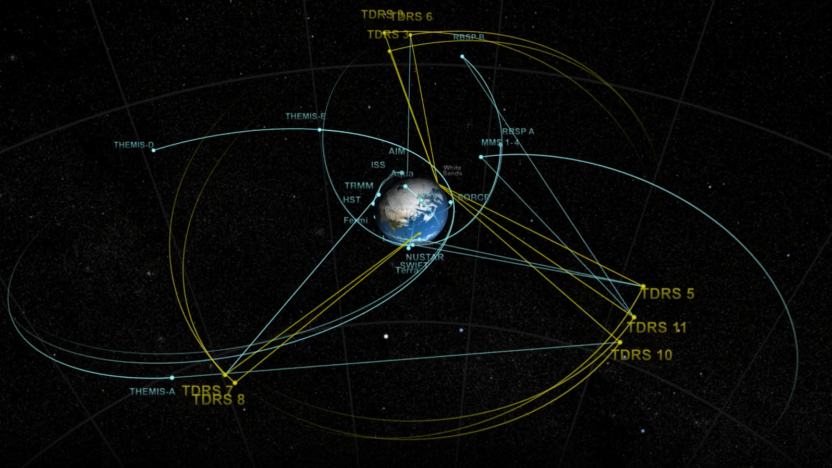
The goal of NEXUS is to develop a commercial Ka-band satellite data relay service to replace the existing Tracking and Data Relay Satellite System, or TDRSS. NASA is in the process of gradually retiring the TDRSS constellation and moving new missions to alternative, commercial communications services.
The agency said it is worried about a “continuity risk” at the end of the decade as more TDRSS satellites reach the end of their lives. That is a concern for older spacecraft that are dependent on TDRSS, like the Hubble Space Telescope and International Space Station.
Those missions, NASA noted in the draft solicitation, cannot shift to alternative systems. “Therefore, these missions risk loss of telemetry, tracking, and command services which directly impacts mission safety and scientific return,” the agency stated.
“One of the most difficult transition challenges is understanding that what we had for so long is reaching the end of life and needs to evolve,” Kevin Coggins, NASA deputy associate administrator for the Space Communications and Navigation, or SCaN, program, said at a March 26 symposium by the Universities Space Research Association and Space Policy Institute.
NEXUS would provide backwards-compatible relay services in Ka-band. Coggins said that NASA will work with the National Telecommunications and Information Administration to ensure companies can use the Ka-band spectrum reserved for TDRSS.
The program will work in three phases. Phase 1, lasting about six months, will allow companies to mature their concepts for an end-to-end TDRSS replacement. Phase 2 will allow some of the companies from Phase 1 to develop their systems and perform ground tests over the next 15 months. Phase 3 will be a three-month on-orbit demonstration of companies’ systems. NASA plans to then hold competitions to provide those relay services for at least 15 years.
NASA has not disclosed a budget for NEXUS but stated it plans to select multiple companies for at least Phase 1. Coggins said that NASA hopes to attract interest from many companies in the satellite communications sector.
While NEXUS is focused on replacing TDRSS services in low Earth orbit, the agency sees it as model for how it might handle future communications services beyond Earth.
“Although NEXUS is focused on near-term relay continuity, it strengthens the industrial base, matures commercially provided relay services and demonstrates acquisition and operational approaches that are directly relevant to the communications architecture needed for future lunar and Mars missions,” NASA stated in the draft solicitation.
The solicitation is part of the NextSTEP program for exploration partnerships. NASA expects to release a final version of the solicitation on or around May 14 with proposals due June 5. Work on Phase 1 would begin by September.