Space domain awareness has a data problem. Not a shortage of data, but a shortage of the right data, delivered at the right time, with enough autonomy to act on it before the moment passes.
The U.S. Space Force and its partners across the intelligence community have spent years building the policy, doctrine, and acquisition frameworks to address this. What has lagged is the commercial infrastructure layer to back it up, an operational constellation of satellites and software that can deliver space-to-space intelligence at mission pace, without the latency of a ground-dependent architecture or the fragility of a single-use payload.
Turion was founded in 2021 to build that layer. This month, the company announced the close of its Series B financing, led by Washington Harbour Partners, with participation from existing investors including Aurelia Foundry, Forward Deployed VC and FoundersX, alongside new partners including Center15, Magnetar, HOF Capital, and Industrious Ventures.
The capital will accelerate spacecraft manufacturing throughput, deepen supply chain capacity, expand Turion’s Starfire software platform, and drive hiring across flight software, autonomy, manufacturing, and mission operations.
The financing signals recognition of execution. Turion is not a pre-revenue startup with a compelling pitch. It is an operational company, with satellites in orbit, government contracts awarded, and a pipeline that reflects genuine demand pull from mission owners who cannot wait for the next program of record.

From concept to operational in 18 months
Turion’s first mission, DROID.001, launched and was delivering imagery within 18 months of the company’s founding. Both DROID.001 and DROID.002 were self-funded, operationally successful, and have collectively delivered more than 40,000 images. The company is now the first NOAA-licensed commercial provider of resolved non-Earth imaging in the United States.
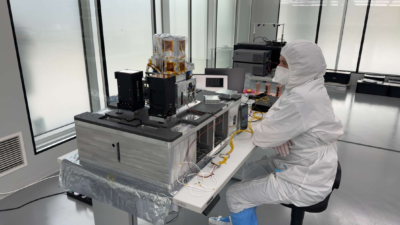
That timeline matters because it reflects something about how Turion is structured: as a hardware company with the discipline of a software company, and as a defense contractor with commercial delivery cadence.
Founded by alumni from SpaceX and Lockheed Martin Skunk Works, with executives from Palantir embedded into the team, Turion was designed from the outset to close the gap between commercial velocity and mission-grade reliability. The result is a platform that government customers can depend on in ways that legacy commercial imagery providers and traditional prime contractors have struggled to offer simultaneously.

A multi-mission architecture built for how threats actually evolve
The DROID spacecraft was designed around a core insight: in a contested orbital environment, what matters is not just what your satellite can see today, but what it can do tomorrow.
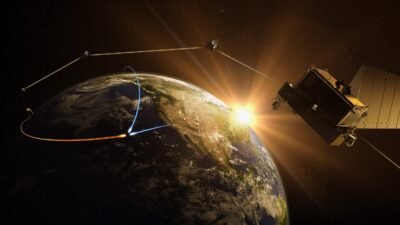
DROID is built for rendezvous and proximity operations, with refuelable architecture, modular payload hosting, and the agility to maneuver as mission needs shift. The platform is designed for the full arc of what space superiority requires: inspection, characterization, surveillance, and ultimately the ability to extend operational life or reposition as the threat picture changes.
Turion has been awarded over 25 U.S. government contracts spanning the Space Force, the Space Development Agency, and the National Reconnaissance Office. Its multi-billion-dollar pipeline spans the mission areas that are driving the most urgent investment in the national security space community today: space domain awareness, missile warning and tracking, orbital resilience, and multi-spectral remote sensing.
The same technical foundation that serves those missions also underpins the orbital environment that civil agencies and commercial operators rely on. Turion is structured to serve both, which is increasingly how the most sophisticated government customers are thinking about commercial partnerships.

Starfire: from constellation command to theater-scale operations
The hardware story is compelling. The software story may be more important.
Starfire, Turion’s software platform, has expanded from constellation command and control into a system capable of autonomous mission planning and execution, multi-sensor tasking, and third-party integrations that allow operators to work across disparate data sources without being locked into a single payload or sensor type.
The vision for Starfire is explicit in how Turion describes it: an infrastructure layer that scales from individual spacecraft to theater-level operations. As the constellation grows, and as government customers look to consolidate fragmented mission operations into coherent, software-driven architectures, the platform becomes more valuable, not just as a Turion product but as an industry utility.
This is the commercial-to-government integration story that the most sophisticated national security customers are actively seeking. They do not want to buy satellites. They want to buy outcomes, delivered by software-defined systems that can adapt to mission requirements without requiring a new program of record every time the threat evolves.

What this moment represents
Washington Harbour Partners’ Mina Faltas framed the investment around a phrase worth sitting with: the default commercial space-infrastructure layer for the U.S. and its allies.
That is an ambitious claim. It is also a precise one. The U.S. space enterprise is converging on a model in which commercial operators provide the persistent, flexible, software-defined layer beneath the most sensitive national security missions. The companies that earn that position will be the ones that have demonstrated operational credibility, not just technical promise.
Turion has two satellites delivering real data. Twenty-five-plus government contracts across the most consequential space agencies in the country. A software platform scaling toward theater-wide operations. And a team that has done this before, at SpaceX, at Skunk Works, and at Palantir.
The Series B closes the gap between where Turion is and where the mission requires it to be. Additional missions are scheduled in both LEO and GEO, expanding coverage and validating a multi-orbit architecture that few commercial operators have attempted at this stage of growth.
Space superiority is not a capability that can be taken for granted. Building the infrastructure to sustain it requires operators who can move at commercial speed without sacrificing mission-grade performance. That is the mandate Turion has built toward since 2021.