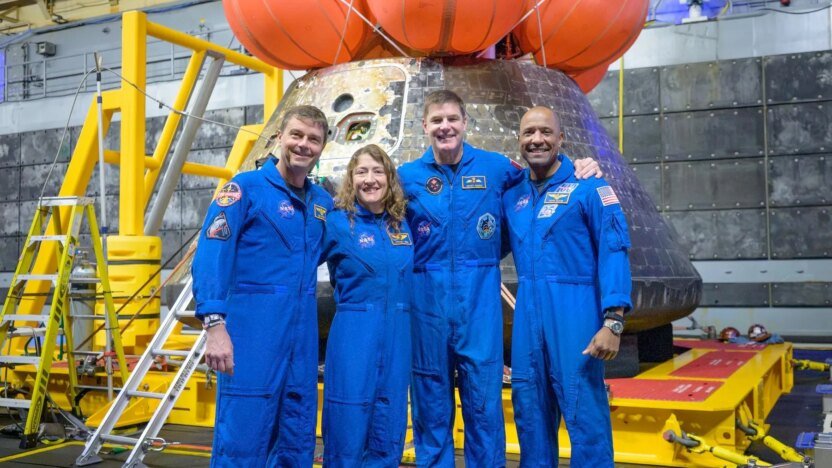
On April 10, the Orion capsule carrying Reid Wiseman, Christina Koch, Victor Glover and Jeremy Hansen splashed down in the Pacific, completing the first crewed lunar mission in more than 50 years. The images they sent back — Earth rising over the lunar far side, the craters and green-brown hues of terrain no human eye had seen up close since Apollo — confirmed what NASA needed to know: The system works, the crew survived and Artemis is real.
The crew itself also made history in ways that will help keep Artemis 2 high in the public imagination. Wiseman commanded the mission, Glover became the first person of color to travel to the lunar vicinity, Koch became the first woman to fly to the moon and Hansen became the first non-U.S. astronaut on a lunar mission. During the flight, Orion reached a record distance of about 252,760 miles from Earth, surpassing Apollo 13 and giving NASA a fresh milestone to carry into the Artemis 3 era.
Now comes Artemis 3.
Where Artemis 2 was a test flight, humans around the moon and back, Artemis 3 is the next step: a 2027 Earth orbit mission to test rendezvous and docking between Orion and one or both commercial landers. The first human landing on the lunar surface since Eugene Cernan stepped off the moon in December 1972 is now targeted for Artemis 4, in early 2028. The target is the lunar south pole, a region of permanent shadow and ancient ice deposits that could one day support sustained human presence. Getting there requires three elements that are either still maturing, still unproven in their final configuration, or carrying known risk into the mission. Each deserves clear-eyed attention.
The landing site
The south pole is a strategic choice. Water ice locked in permanently shadowed craters is the resource that makes long-duration surface operations viable, as propellant, as drinking water, as radiation shielding. NASA has identified 13 candidate landing regions near the pole, each within reach of both sunlight for power and shadow for ice access. The surface terrain is unlike anything Apollo encountered: steep slopes, extreme temperature gradients and lighting conditions that cast long shadows across almost everything.
The Axiom Space AxEMU suits designed for Artemis 3 are built specifically for these conditions, with greater mobility, better thermal management and a camera system that lets crews document science in detail Apollo never could. They are a genuine engineering advance. They have also never been worn on the moon, despite the fact that NASA has already committed an initial Axiom suit task order worth $228 million.
Artemis 3 will evaluate the AxEMU suit in Earth orbit in 2027, a necessary validation step before any astronaut wears it on the lunar surface. That sequencing is deliberate. It is also a reminder of how much remains untested on the path to Artemis 4.
The Starship Human Landing System
SpaceX’s Starship is the vehicle that will actually touch down. This is both the most consequential and the most uncertain element of Artemis 3. Starship HLS is a derivative of the same vehicle that has been evolving through a rapid test campaign, and NASA awarded SpaceX the contract precisely because of that development velocity, under a Human Landing System award valued at $2.89 billion for the first crewed landing mission.
But Starship HLS has never performed a lunar landing. It has never demonstrated the on-orbit propellant transfer that the architecture requires. The integrated system, Orion delivering crew to lunar orbit, Starship HLS rendezvousing, crew transferring, descending, landing, ascending and transferring back, has not been demonstrated end to end. NASA and SpaceX both know this. The question is whether the development timeline is sufficient to close that gap before the mission flies.
That uncertainty is sharpened by the fact that NASA has also selected Blue Origin as a second lunar lander provider under a separate Blue Moon contract worth $3.4 billion for later Artemis missions. That does not change the near-term reliance on Starship for Artemis 3. It does, however, reveal how much money, schedule pressure and strategic hedging are now concentrated in the lander lane.
Both Starship HLS and Blue Moon must complete NASA human-rating certification before any astronaut boards either vehicle. Congress should press the House Armed Services Committee, which manages NDAA provisions governing commercial space acquisition, to mandate milestone transparency requirements for both providers, ensuring the public and the program office have clear visibility into certification progress against the Artemis 4 timeline.
The structural risk beneath the mission
What receives less attention in the post-mission coverage is a vulnerability that does not appear in any flight readiness review but shapes what Artemis 3 can actually accomplish and sustain. The contractor ecosystem that builds the components, materials and subsystems flowing into Artemis, Gateway and follow-on programs is operating under mounting compliance pressure that many suppliers are not prepared for.
The Cybersecurity Maturity Model Certification program, which requires verified cybersecurity posture for contractors handling controlled defense-related information, has enforcement deadlines that are now active. The pool of authorized assessors remains limited relative to the tens of thousands of contractors in scope. And NASA’s own Office of Inspector General has already warned, in its review of Artemis cost and schedule pressure, that total spending was on track to reach about $93 billion by 2025.
The assessor shortage alone could choke this pipeline. Somewhere between 80,000 and 118,000 firms need Level 2 certification, but as of early 2026 there were only about 633 certified assessors worldwide. GAO warned in March that DoD still has not documented how it will handle that gap if private-sector capacity falls short. And the cost is not trivial. A Level 2 assessment takes three assessors and can run a small company more than $100,000 over three years in audit fees before they spend a dollar fixing anything. For a subcontractor making $500,000 a year in DoD revenue, that can wipe out an entire year of profit. Congress has a clear lever here: fund faster Tier 3 background checks through the NDAA and cut the six-to-eight-month wait now, before the November 2026 certification deadline hits.
That same inspector general report also captured a deeper concern: the agency’s ability to sustain the architecture as it scales. NASA’s cybersecurity guidance to contractors has not always been made mandatory across all acquisition pathways. That gap matters more as Artemis accelerates. A contractor that cannot demonstrate required compliance cannot bid on certain work. A supplier base with weak cybersecurity is not just an IT headache. It is a mission risk hiding in plain sight.
This is the same class of vulnerability the OIG identified in the Artemis 2 digital environment: authentication flaws in spacecraft-to-ground communications software, contractor guidance that was suggested rather than required and a cybersecurity posture that launched alongside the crew because the mission timeline did not permit delay. The fix for Artemis 3 needs to happen in the industrial base, not on orbit.
The cost question no one can ignore
This is where the financial conversation around Artemis becomes impossible to separate from the mission architecture itself.
Artemis 2 and Artemis 3 both sit atop the same heavy-lift government-owned core, but Artemis 3 adds the full cost and readiness burden of private lunar landing systems, next-generation suits and a more fragile integration timeline. NASA’s inspector general has already pegged the SLS/Orion launch cost at roughly $4.1 billion per mission, a figure the office explicitly called unsustainable in its current form.
That cost pressure lands hardest on the smallest suppliers. Small manufacturers with fewer than 50 employees face an average of roughly $50,000 per employee per year in federal regulatory compliance costs, more than triple the burden of large manufacturers. For the 88% of aerospace firms that are small businesses, compliance is not a line item. It is an existential question. A proposed 23% cut to NASA’s budget, if enacted, would not just reduce the agency’s science program. It would shrink the very funding streams that help smaller suppliers absorb those compliance costs.
That means Artemis 3 is not simply the next flight. It is a financial and technical inflection point.
The aha moment is this: Artemis 2 proved the United States can send astronauts around the moon again. Artemis 3 has to prove the U.S. can do something much harder: integrate a public-private lunar architecture at scale, sustain the contractor base beneath it and land before the entire model buckles under cost, schedule, or supply-chain weakness.
What the path forward requires
Artemis 3 will demand more from the contractor base than any mission since Apollo, and it will demand it faster. The south pole landing will generate science, data and operational requirements that drive follow-on work across propulsion, life support, surface mobility, communications and in-situ resource utilization. That work flows to suppliers who are right now either preparing for the compliance environment ahead or falling behind it.

Congress should act on three fronts:
- Expand assessor capacity. What good is a compliance mandate if there are not enough assessors to carry it out? Fund faster Tier 3 background checks and give suppliers a clear line of sight into which programs will require which CMMC level well ahead of time.
- Lock in the timeline. How are contractors supposed to invest if they are still guessing about enforcement? With Phase 2 arriving in November 2026 and Phase 3 a year later, the industrial base needs certainty now, not more wait-and-see fog.
- Reduce the small-supplier burden. What happens when an audit alone costs more than $100,000 before a single technical fix is made? For many small suppliers, that is an insurmountable hurdle. Grants, APEX support and targeted tax relief would help keep more of the industrial base in the fight.
NASA and the Department of Defense should align their contractor guidance so that companies serving both ecosystems are not navigating two separate compliance frameworks with overlapping requirements and conflicting deadlines. The Revolutionary FAR Overhaul Initiative, launched in May 2025 by GSA, NASA and DoD, is a promising start. Congress should accelerate it. A supplier certified under one agency’s framework should not face redundant audits and documentation requirements from the other. The current misalignment creates dead zones where a supplier is certified for NASA but blocked from DoD contracts pending a separate CMMC audit, or vice versa. That is wasted capacity the program cannot afford.
And the space industry should treat CMMC readiness as a mission-readiness issue, not an administrative one. The Aerospace Industries Association warned in March 2026 that complex regulatory costs are already forcing some firms to exit the defense marketplace entirely. An October 2025 survey found that while 69% of contractors claimed compliance via self-assessment, only 1% reported being fully ready for the third-party validation required in Phase 2. Those numbers do not describe a supply chain that is ready. They describe one that is hoping the deadline moves again.
The path from Artemis 3 to Artemis 4 is short on paper. In the industrial base, it is not short at all. When the landing mission flies, the supply chain beneath it will either be ready or it will not. Unlike the crew, the supply chain does not have a launch window it can scrub to.
Mercifully, this crew was not thinking about CMMC compliance when they crossed 252,000 miles from Earth. They were thinking about their families, their spacecraft, and each other. That is exactly as it should be. The point of getting the industrial base right is so the crew never has to think about it at all.
Now the story pivots. The Artemis 3 crew is not flying to the lunar surface. Not this time. Instead they will stay in Earth orbit, docking Orion with commercial landers from SpaceX or Blue Origin. A demo, not a landing. That sounds smaller, does not it? But ask yourself this. What made Apollo feel inevitable? A sustained return to deep space is not built on a single giant leap. It is built on the quiet, unglamorous work of making sure the crew that does land comes back safely. That is how a program stops being a promise and starts feeling real. The Artemis 2 crew saw the far side of the moon and came home. That was the easy part.
Michelle Buckner is a former NASA Information System Security Officer and a writer covering AI governance, enterprise security, aerospace and the economics of agentic AI.
SpaceNews is committed to publishing our community’s diverse perspectives. Whether you’re an academic, executive, engineer or even just a concerned citizen of the cosmos, send your arguments and viewpoints to opinion (at) spacenews.com to be considered for publication online or in our next magazine. If you have something to submit, read some of our recent opinion articles and our submission guidelines to get a sense of what we’re looking for. The perspectives shared in these opinion articles are solely those of the authors and do not necessarily represent their employers or professional affiliations.